Camponotus vicinus
Bicolored Carpenter Ant
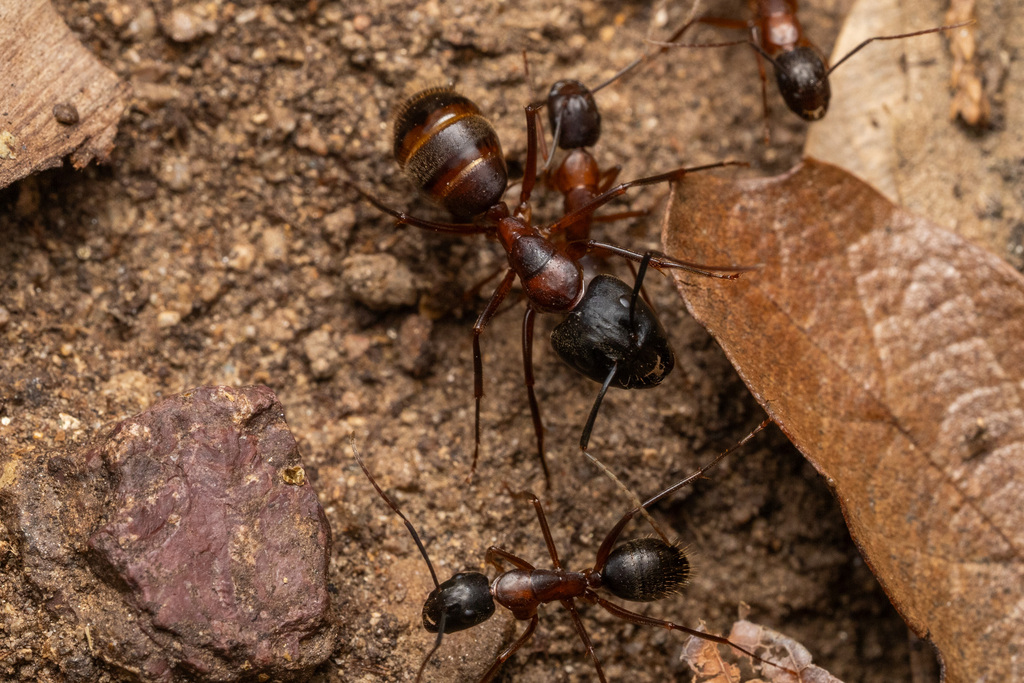
(c) Emmett Collins-Sussman, some rights reserved (CC BY) · licence
Family: Formicidae · Class: Insecta · Order: Hymenoptera
Camponotus vicinus (Bicolored Carpenter Ant) is a California animal in the Formicidae family.
Camponotus vicinus is a carpenter ant species native to western North America, commonly known as the bicolored carpenter ant. Workers range from approximately 7 to 11 millimeters in length, displaying distinct size polymorphism with at least three distinct worker castes within colonies (BugGuide 2025). The species exhibits the typical bicolored pattern that gives it its common name, though specific coloration details vary among individuals and castes. The bicolored carpenter ant occurs throughout much of western North America, with documented populations extending from British Columbia south through California and into other western states. In California, the species has been recorded in coastal regions and inland areas, demonstrating considerable ecological adaptability across different elevation zones and habitat types. This species inhabits diverse environments ranging from coastal sandy back dune systems to forested areas and chaparral. Coastal populations have been documented forming large foraging trails in sandy back dune habitat, particularly active during dusk hours (BugGuide 2025). Like other Camponotus species, C. vicinus typically nests in wood, including dead trees, stumps, and wooden structures, where they excavate galleries for brood rearing and colony activities. The species shows preference for moderately decayed wood that provides suitable excavation conditions while maintaining structural integrity. Behaviorally, bicolored carpenter ants are primarily nocturnal foragers, with peak activity occurring during evening and nighttime hours. Workers form distinct foraging trails leading from nest sites to food sources, which may extend considerable distances from the colony. The species exhibits typical carpenter ant omnivorous feeding habits, collecting honeydew from aphids and scale insects, scavenging dead arthropods, and gathering plant materials. Colony founding follows the standard pattern for Camponotus species, with newly mated queens establishing colonies independently after nuptial flights, typically occurring during warm months. Colonies develop slowly, requiring multiple years to reach maturity and produce reproductive individuals. The pronounced worker polymorphism includes minor workers for general colony maintenance and foraging, media workers for intermediate tasks, and major workers (soldiers) with enlarged heads and mandibles for colony defense and processing larger food items. Reproductive cycles are seasonal, with alate production and mating flights generally occurring during late spring through early fall, depending on local climatic conditions. Currently, Camponotus vicinus does not hold any federal or state conservation listing status and appears to maintain stable populations throughout its range. The species demonstrates adaptability to various habitat types and some degree of tolerance for human-modified environments. However, like many native ant species, populations may face localized pressures from habitat modification, invasive ant species, and pesticide applications. No specific conservation measures are currently directed toward this species, though preservation of native habitat types benefits C. vicinus along with other native arthropod communities.
Classification
Class: Insecta · Order: Hymenoptera · Family: Formicidae
Frequently asked questions
How is Camponotus vicinus classified?
Camponotus vicinus belongs to class Insecta, order Hymenoptera, family Formicidae.
What family does Camponotus vicinus belong to?
Camponotus vicinus is in the Formicidae family.
What is Camponotus vicinus?
Camponotus vicinus is a carpenter ant species native to western North America, commonly known as the bicolored carpenter ant.
Is Camponotus vicinus found in California?
Yes. Camponotus vicinus is recorded in California in The California Species Project's catalogue.
Related species
Other California species in the same genus, family, or bioregion.
Data from The California Species Project — 14,000+ California species with verified data from CNPS, CDFW, USFWS, and more.