Campylorhynchus brunneicapillus
Cactus Wren
no rights reserved · CC0
Family: Troglodytidae · Class: Aves · Order: Passeriformes
Campylorhynchus brunneicapillus (Cactus Wren) is a California animal in the Troglodytidae family.
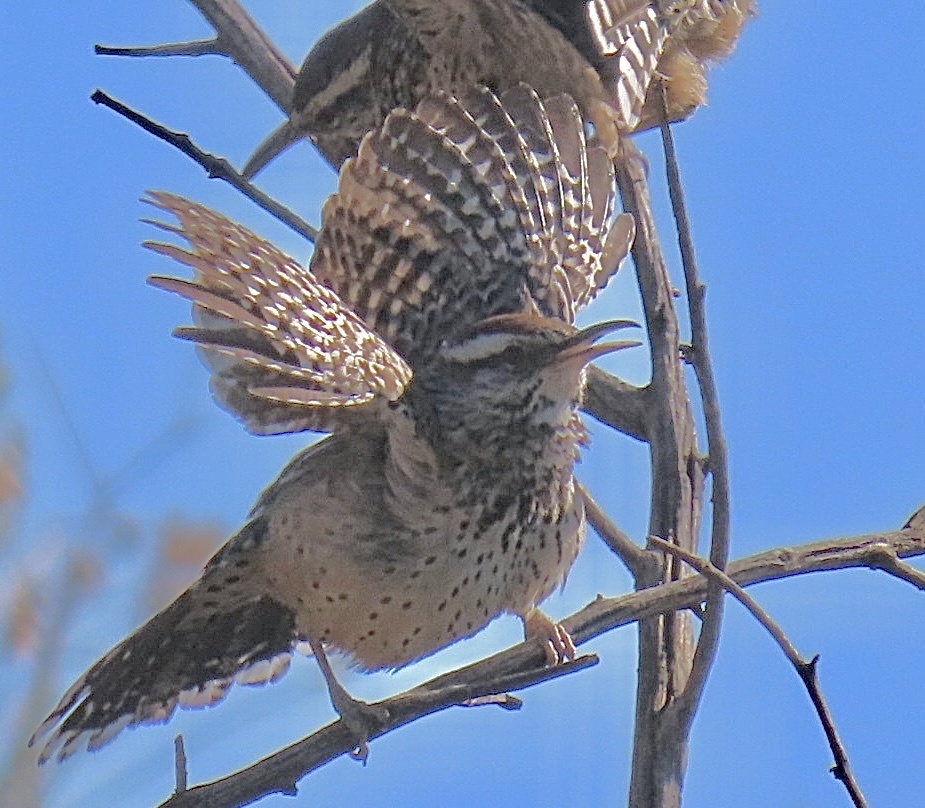
The Cactus Wren is North America's largest wren, measuring 18 to 22 centimeters (7.1 to 8.7 inches) in length with a wingspan of 25 to 28 centimeters (9.8 to 11.0 inches). Adults weigh 32 to 47 grams (1.1 to 1.7 ounces). The species displays distinctive brown and white barred plumage across the back and wings, with a rusty-brown cap extending from the forehead to the nape. The underparts are white to pale buff with heavy black spotting on the breast and flanks. A prominent white eyebrow stripe contrasts with a dark eye line, and the long, slightly decurved bill is adapted for extracting insects from crevices. Cactus Wrens occur in desert regions of California, primarily in the Sonoran and Mojave deserts. The species ranges from sea level to approximately 1,200 meters (3,900 feet) elevation. In California, populations are found in Imperial, Riverside, San Bernardino, Kern, Kings, Fresno, Tulare, and Los Angeles counties. The species also occurs in Arizona, Nevada, Utah, New Mexico, Texas, and northwestern Mexico. The species inhabits arid scrubland and desert environments dominated by cacti, particularly cholla and prickly pear species. Cactus Wrens require areas with 10 to 15 percent shrub cover, including mesquite, palo verde, ironwood, and various acacia species. Nesting sites are typically located in cholla cacti 1 to 3 meters (3.3 to 9.8 feet) above ground, though nests may also be placed in other thorny shrubs or small trees. Cactus Wrens are omnivorous, feeding on insects, spiders, small lizards, frogs, and occasionally fruits and seeds. Their diet consists primarily of beetles, ants, wasps, grasshoppers, and caterpillars during the breeding season. The species forages primarily on the ground, using its bill to probe bark crevices and turn over debris. Cactus Wrens are monogamous and maintain year-round territories. Breeding occurs from February through September, with peak activity from March through June. Females construct dome-shaped nests with side entrances, using grasses, plant fibers, and feathers. Clutch size ranges from 2 to 5 eggs, typically 3 to 4, with an incubation period of 16 to 18 days. Pairs may produce 2 to 3 broods annually. Cactus Wrens are not federally or state listed as threatened or endangered. However, populations face pressure from habitat loss due to urban development, agricultural conversion, and invasive plant species. Fire suppression has altered natural fire cycles, allowing non-native grasses to establish and increase wildfire intensity, which can eliminate nesting habitat. Climate change may affect prey availability and suitable habitat distribution. Despite these challenges, the species maintains stable populations across much of its range, with some local declines documented in urbanized areas of southern California.
Classification
Class: Aves · Order: Passeriformes · Family: Troglodytidae
Frequently asked questions
How is Campylorhynchus brunneicapillus classified?
Campylorhynchus brunneicapillus belongs to class Aves, order Passeriformes, family Troglodytidae.
What family does Campylorhynchus brunneicapillus belong to?
Campylorhynchus brunneicapillus is in the Troglodytidae family.
What is Campylorhynchus brunneicapillus?
The Cactus Wren is North America's largest wren, measuring 18 to 22 centimeters (7.1 to 8.7 inches) in length with a wingspan of 25 to 28 centimeters (9.8 to 11.0 inches).
Is Campylorhynchus brunneicapillus found in California?
Yes. Campylorhynchus brunneicapillus is recorded in California in The California Species Project's catalogue.
Related species
Other California species in the same genus, family, or bioregion.
Data from The California Species Project — 14,000+ California species with verified data from CNPS, CDFW, USFWS, and more.