Campylorhynchus brunneicapillus sandiegensis
Coastal Cactus Wren
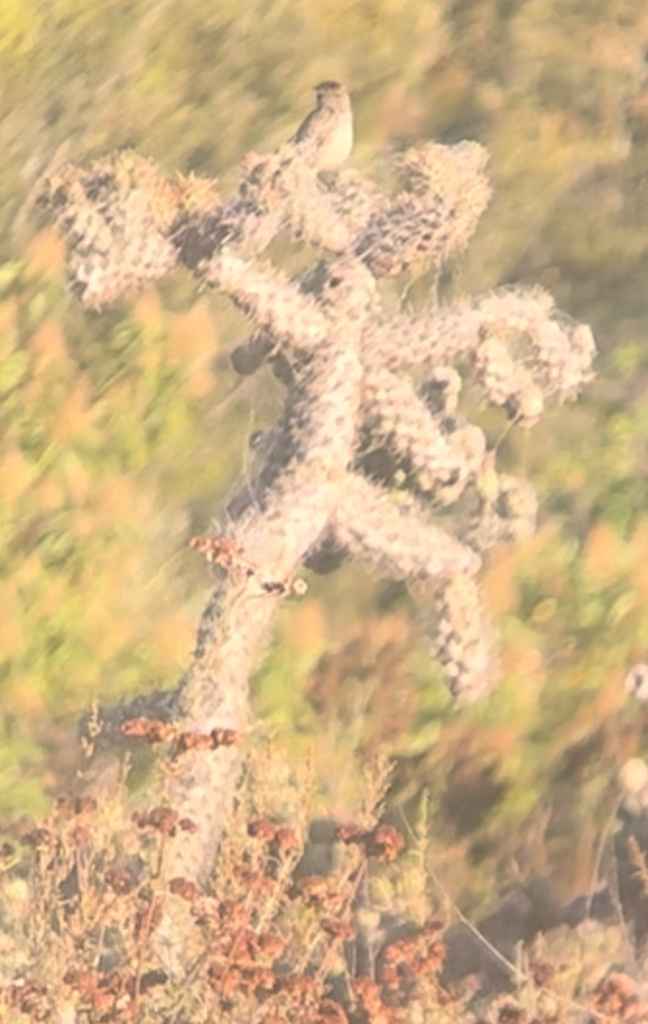
(c) Ian, some rights reserved (CC BY) · licence
Family: Troglodytidae · Class: Aves · Order: Passeriformes
Conservation status: G5T3Q S2
Campylorhynchus brunneicapillus sandiegensis (Coastal Cactus Wren) is a California animal in the Troglodytidae family.
The Coastal Cactus Wren (Campylorhynchus brunneicapillus sandiegensis) is a subspecies of the widespread Cactus Wren, distinguished by subtle morphological differences from its desert relatives. Adults measure approximately 18-23 cm (7-9 inches) in length with a wingspan of 25-30 cm (10-12 inches). The species displays brown upperparts with white streaking, a distinctive white eyebrow stripe, and heavily barred wings and tail. The underparts are white to pale buff with bold black spotting on the breast that becomes streaking toward the flanks. The bill is long, slightly curved, and dark, adapted for probing into crevices and extracting prey. Historically, the Coastal Cactus Wren ranged throughout coastal sage scrub and chaparral communities from Ventura County south through Orange, Riverside, and San Diego counties in California, extending into northwestern Baja California, Mexico. The subspecies has experienced severe range contraction and population fragmentation, with current populations restricted primarily to fragmented habitat patches in southern California. The largest remaining populations occur in San Diego County, with smaller isolated populations persisting in Orange and Riverside counties. This subspecies inhabits coastal sage scrub, chaparral, and desert scrub communities, typically at elevations below 750 meters (2,460 feet). Unlike desert populations that rely heavily on large cacti, Coastal Cactus Wrens utilize dense shrublands dominated by California sagebrush, cactus patches, and other native scrub vegetation. They require areas with sufficient shrub density for nesting cover and foraging opportunities, preferring habitat mosaics that include both dense shrub patches and more open areas. Coastal Cactus Wrens are non-migratory residents that maintain territories year-round. They are primarily insectivorous, foraging on the ground and in low vegetation for beetles, ants, grasshoppers, and other arthropods, supplemented by occasional small fruits and seeds. The species can meet its water requirements entirely through food intake, an adaptation to arid environments. Breeding occurs from March through August, with pairs constructing multiple domed nests of twigs and grass lined with feathers and other soft materials. Females typically lay 3-5 eggs, with clutches incubated for 16-18 days. The Coastal Cactus Wren faces critical conservation challenges, with populations declining to crisis levels in fragmented coastal habitats (Birds of the World). According to USFWS documentation, the San Diego population was considered for federal listing as endangered in 1990. Primary threats include habitat loss and fragmentation from urbanization, increased fire frequency and intensity, and edge effects in remaining habitat patches. Large wildfires have eliminated substantial portions of suitable habitat, while urban development continues to fragment remaining populations. The subspecies' global rank of G5T3Q indicates the taxonomic uncertainty and conservation concern for this coastal population, with the California rank of S2 reflecting its imperiled status within the state. Conservation efforts focus on habitat protection, restoration, and fire management in remaining population centers.
Classification
Class: Aves · Order: Passeriformes · Family: Troglodytidae
Conservation status
G5T3Q S2
Frequently asked questions
How is Campylorhynchus brunneicapillus sandiegensis classified?
Campylorhynchus brunneicapillus sandiegensis belongs to class Aves, order Passeriformes, family Troglodytidae.
What family does Campylorhynchus brunneicapillus sandiegensis belong to?
Campylorhynchus brunneicapillus sandiegensis is in the Troglodytidae family.
Is Campylorhynchus brunneicapillus sandiegensis protected or of conservation concern?
Campylorhynchus brunneicapillus sandiegensis carries the following status: G5T3Q S2.
What is Campylorhynchus brunneicapillus sandiegensis?
The Coastal Cactus Wren (Campylorhynchus brunneicapillus sandiegensis) is a subspecies of the widespread Cactus Wren, distinguished by subtle morphological differences from its desert relatives.
Is Campylorhynchus brunneicapillus sandiegensis found in California?
Yes. Campylorhynchus brunneicapillus sandiegensis is recorded in California in The California Species Project's catalogue.
Related species
Other California species in the same genus, family, or bioregion.
Data from The California Species Project — 14,000+ California species with verified data from CNPS, CDFW, USFWS, and more.