Caprella mutica
Japanese Skeleton Shrimp
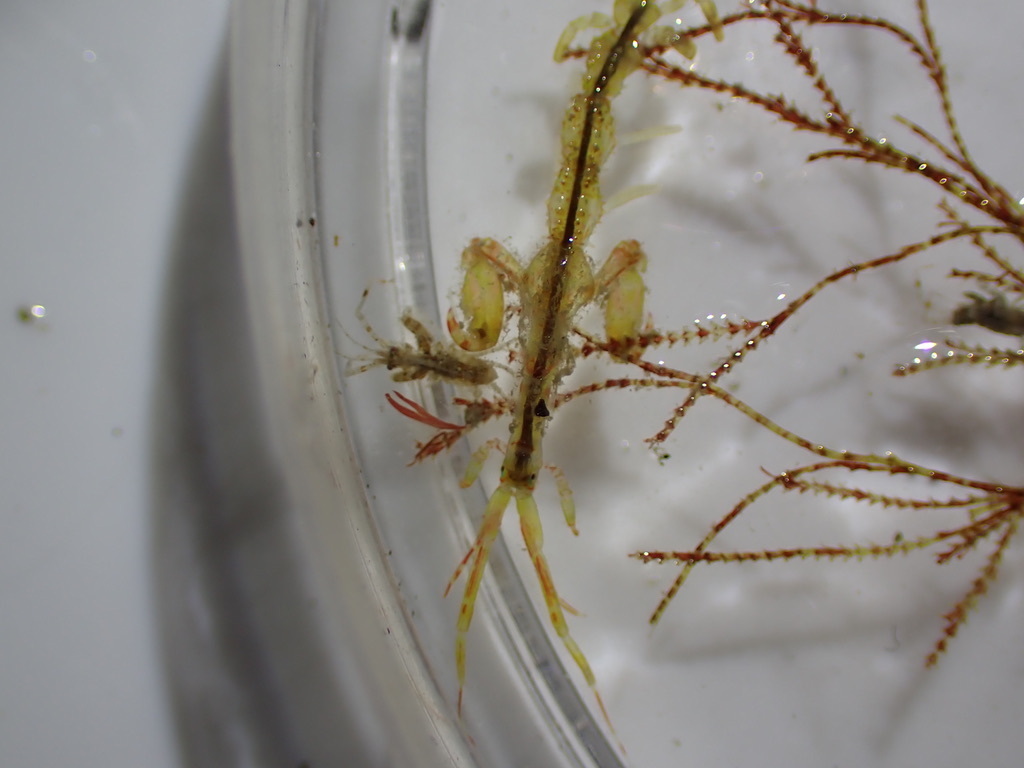
(c) J Yager, some rights reserved (CC BY) · licence
Family: Caprellidae · Class: Malacostraca · Order: Amphipoda
Caprella mutica (Japanese Skeleton Shrimp) is a California animal in the Caprellidae family.
The Japanese skeleton shrimp (Caprella mutica) is a marine amphipod crustacean in the family Caprellidae, characterized by its elongated, stick-like body that resembles a praying mantis. Adults typically measure 20-50 mm in length, with males generally larger than females. The body is highly compressed laterally and segmented, with reduced abdominal segments that give the species its distinctive skeletal appearance. The head bears large compound eyes and long antennae, while the thoracic segments possess grasping appendages (gnathopods) used for feeding and clinging to substrates. Coloration varies from translucent white to reddish-brown, often matching the host organism or substrate. Native to the northwestern Pacific Ocean, including waters around Japan, Korea, and eastern Russia, Caprella mutica has become a widespread invasive species. In North America, it was first detected in California waters in the 1970s and has since established populations along the Pacific Coast from Alaska to southern California. According to the USGS Nonindigenous Aquatic Species database, established populations occur in Humboldt Bay, including locations at the Coast Guard Ready Dock and Woodley Island Marina in Eureka Slough. The species has also been documented in San Francisco Bay and other California coastal waters. Japanese skeleton shrimp inhabit marine and estuarine environments, typically in depths ranging from the intertidal zone to approximately 50 meters. They are commonly found attached to various substrates including algae, hydroids, bryozoans, mussels, and artificial structures such as docks, pilings, and aquaculture equipment. The species shows particular affinity for fouling communities on floating structures and has been observed colonizing biogenic reefs in marine protected areas. They prefer areas with moderate to strong water flow that facilitates filter feeding. Caprella mutica are omnivorous filter feeders and grazers, capturing plankton and detritus from the water column using their specialized gnathopods. They also scrape diatoms and other microorganisms from surfaces. Reproduction is sexual, with females carrying eggs in a brood pouch (marsupium) for approximately two weeks before releasing juveniles. The species exhibits direct development, with no larval stage. Generation time is typically 2-4 months, allowing for multiple broods per year in favorable conditions. Dense aggregations can form on suitable substrates, with populations reaching thousands of individuals per square meter. As a non-native species, Caprella mutica is not protected under federal or state conservation legislation. Instead, it is considered an invasive species of management concern. NOAA Fisheries preliminary assessments have confirmed its continued presence at multiple California locations, though populations appear to remain localized to specific dock areas in some regions. The species' ability to rapidly colonize artificial substrates and form dense populations raises concerns about potential impacts on native fouling communities and aquaculture operations. Management efforts focus on preventing further spread through ballast water treatment and hull cleaning protocols.
Classification
Class: Malacostraca · Order: Amphipoda · Family: Caprellidae
Frequently asked questions
How is Caprella mutica classified?
Caprella mutica belongs to class Malacostraca, order Amphipoda, family Caprellidae.
What family does Caprella mutica belong to?
Caprella mutica is in the Caprellidae family.
What is Caprella mutica?
The Japanese skeleton shrimp (Caprella mutica) is a marine amphipod crustacean in the family Caprellidae, characterized by its elongated, stick-like body that resembles a praying mantis.
Is Caprella mutica found in California?
Yes. Caprella mutica is recorded in California in The California Species Project's catalogue.
More California species
This species has no close relatives in our California data — here are other species to explore.
Data from The California Species Project — 14,000+ California species with verified data from CNPS, CDFW, USFWS, and more.