Caradrina montana
Civil Rustic
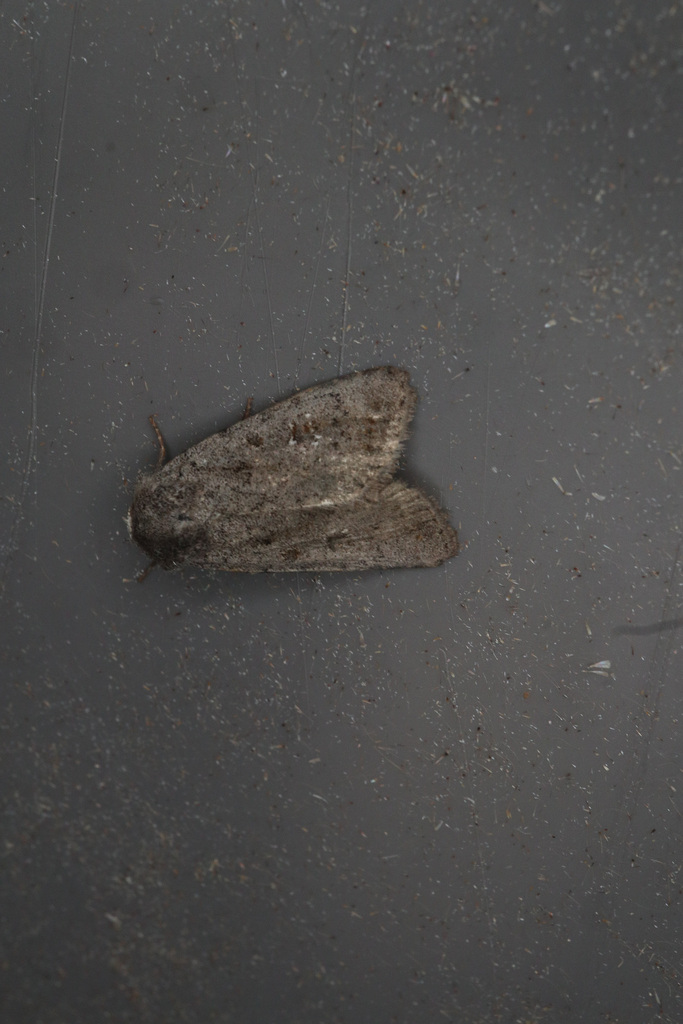
no rights reserved · CC0
Family: Noctuidae · Class: Insecta · Order: Lepidoptera
Caradrina montana (Civil Rustic) is a California animal in the Noctuidae family.
The Civil Rustic (Caradrina montana) is a medium-sized moth in the family Noctuidae, characterized by forewings measuring approximately 14-16 mm in length with a wingspan of 28-32 mm. The forewings display a mottled gray-brown coloration with darker cross-lines and a distinctive pale subterminal line. The reniform and orbicular spots are typically outlined in pale scales, though they may be indistinct in worn specimens. Hindwings are pale gray with darker marginal shading. Males possess feathery antennae, while females have simple, thread-like antennae. The Civil Rustic has a limited distribution in western North America, with populations documented in California, Oregon, and possibly Washington. In California, the species occurs primarily in mountainous regions of the Sierra Nevada and possibly the Cascade Range, typically at elevations between 1,200 and 2,400 meters (3,900 to 7,900 feet). Historical records indicate a patchy distribution, with specimens collected from scattered localities rather than continuous populations. This species inhabits montane forest ecosystems, particularly areas with mixed coniferous forests dominated by Douglas fir, white fir, and ponderosa pine. Adults are typically found in forest clearings, meadow edges, and areas with moderate canopy cover that allow sufficient understory vegetation development. The species appears to prefer sites with well-drained soils and moderate moisture levels, avoiding both extremely dry and waterlogged conditions. Adult Civil Rustics are nocturnal and exhibit typical noctuid behavior, being attracted to artificial light sources during their flight period, which extends from late June through August. Larvae are believed to feed on low-growing herbaceous plants and possibly grasses, though specific host plant relationships remain poorly documented. The species likely overwinters as eggs or early-instar larvae, with development occurring during the following spring and early summer. Adults emerge for a single generation per year, with peak activity occurring in July. The Civil Rustic lacks formal conservation status listings at federal or state levels, reflecting both limited survey data and the species' naturally restricted distribution. Population trends remain largely unknown due to insufficient monitoring efforts and the species' cryptic nature. Primary conservation concerns include habitat loss from logging activities, fire suppression altering natural forest succession patterns, and climate change potentially shifting suitable elevation zones upward. The species' apparent rarity and limited distribution suggest it may be vulnerable to environmental changes, though comprehensive population assessments are needed to determine actual conservation needs. Forest management practices that maintain diverse age structures and preserve understory vegetation may benefit this species, along with other montane forest noctuids sharing similar habitat requirements.
Classification
Class: Insecta · Order: Lepidoptera · Family: Noctuidae
Frequently asked questions
How is Caradrina montana classified?
Caradrina montana belongs to class Insecta, order Lepidoptera, family Noctuidae.
What family does Caradrina montana belong to?
Caradrina montana is in the Noctuidae family.
What is Caradrina montana?
The Civil Rustic (Caradrina montana) is a medium-sized moth in the family Noctuidae, characterized by forewings measuring approximately 14-16 mm in length with a wingspan of 28-32 mm.
Is Caradrina montana found in California?
Yes. Caradrina montana is recorded in California in The California Species Project's catalogue.
Related species
Other California species in the same genus, family, or bioregion.
Data from The California Species Project — 14,000+ California species with verified data from CNPS, CDFW, USFWS, and more.