Carausius morosus
Indian Walking Stick
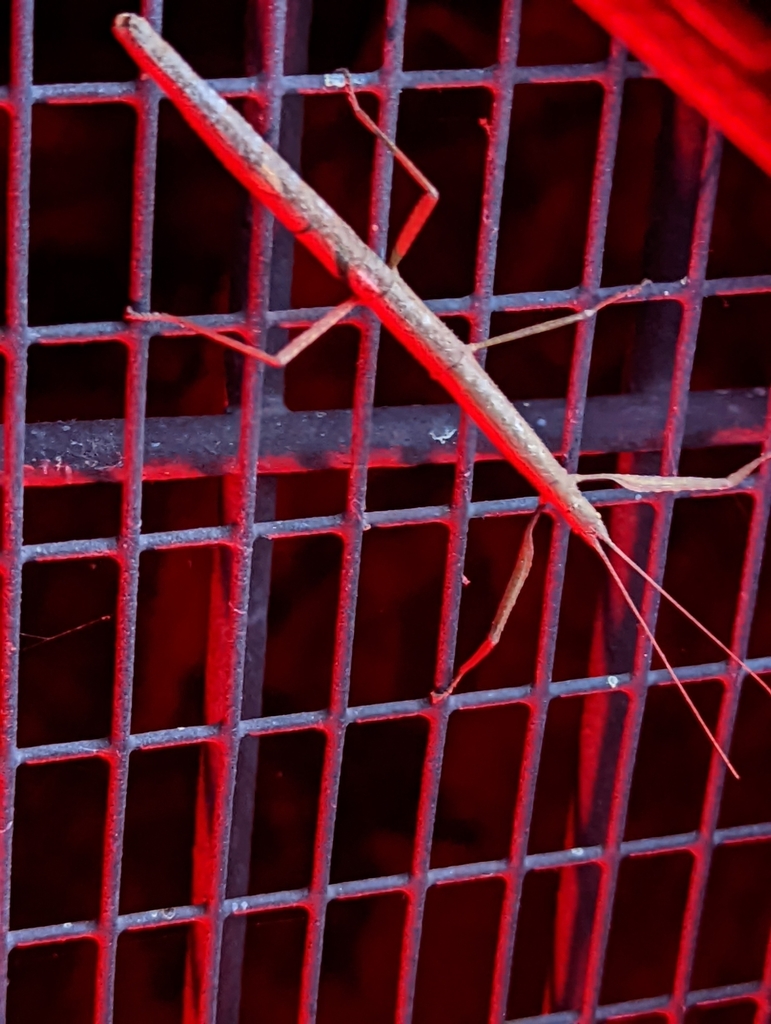
(c) Tom and T Herman, some rights reserved (CC BY) · licence
Family: Lonchodidae · Class: Insecta · Order: Phasmatodea
Carausius morosus (Indian Walking Stick) is a California animal in the Lonchodidae family.
The Indian walking stick (Carausius morosus) is a slender, elongate insect belonging to the order Phasmatodea. This species exhibits the characteristic stick-like body form typical of phasmids, with an extremely thin, cylindrical body and long, slender legs that closely mimic twigs or small branches. Adults typically measure 70-100 mm (2.8-3.9 inches) in total length, with females generally larger than males (BugGuide.Net). The body coloration ranges from pale green to brown, providing effective camouflage against plant material. Both winged and wingless forms occur, with wings, when present, being relatively short and non-functional for flight. Carausius morosus is native to India and Southeast Asia but has become established as an introduced species in various parts of the world, including portions of North America (Brock & Hasenpusch 2009). In California, the species has been reported from urban and suburban areas, particularly in regions with suitable host vegetation. The exact extent of its California distribution requires further documentation, as many phasmid species remain poorly surveyed. This species inhabits areas with abundant vegetation, showing a preference for shrubs and small trees that serve as both food sources and camouflage sites. Indian walking sticks are commonly found in gardens, parks, and other cultivated landscapes where suitable host plants are available. They typically remain on host vegetation during daylight hours, becoming more active during evening and nighttime periods (Brock & Hasenpusch 2009). Indian walking sticks are herbivorous, feeding primarily on leaves of various broadleaf plants including privet, rose, and bramble species (BugGuide.Net). The species exhibits parthenogenetic reproduction, with females capable of producing viable eggs without mating (Brock & Hasenpusch 2009). This reproductive strategy allows rapid population establishment from a single individual. Eggs are typically dropped randomly by females and may overwinter before hatching. Development proceeds through several molts over a period of months, with nymphs resembling miniature adults. The species exhibits typical phasmid defensive behaviors, including catalepsis (remaining motionless when disturbed) and autotomy (the ability to shed limbs when grasped by predators) (Brock & Hasenpusch 2009). When threatened, individuals may sway gently to mimic vegetation movement in a breeze or drop to the ground and remain motionless. As an introduced species in California, Carausius morosus does not have formal conservation status under state or federal listing programs. The species is not considered threatened or endangered in its native range. However, like many introduced insects, its establishment in non-native environments raises questions about potential ecological impacts on native plant communities and arthropod assemblages. The extent of its California populations and any associated ecological effects have not been comprehensively studied. Further research is needed to understand the species' distribution patterns, host plant relationships, and ecological role within California ecosystems where it has become established.
Classification
Class: Insecta · Order: Phasmatodea · Family: Lonchodidae
Frequently asked questions
How is Carausius morosus classified?
Carausius morosus belongs to class Insecta, order Phasmatodea, family Lonchodidae.
What family does Carausius morosus belong to?
Carausius morosus is in the Lonchodidae family.
What is Carausius morosus?
The Indian walking stick (Carausius morosus) is a slender, elongate insect belonging to the order Phasmatodea.
Is Carausius morosus found in California?
Yes. Carausius morosus is recorded in California in The California Species Project's catalogue.
More California species
This species has no close relatives in our California data — here are other species to explore.
Data from The California Species Project — 14,000+ California species with verified data from CNPS, CDFW, USFWS, and more.