Cardellina canadensis
Canada Warbler
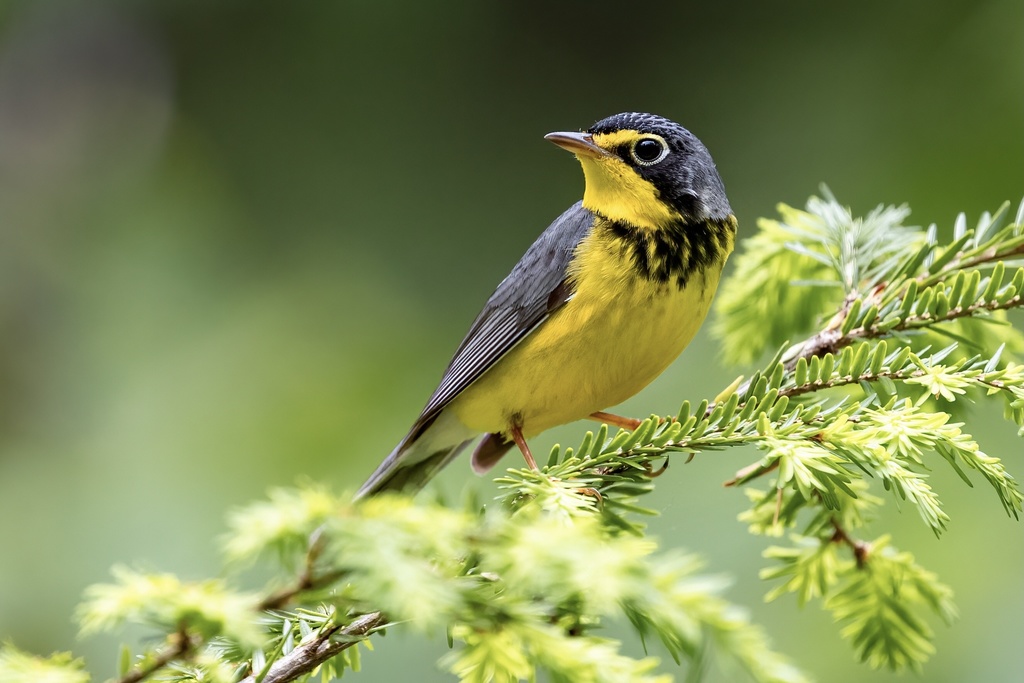
(c) Matt Felperin, some rights reserved (CC BY) · licence
Family: Parulidae · Class: Aves · Order: Passeriformes
Cardellina canadensis (Canada Warbler) is a California animal in the Parulidae family.
The Canada Warbler is a small migratory songbird measuring 12 to 15 centimeters (4.7 to 5.9 inches) in length with a wingspan of 17 to 22 centimeters (6.7 to 8.7 inches). Adults weigh 9 to 13 grams (0.32 to 0.46 ounces). Males display distinctive plumage with blue-gray upperparts, bright yellow underparts, and a prominent black necklace of streaks across the upper breast. The species exhibits a bold white eye-ring and lacks wing bars. Females and immature birds show similar but duller coloration with a less pronounced breast pattern and brownish-gray upperparts instead of blue-gray. The Canada Warbler breeds across the boreal forests of Canada and the northern United States, extending south through the Appalachian Mountains. In California, this species occurs primarily as a rare migrant during spring and fall passage, typically observed from late April through May and again from August through September. The species has been documented in various California locations including coastal areas, mountain ranges, and desert oases, though sightings remain uncommon and irregular. During migration, Canada Warblers utilize diverse habitats including riparian woodlands, mixed coniferous-deciduous forests, parks, and gardens with dense understory vegetation. The species shows preference for areas with thick shrub layers and forest edges. On breeding grounds, they inhabit mature mixed and coniferous forests with dense understory, particularly areas near water sources such as streams, swamps, and forest clearings with abundant shrub cover at elevations typically between 300 to 1,500 meters. Canada Warblers are active insectivores, gleaning insects and spiders from foliage in the forest understory and midstory. They frequently catch prey through hawking behavior, making short flights to capture insects in mid-air before returning to perches. The diet consists primarily of flies, moths, caterpillars, beetles, and other small arthropods. During breeding season, males establish territories through persistent singing from concealed perches. Nesting occurs on or near the ground in dense vegetation, with females constructing cup-shaped nests of grasses, moss, and bark strips. Clutches typically contain 3 to 5 eggs, with incubation lasting 12 to 13 days. The Canada Warbler is not federally listed but has experienced significant population declines across its range. According to the North American Breeding Bird Survey, populations have declined by approximately 60 percent since 1970. The species faces threats from habitat loss on both breeding and wintering grounds, including deforestation, agricultural conversion, and urban development. Climate change poses additional challenges through altered precipitation patterns and temperature regimes affecting insect prey availability. In California, the species' status as a rare migrant reflects broader continental population trends, with conservation efforts focused on protecting stopover habitat during migration periods.
Classification
Class: Aves · Order: Passeriformes · Family: Parulidae
Frequently asked questions
How is Cardellina canadensis classified?
Cardellina canadensis belongs to class Aves, order Passeriformes, family Parulidae.
What family does Cardellina canadensis belong to?
Cardellina canadensis is in the Parulidae family.
What is Cardellina canadensis?
The Canada Warbler is a small migratory songbird measuring 12 to 15 centimeters (4.7 to 5.9 inches) in length with a wingspan of 17 to 22 centimeters (6.7 to 8.7 inches).
Is Cardellina canadensis found in California?
Yes. Cardellina canadensis is recorded in California in The California Species Project's catalogue.
Related species
Other California species in the same genus, family, or bioregion.
Data from The California Species Project — 14,000+ California species with verified data from CNPS, CDFW, USFWS, and more.