Cardellina pusilla
Wilson's Warbler
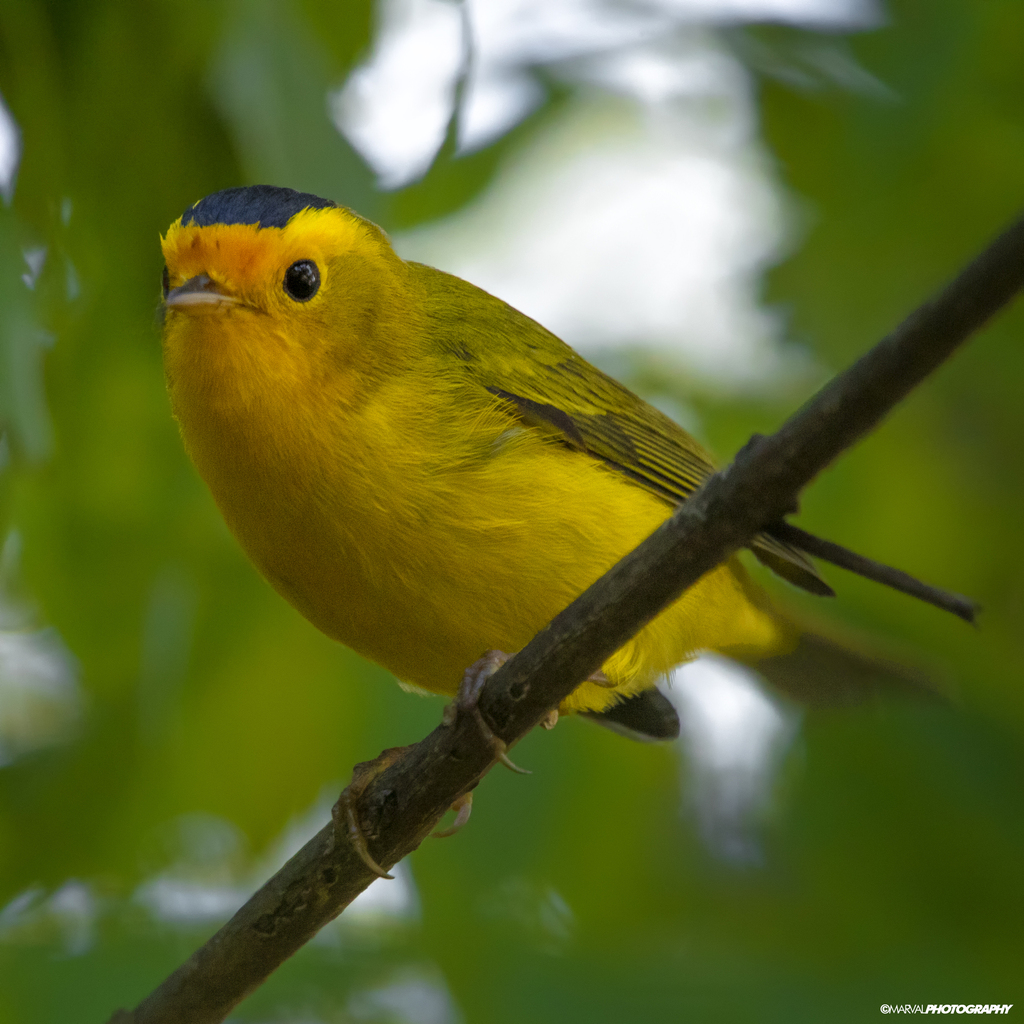
(c) MarvalPhotography19, some rights reserved (CC BY) · licence
Family: Parulidae · Class: Aves · Order: Passeriformes
Cardellina pusilla (Wilson's Warbler) is a California animal in the Parulidae family.
Wilson's Warbler is a small songbird measuring 10 to 12 centimeters (4 to 4.7 inches) in length with a wingspan of 14 to 17 centimeters (5.5 to 6.7 inches). Adults weigh 6 to 10 grams (0.2 to 0.4 ounces). Males display bright yellow underparts and face with olive-green upperparts and wings. The most distinctive feature is the male's glossy black cap that extends from the forehead to the nape. Females and juveniles show similar yellow and olive coloration but lack the black cap, though some females may show a faint dusky crown. The species has a thin, pointed bill typical of insectivorous warblers and dark eyes that contrast with the yellow face. Wilson's Warbler breeds across western North America from Alaska to central California, with the species occurring throughout most of California during migration and breeding seasons. The breeding range in California includes the Sierra Nevada, Cascade Range, Coast Ranges, and mountainous areas of northern and central regions. During winter, the species migrates to Central America and Mexico, though some individuals may winter in southern California and Baja California. The species follows the Pacific Flyway during migration, making it a common transient throughout the state from April to May and August to September. Breeding habitat consists of dense understory vegetation in riparian areas, montane forests, and thickets near water sources. The species shows strong preference for willow thickets, alder groves, and areas with dense shrub cover along streams and meadow edges. Elevation range extends from sea level to approximately 3,000 meters (9,800 feet), with highest breeding densities occurring between 1,200 and 2,400 meters (3,900 to 7,900 feet) in the Sierra Nevada. During migration, Wilson's Warblers utilize diverse habitats including urban parks, desert oases, and coastal scrub. Wilson's Warblers are primarily insectivorous, capturing flies, gnats, aphids, caterpillars, and other small arthropods through gleaning and hawking behaviors. They forage actively in dense vegetation, often hovering to pick insects from leaves and bark surfaces. The breeding season extends from May through July in California. Females construct cup-shaped nests on or near the ground, hidden in dense shrubs or grass clumps. Clutch size ranges from three to six eggs, which are incubated for 11 to 13 days. Young fledge after 8 to 11 days in the nest. The species typically produces one brood per season, though second broods may occur in favorable conditions. Wilson's Warbler is not federally or state listed as threatened or endangered. According to the North American Breeding Bird Survey, populations have shown long-term stability across much of the range, though some regional declines have been documented. The species faces threats from habitat loss due to development, livestock grazing impacts on riparian areas, and climate change effects on montane breeding habitats. Forest management practices that maintain dense understory vegetation and preserve riparian corridors support population stability. The species benefits from conservation efforts targeting riparian habitat restoration and protection of migration stopover sites.
Classification
Class: Aves · Order: Passeriformes · Family: Parulidae
Frequently asked questions
How is Cardellina pusilla classified?
Cardellina pusilla belongs to class Aves, order Passeriformes, family Parulidae.
What family does Cardellina pusilla belong to?
Cardellina pusilla is in the Parulidae family.
What is Cardellina pusilla?
Wilson's Warbler is a small songbird measuring 10 to 12 centimeters (4 to 4.7 inches) in length with a wingspan of 14 to 17 centimeters (5.5 to 6.7 inches).
Is Cardellina pusilla found in California?
Yes. Cardellina pusilla is recorded in California in The California Species Project's catalogue.
Related species
Other California species in the same genus, family, or bioregion.
Data from The California Species Project — 14,000+ California species with verified data from CNPS, CDFW, USFWS, and more.