Cardinalis cardinalis
Northern Cardinal
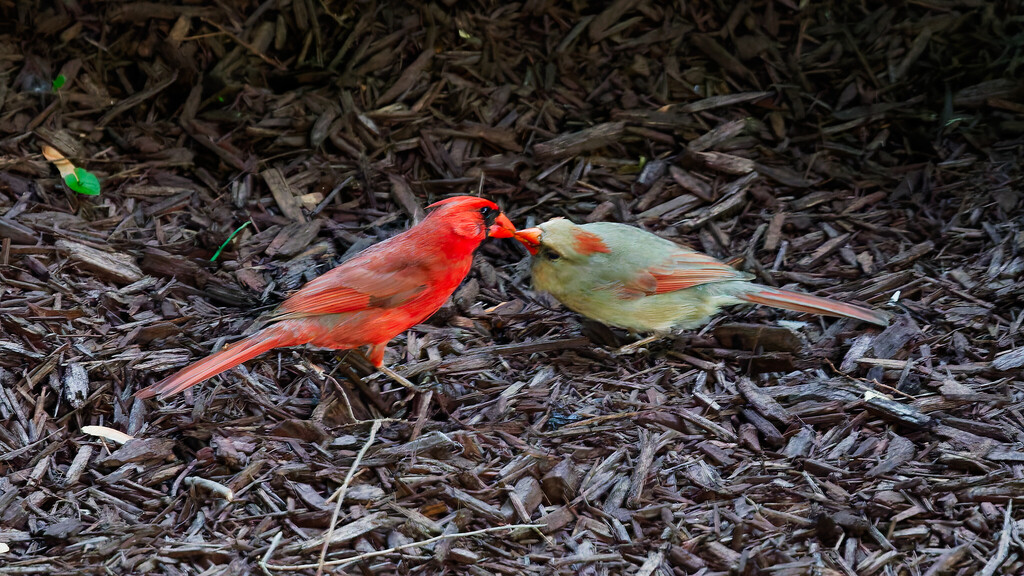
(c) Daughter Dad, some rights reserved (CC BY) · licence
Family: Cardinalidae · Class: Aves · Order: Passeriformes
Conservation status: WL · G5 S1
Cardinalis cardinalis (Northern Cardinal) is a California animal in the Cardinalidae family.
The Northern Cardinal is a medium-sized songbird measuring 21 to 23 centimeters (8.3 to 9.1 inches) in length with a wingspan of 25 to 31 centimeters (9.8 to 12.2 inches). Adult males display bright red plumage across their entire body, while females exhibit warm brown coloration with reddish tinges on the wings, tail, and crest. Both sexes possess a distinctive pointed crest, thick orange-red conical bill adapted for seed cracking, and a black mask extending from the bill around the eyes. Males typically weigh 42 to 48 grams, while females range from 42 to 44 grams. Historically, Northern Cardinals were restricted to the southeastern United States, with their range not extending into California. The species has undergone significant range expansion northward and westward since the early 1900s, attributed to climate warming, habitat modification, and supplemental feeding by humans. In California, Northern Cardinals are considered non-native residents with a state ranking of S1, indicating they are critically imperiled within the state. The species maintains a global ranking of G5, reflecting stable populations across its native range. California has designated the Northern Cardinal as a Watch List species due to its limited and potentially vulnerable status within the state. Within California, Northern Cardinals inhabit riparian woodlands, urban parks, suburban gardens, and areas with dense shrub cover. The species shows strong preference for edge habitats where open areas meet wooded zones. Cardinals require dense vegetation for nesting and foraging, typically selecting sites with multilayered canopy structure. They adapt well to human-modified landscapes, thriving in residential areas with mature trees, shrubs, and reliable food sources. Northern Cardinals are primarily granivorous, consuming seeds from grasses, forbs, and shrubs, though they supplement their diet with insects, particularly during breeding season. Their powerful bills enable them to crack tough seeds that other songbirds cannot access. Cardinals are non-migratory residents that maintain territories year-round. Breeding occurs from March through August, with pairs producing two to three broods per season. Females construct cup-shaped nests in dense shrubs or low tree branches, typically 1 to 3 meters above ground. Clutch size ranges from 2 to 5 eggs, with an incubation period of 11 to 13 days. Males actively participate in territory defense and nestling care, often feeding fledglings while females begin subsequent nests. The species exhibits strong pair bonds, with many pairs remaining together across multiple breeding seasons. Cardinals are known for their vocal repertoire, with males producing loud, clear whistled songs used for territory establishment and mate attraction. Both sexes produce sharp 'chip' calls for communication and alarm. In California, Northern Cardinal populations face uncertainty regarding their long-term establishment and potential impacts on native bird communities. While the species demonstrates adaptability to California's Mediterranean climate, ongoing monitoring is necessary to assess population trends and ecological interactions within their introduced range.
Classification
Class: Aves · Order: Passeriformes · Family: Cardinalidae
Conservation status
WL · G5 S1
Frequently asked questions
How is Cardinalis cardinalis classified?
Cardinalis cardinalis belongs to class Aves, order Passeriformes, family Cardinalidae.
What family does Cardinalis cardinalis belong to?
Cardinalis cardinalis is in the Cardinalidae family.
Is Cardinalis cardinalis protected or of conservation concern?
Cardinalis cardinalis carries the following status: WL · G5 S1.
What is Cardinalis cardinalis?
The Northern Cardinal is a medium-sized songbird measuring 21 to 23 centimeters (8.3 to 9.1 inches) in length with a wingspan of 25 to 31 centimeters (9.8 to 12.2 inches).
Is Cardinalis cardinalis found in California?
Yes. Cardinalis cardinalis is recorded in California in The California Species Project's catalogue.
Related species
Other California species in the same genus, family, or bioregion.
Data from The California Species Project — 14,000+ California species with verified data from CNPS, CDFW, USFWS, and more.