Cardinalis sinuatus
Pyrrhuloxia
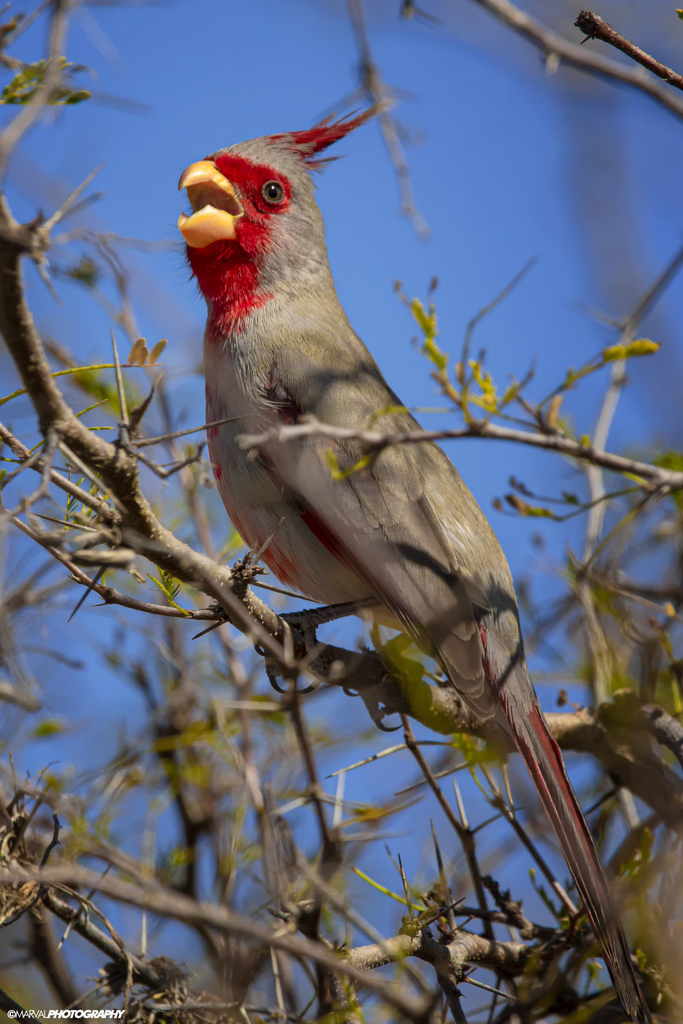
(c) MarvalPhotography19, some rights reserved (CC BY) · licence
Family: Cardinalidae · Class: Aves · Order: Passeriformes
Cardinalis sinuatus (Pyrrhuloxia) is a California animal in the Cardinalidae family.
The Pyrrhuloxia is a medium-sized songbird in the cardinal family, measuring 21-23 cm (8.3-9.1 inches) in length with a wingspan of 25-30 cm (9.8-11.8 inches). Males display distinctive gray plumage with bright red coloration on the face, crest, wings, tail, and underparts. The red markings form a striking pattern against the gray base color, with the most prominent red appearing as a bib on the throat and breast. Females are similar but show more muted red coloration, appearing predominantly gray-brown with subtle reddish tinges on the wings, tail, and crest. Both sexes possess a prominent pointed crest and a distinctive thick, curved, parrot-like bill that is yellow to orange in color, distinguishing them from the closely related Northern Cardinal. The Pyrrhuloxia's range extends from the southwestern United States into Mexico, with populations occurring in Arizona, New Mexico, and Texas. In California, the species is considered a vagrant, with rare sightings reported primarily in the southeastern desert regions along the Colorado River. Historical records indicate occasional observations in Imperial and eastern Riverside counties, though established breeding populations do not occur within the state. This species inhabits arid and semi-arid environments, showing a strong preference for desert scrub, mesquite bosques, and riparian woodlands in desert regions. Pyrrhuloxias are typically found at elevations below 1,200 meters (4,000 feet), favoring areas with dense shrubland that provides both nesting sites and foraging opportunities. They show particular affinity for habitats containing mesquite, palo verde, desert willow, and various cacti species, especially cholla and prickly pear. Pyrrhuloxias are primarily granivorous, feeding extensively on seeds from desert plants, particularly mesquite beans, palo verde seeds, and cactus fruits. During breeding season, they supplement their diet with insects including beetles, caterpillars, and grasshoppers, which provide essential protein for developing young. The species exhibits year-round territoriality, with pairs maintaining territories of 2-4 hectares. Breeding occurs from March through September, with peak activity from April to July. Females construct cup-shaped nests in dense shrubs or small trees, typically 1-3 meters above ground. Clutch size ranges from 2-4 eggs, with an incubation period of 14 days. Young fledge after 10-11 days in the nest. The Pyrrhuloxia is not federally listed and maintains stable populations throughout most of its range. The species is classified as Least Concern by the International Union for Conservation of Nature. However, habitat loss due to urban development, agriculture, and water diversions in desert regions poses ongoing challenges. In California, the species remains an irregular vagrant with no established breeding population, making any conservation assessment within the state difficult to determine.
Classification
Class: Aves · Order: Passeriformes · Family: Cardinalidae
Frequently asked questions
How is Cardinalis sinuatus classified?
Cardinalis sinuatus belongs to class Aves, order Passeriformes, family Cardinalidae.
What family does Cardinalis sinuatus belong to?
Cardinalis sinuatus is in the Cardinalidae family.
What is Cardinalis sinuatus?
The Pyrrhuloxia is a medium-sized songbird in the cardinal family, measuring 21-23 cm (8.3-9.1 inches) in length with a wingspan of 25-30 cm (9.8-11.8 inches).
Is Cardinalis sinuatus found in California?
Yes. Cardinalis sinuatus is recorded in California in The California Species Project's catalogue.
Related species
Other California species in the same genus, family, or bioregion.
Data from The California Species Project — 14,000+ California species with verified data from CNPS, CDFW, USFWS, and more.