Cardiocondyla mauritanica
Moorish Sneaking Ant
(c) Kylie Etter, some rights reserved (CC BY) · licence
Family: Formicidae · Class: Insecta · Order: Hymenoptera
Cardiocondyla mauritanica (Moorish Sneaking Ant) is a California animal in the Formicidae family.
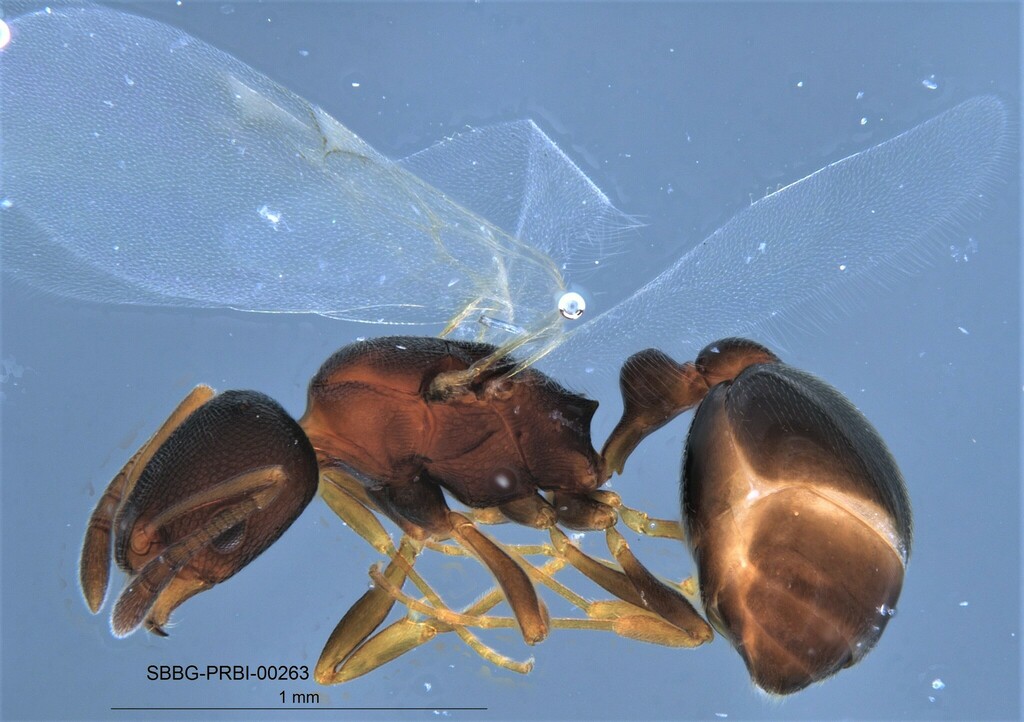
The Moorish sneaking ant (Cardiocondyla mauritanica) is a small, introduced ant species belonging to the subfamily Myrmicinae. Workers are small and slender, measuring approximately 2-3 mm in length, with brown-red coloration and a distinctive blackish, ovoid abdomen (BugGuide). The species exhibits the characteristic two-segmented metasomal nodes typical of myrmicine ants and possesses small propodeal spines. The head and thorax are typically lighter brown-red, contrasting with the darker abdominal segments. Cardiocondyla mauritanica is native to the Mediterranean region but has become established in various parts of North America, including California. The species has been documented in southern California, with confirmed records from Orange County, specifically in the Fullerton area (BugGuide). As an introduced species, its current distribution in California may be expanding but remains poorly documented compared to native ant fauna. This species typically inhabits disturbed urban and suburban environments, showing a preference for areas with human activity. Moorish sneaking ants are commonly found in gardens, parks, and residential areas where they nest in soil, under stones, or in cracks in pavement and building foundations. They demonstrate tolerance for a variety of soil types and moisture conditions, contributing to their success as an introduced species in Mediterranean-type climates. Cardiocondyla mauritanica exhibits typical myrmicine social organization with distinct worker and reproductive castes. Colonies are relatively small, typically containing a few hundred to a few thousand individuals. Workers are omnivorous, foraging for small insects, honeydew from aphids and scale insects, and various organic matter including food scraps in urban environments. The species displays a polygynous social structure, meaning colonies may contain multiple queens. Reproduction occurs throughout the warmer months, with new colonies established through budding or independent founding by mated queens. This species is not listed under any federal or state conservation programs, as it is an introduced species rather than a native component of California's biodiversity. As with many introduced ant species, C. mauritanica may compete with native ants for resources and nesting sites, potentially affecting local ecosystem dynamics. However, specific ecological impact studies for this species in California ecosystems are limited. The species' establishment and spread are facilitated by human activities, particularly through the transport of soil, plants, and building materials. Current population trends and distribution expansion rates within California remain undocumented, reflecting the general lack of comprehensive monitoring for non-native ant species. Management focus typically centers on preventing further spread rather than population control, as eradication of established ant populations is generally impractical in urban environments.
Classification
Class: Insecta · Order: Hymenoptera · Family: Formicidae
Frequently asked questions
How is Cardiocondyla mauritanica classified?
Cardiocondyla mauritanica belongs to class Insecta, order Hymenoptera, family Formicidae.
What family does Cardiocondyla mauritanica belong to?
Cardiocondyla mauritanica is in the Formicidae family.
What is Cardiocondyla mauritanica?
The Moorish sneaking ant (Cardiocondyla mauritanica) is a small, introduced ant species belonging to the subfamily Myrmicinae.
Is Cardiocondyla mauritanica found in California?
Yes. Cardiocondyla mauritanica is recorded in California in The California Species Project's catalogue.
Related species
Other California species in the same genus, family, or bioregion.
Data from The California Species Project — 14,000+ California species with verified data from CNPS, CDFW, USFWS, and more.