Caripeta aequaliaria
Western Conifer Looper
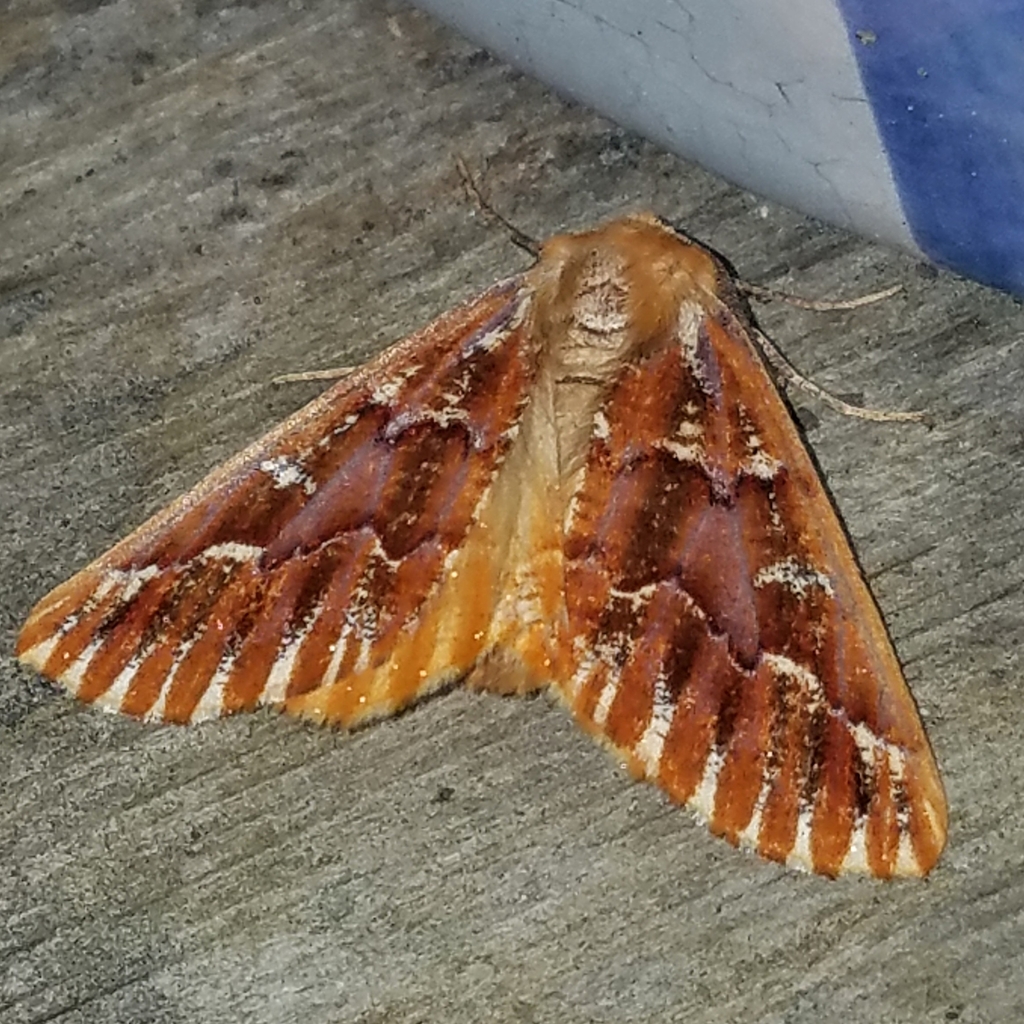
(c) Charles Swift, some rights reserved (CC BY) · licence
Family: Geometridae · Class: Insecta · Order: Lepidoptera
Caripeta aequaliaria (Western Conifer Looper) is a California animal in the Geometridae family.
The Western Conifer Looper (Caripeta aequaliaria) is a geometrid moth in the family Geometridae, also known as the red girdle moth. Adults display distinctive pale red-brown forewings marked by two jagged median lines and a small pale discal spot. The wings feature prominent orange dashes in the submarginal areas, creating the characteristic pattern that distinguishes this species from other loopers (Butterflies and Moths of North America). This species occurs across western North America, with populations documented from British Columbia south through California. In California, the Western Conifer Looper is found primarily in mountainous regions where suitable coniferous host trees are present. The species shows a preference for areas with mixed coniferous forests and has been recorded from both coastal and inland mountain ranges. The Western Conifer Looper inhabits coniferous forest ecosystems, particularly those dominated by Douglas-fir, western hemlock, and other native conifers. Adults are active during late spring and summer months, typically emerging when host trees are in active growth phase. The species appears to favor mature forest stands over young plantations, suggesting a preference for established forest canopy structure. Larvae function as defoliators of coniferous trees, with feeding behavior typical of geometrid caterpillars - they move in a characteristic looping motion by bringing their rear legs forward to meet their front legs. The caterpillars feed on needle foliage of various coniferous species, though specific host plant relationships for this species require further documentation. Like other geometrids, larvae pupate in soil or leaf litter, with adults emerging the following season. Adults are primarily nocturnal and are attracted to artificial lights, making them observable to researchers and citizen scientists conducting moth surveys. Flight period varies with elevation and latitude but generally occurs from May through August in most of the species' range. Mating and egg-laying behaviors follow typical geometrid patterns, with females depositing eggs on or near host plant foliage. The Western Conifer Looper currently holds a global conservation status of G5 (secure) according to NatureServe, indicating stable populations across its range. The species does not appear on federal or state endangered species lists, and no specific conservation concerns have been identified. However, like many forest-dependent species, populations may face localized impacts from forest management practices, wildfire patterns, and climate change effects on coniferous forest ecosystems. Population trends for this species have not been systematically monitored, and specific abundance data are not available in the literature. The species appears to maintain stable populations throughout its range, though more research is needed to understand population dynamics and response to environmental changes in western coniferous forests.
Classification
Class: Insecta · Order: Lepidoptera · Family: Geometridae
Frequently asked questions
How is Caripeta aequaliaria classified?
Caripeta aequaliaria belongs to class Insecta, order Lepidoptera, family Geometridae.
What family does Caripeta aequaliaria belong to?
Caripeta aequaliaria is in the Geometridae family.
What is Caripeta aequaliaria?
The Western Conifer Looper (Caripeta aequaliaria) is a geometrid moth in the family Geometridae, also known as the red girdle moth.
Is Caripeta aequaliaria found in California?
Yes. Caripeta aequaliaria is recorded in California in The California Species Project's catalogue.
Related species
Other California species in the same genus, family, or bioregion.
Data from The California Species Project — 14,000+ California species with verified data from CNPS, CDFW, USFWS, and more.