Carpodacus erythrinus
Common Rosefinch
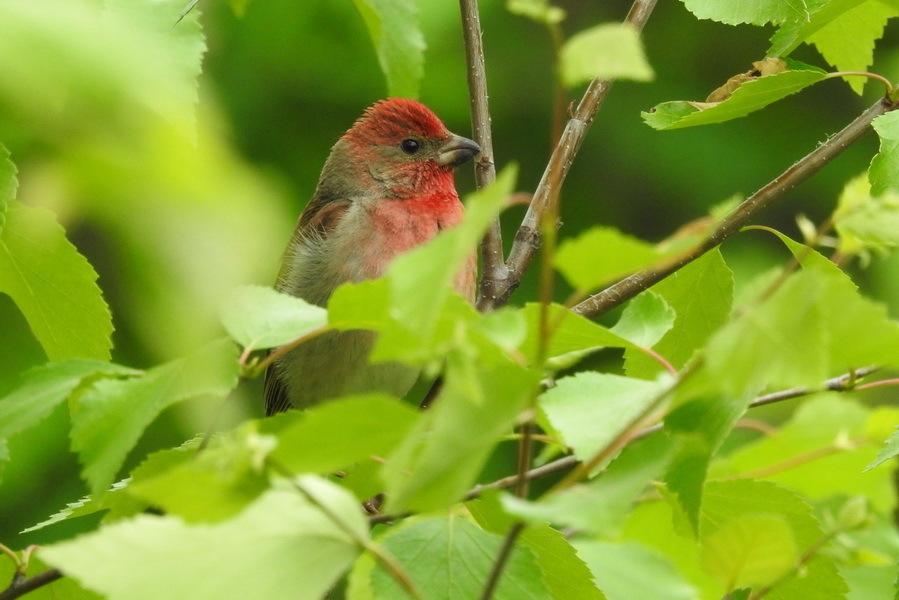
no rights reserved · CC0
Family: Fringillidae · Class: Aves · Order: Passeriformes
Carpodacus erythrinus (Common Rosefinch) is a California animal in the Fringillidae family.
The Common Rosefinch is a medium-sized finch measuring 14 to 15 cm (5.5 to 5.9 inches) in length with a wingspan of 22 to 26 cm (8.7 to 10.2 inches). Adult males display distinctive rosy-pink plumage on the head, breast, and rump, with brownish wings and back. The intensity of the pink coloration varies seasonally and with age, being most vibrant during breeding season. Females and juveniles are brownish-gray with streaked underparts and lack the characteristic pink tones. Both sexes possess a thick, conical bill adapted for seed consumption and dark eyes. The Common Rosefinch has an extensive range across Eurasia, breeding from Scandinavia and eastern Europe through Siberia to the Pacific coast, and from the Arctic tundra south to the Himalayas and central Asia. In North America, the species occurs primarily as a vagrant, with documented records from Alaska, particularly the western Aleutian Islands and Pribilof Islands. California records are extremely rare, with only a handful of documented occurrences representing far-traveling vagrants, primarily during spring and fall migration periods. This species inhabits diverse environments across its range, including taiga forests, mixed woodlands, scrublands, and forest edges. During breeding season, Common Rosefinches prefer areas with dense shrub cover near water sources, including willow and birch thickets, overgrown clearings, and riparian zones. They occupy elevations from sea level to approximately 2,000 meters (6,560 feet) in mountainous regions. Outside the breeding season, they utilize more open habitats including agricultural areas, parks, and gardens. Common Rosefinches are primarily granivorous, feeding on seeds from grasses, herbs, and shrubs, including dandelion, dock, and various cereal grains. During breeding season, they supplement their diet with insects, particularly when feeding nestlings. The species constructs cup-shaped nests in dense shrubs or low trees, typically 1 to 3 meters (3.3 to 9.8 feet) above ground. Females lay 3 to 6 pale blue-green eggs with dark spots, which are incubated for 11 to 14 days. Young fledge after 11 to 17 days. The species exhibits a distinctive song described as a clear, melodious whistle often rendered as 'pleased-to-meet-you.' The Common Rosefinch is not federally or state-listed in the United States, as it is not an established breeding species in North America. Globally, the International Union for Conservation of Nature classifies the species as Least Concern due to its large population and extensive range. Population trends across the Eurasian range show local variations, with some northern populations experiencing declines attributed to habitat modification and climate change effects on breeding territories. In California, the species remains an exceptional vagrant with no established population or conservation concerns, as occurrences represent individual birds far outside their normal range.
Classification
Class: Aves · Order: Passeriformes · Family: Fringillidae
Frequently asked questions
How is Carpodacus erythrinus classified?
Carpodacus erythrinus belongs to class Aves, order Passeriformes, family Fringillidae.
What family does Carpodacus erythrinus belong to?
Carpodacus erythrinus is in the Fringillidae family.
What is Carpodacus erythrinus?
The Common Rosefinch is a medium-sized finch measuring 14 to 15 cm (5.5 to 5.9 inches) in length with a wingspan of 22 to 26 cm (8.7 to 10.2 inches).
Is Carpodacus erythrinus found in California?
Yes. Carpodacus erythrinus is recorded in California in The California Species Project's catalogue.
Related species
Other California species in the same genus, family, or bioregion.
Data from The California Species Project — 14,000+ California species with verified data from CNPS, CDFW, USFWS, and more.