Cathartes aura
Turkey Vulture
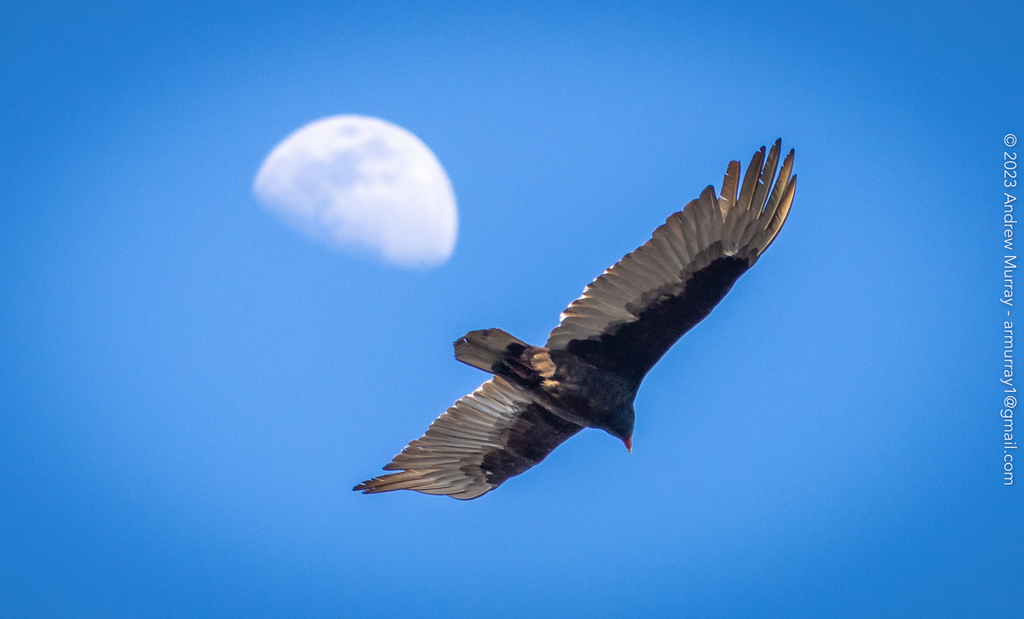
(c) Andrew Murray, some rights reserved (CC BY) · licence
Family: Cathartidae · Class: Aves · Order: Accipitriformes
Cathartes aura (Turkey Vulture) is a California animal in the Cathartidae family.
The Turkey Vulture is a large soaring bird with distinctive flight characteristics and scavenging behavior. Adults measure 62 to 81 cm (24 to 32 inches) in length with a wingspan of 160 to 183 cm (63 to 72 inches). Body weight ranges from 0.8 to 2.3 kg (1.8 to 5.1 pounds). The species exhibits sexual dimorphism, with females typically larger than males. Adult plumage is primarily dark brown to black with a metallic sheen. The flight feathers appear silvery-gray from below, creating a distinctive two-toned wing pattern visible during soaring. The head and neck are featherless, displaying red skin in adults and dark gray in juveniles. The bill is ivory-colored with a dark tip. Turkey Vultures maintain one of the most extensive ranges of any raptor in the Western Hemisphere, occurring from southern Canada to the southern tip of South America. In California, the species is resident throughout most of the state, from sea level to elevations exceeding 3,000 meters (10,000 feet) in the Sierra Nevada. Populations in northern regions may migrate seasonally, while those in California and other southern areas typically remain year-round residents. The species occupies diverse habitats including open woodlands, grasslands, agricultural areas, scrublands, and urban environments. Turkey Vultures require suitable roosting sites such as large trees, cliffs, or human-made structures, and open areas for foraging. They utilize thermal updrafts for energy-efficient soaring and typically avoid dense forests where flight maneuverability is limited. The species adapts well to human-modified landscapes and is commonly observed near roads where vehicle-killed wildlife provides food sources. Turkey Vultures are obligate scavengers, feeding exclusively on carrion. Their exceptional sense of smell, rare among birds, allows them to locate decomposing carcasses from considerable distances. The species can detect ethyl mercaptan, a gas produced by decaying organic matter, at concentrations as low as 10 parts per billion. Breeding occurs from February through July, varying by latitude. Pairs typically produce two eggs, though clutch sizes of one or three occur occasionally. Nests are placed on the ground in caves, hollow logs, dense thickets, or abandoned buildings. Incubation lasts 34 to 41 days, with both parents sharing duties. Young fledge after 60 to 84 days but may remain dependent on parents for several additional weeks. Turkey Vultures are not federally or state listed and maintain stable populations throughout their range. The species has likely benefited from human activities that increase carrion availability, including road construction and livestock operations. Primary threats include vehicle strikes, illegal shooting, and poisoning from lead ammunition in hunter-killed game. The species plays a crucial ecological role in nutrient cycling and disease prevention through rapid consumption of carrion. Climate change may affect thermal generation patterns essential for their soaring behavior, though population impacts remain unclear.
Classification
Class: Aves · Order: Accipitriformes · Family: Cathartidae
Frequently asked questions
How is Cathartes aura classified?
Cathartes aura belongs to class Aves, order Accipitriformes, family Cathartidae.
What family does Cathartes aura belong to?
Cathartes aura is in the Cathartidae family.
What is Cathartes aura?
The Turkey Vulture is a large soaring bird with distinctive flight characteristics and scavenging behavior.
Is Cathartes aura found in California?
Yes. Cathartes aura is recorded in California in The California Species Project's catalogue.
Related species
Other California species in the same genus, family, or bioregion.
Data from The California Species Project — 14,000+ California species with verified data from CNPS, CDFW, USFWS, and more.