Catharus fuscescens
Veery
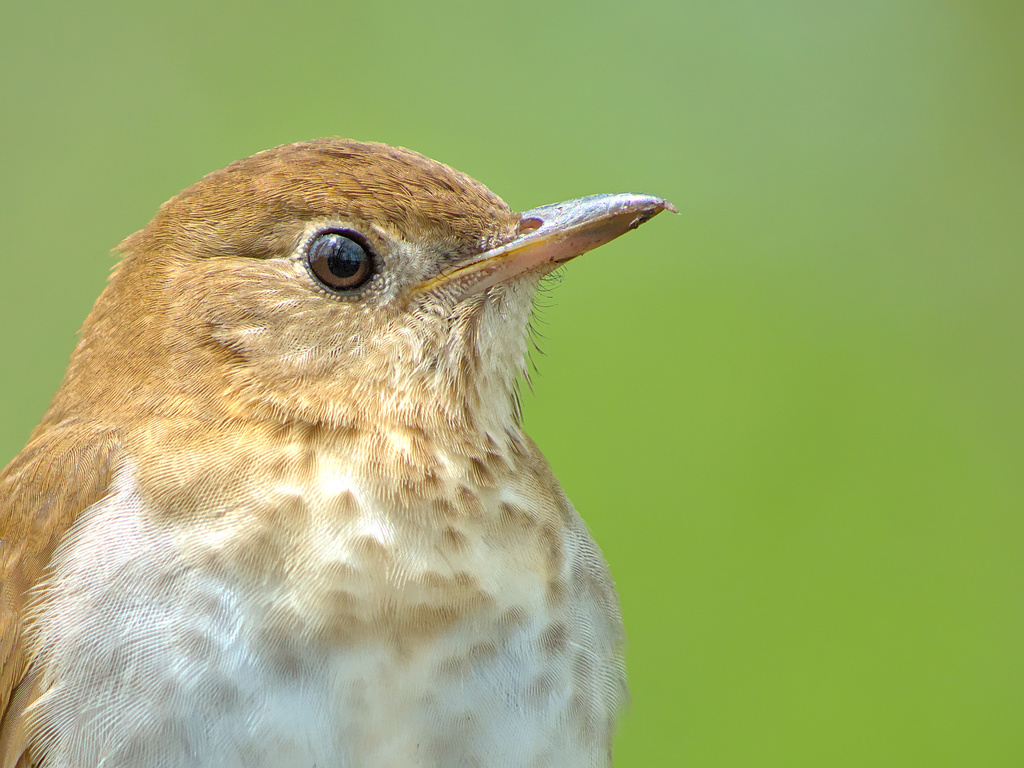
(c) Blake Ross, some rights reserved (CC BY) · licence
Family: Turdidae · Class: Aves · Order: Passeriformes
Catharus fuscescens (Veery) is a California animal in the Turdidae family.
The Veery is a medium-sized thrush measuring 16 to 18 cm (6.3 to 7.1 inches) in length with a wingspan of 28 to 30 cm (11 to 12 inches). Adults weigh 28 to 54 grams (1.0 to 1.9 ounces). The species displays relatively uniform cinnamon-brown to russet upperparts, with the head and back showing the richest coloration. The underparts are pale buff to white with faint brown spotting on the throat and upper breast that becomes less distinct toward the belly. The tail and wings are slightly darker than the back, and the species has a thin, dark eye ring and yellow-orange legs. Historically, the Veery bred across much of northern and mountainous regions of North America, from British Columbia east to Newfoundland and south through the Appalachian Mountains and western mountain ranges. In California, the species was documented as a breeding resident in the Sierra Nevada and Cascade Range, typically at elevations between 1,200 and 2,400 meters (4,000 to 8,000 feet). Current breeding populations in California appear to be significantly reduced or possibly extirpated from many historical locations. Veeries inhabit dense, moist deciduous and mixed forests with well-developed understory vegetation. In California, they historically occupied riparian woodlands, aspen groves, and mixed conifer forests with substantial deciduous components. The species prefers areas near water sources such as streams, seeps, or wet meadows. Optimal habitat includes a closed or semi-closed canopy with dense shrub layers and abundant leaf litter for foraging. This species is primarily insectivorous during the breeding season, foraging on the ground and in low vegetation for beetles, caterpillars, ants, flies, and other invertebrates. Veeries also consume berries and small fruits, particularly during migration and late summer. The species is known for its distinctive, downward-spiraling flute-like song that gives it its name. Nesting occurs from May through July, with females constructing cup-shaped nests in shrubs or low tree branches, typically 0.3 to 4.6 meters (1 to 15 feet) above ground. Clutch size ranges from three to five pale blue eggs, and females incubate eggs for 10 to 14 days. The Veery is not federally listed but has experienced significant population declines across much of its range. According to the North American Breeding Bird Survey, continental populations declined by approximately 1.5% annually between 1966 and 2019. In California, the species appears to have experienced severe declines or local extinctions in much of its historical breeding range. Primary threats include habitat loss and fragmentation, particularly of riparian and montane forest ecosystems, livestock grazing impacts on understory vegetation, and climate change effects on moisture availability in breeding habitats. The species' dependence on dense forest understory makes it particularly vulnerable to logging practices and forest management that reduces structural diversity.
Classification
Class: Aves · Order: Passeriformes · Family: Turdidae
Frequently asked questions
How is Catharus fuscescens classified?
Catharus fuscescens belongs to class Aves, order Passeriformes, family Turdidae.
What family does Catharus fuscescens belong to?
Catharus fuscescens is in the Turdidae family.
What is Catharus fuscescens?
The Veery is a medium-sized thrush measuring 16 to 18 cm (6.3 to 7.1 inches) in length with a wingspan of 28 to 30 cm (11 to 12 inches).
Is Catharus fuscescens found in California?
Yes. Catharus fuscescens is recorded in California in The California Species Project's catalogue.
Related species
Other California species in the same genus, family, or bioregion.
Data from The California Species Project — 14,000+ California species with verified data from CNPS, CDFW, USFWS, and more.