Catharus guttatus
Hermit Thrush
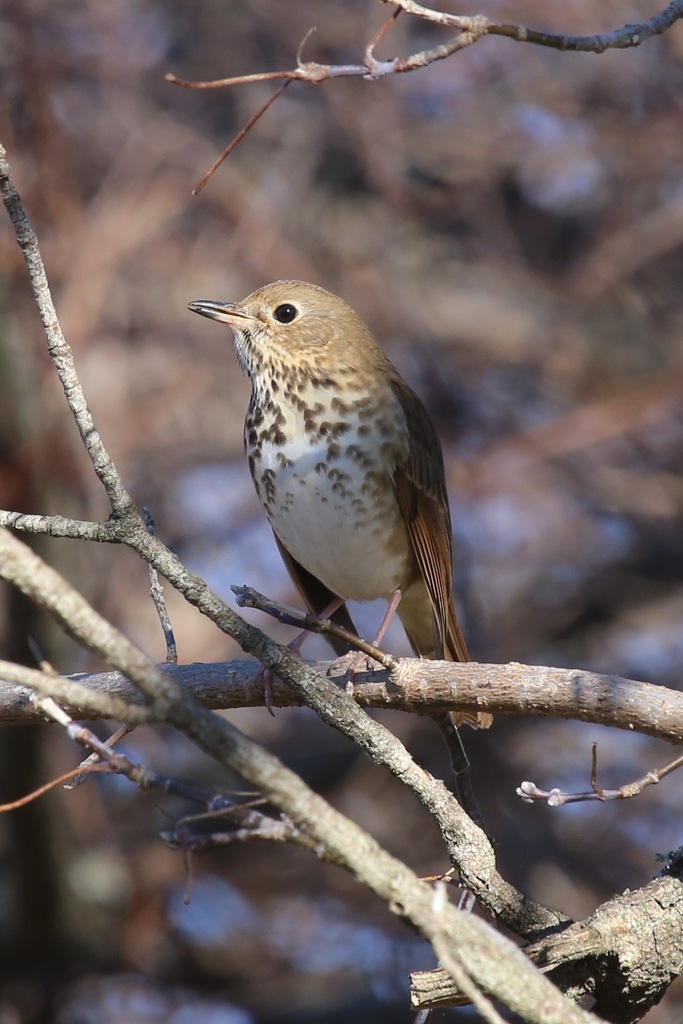
(c) Laura Gaudette, some rights reserved (CC BY) · licence
Family: Turdidae · Class: Aves · Order: Passeriformes
Catharus guttatus (Hermit Thrush) is a California animal in the Turdidae family.
The Hermit Thrush is a medium-sized songbird measuring 15-18 cm (6-7 inches) in length with a wingspan of 25-30 cm (10-12 inches) and weighing 18-37 grams. The species displays a distinctive reddish-brown tail that contrasts with its olive-brown to grayish-brown upperparts. The underparts are whitish to buff with dark spotting concentrated on the breast and throat. A pale eye ring provides subtle facial definition. The bill is dark above and yellow-orange below, adapted for both insectivory and frugivory. In California, Hermit Thrushes breed in coniferous and mixed forests throughout the Sierra Nevada, Cascade Range, Coast Ranges, and higher elevations of southern California mountains. During winter, the species expands to lower elevations and broader habitat types, including oak woodlands, chaparral, parks, and urban areas with suitable vegetation. Year-round populations occur in coastal fog belt forests from Mendocino County south to Monterey County. The species ranges from sea level to approximately 3,350 meters (11,000 feet) elevation. Breeding habitat consists primarily of mature coniferous forests, including Douglas fir, ponderosa pine, lodgepole pine, and mixed conifer communities. The species requires moderate to dense canopy cover with an open understory for foraging. Essential habitat features include fallen logs, leaf litter accumulations, and scattered shrubs or low branches for nesting sites. During winter, Hermit Thrushes utilize diverse habitats including riparian woodlands, suburban gardens, and scrubland with berry-producing plants. Hermit Thrushes are primarily insectivorous during the breeding season, consuming beetles, caterpillars, ants, flies, and other arthropods gleaned from the ground and low vegetation. Their diet shifts to include substantial amounts of fruit during fall and winter, particularly elderberries, madrone berries, and other native fruits. The species employs a distinctive foraging behavior of flicking fallen leaves aside with rapid foot movements while searching for prey underneath. Breeding occurs from May through August, with females constructing cup-shaped nests of twigs, moss, and plant fibers, typically placed 1-4 meters above ground in dense shrubs or small trees. Clutch size ranges from 3-5 eggs, which are incubated for 12-13 days. Young fledge after 10-15 days but remain dependent on adults for several additional weeks. The species is renowned for its complex, flute-like song consisting of clear, descending phrases delivered from prominent perches. The Hermit Thrush is not federally or state-listed in California and maintains stable populations across most of its range. According to the North American Breeding Bird Survey, populations have remained relatively stable from 1970-2019, though some regional declines have been documented. Primary conservation concerns include habitat loss from logging, urban development, and climate change impacts on high-elevation forests. Forest management practices that maintain structural diversity and understory complexity benefit this species. The Hermit Thrush serves as an indicator species for healthy forest ecosystems and responds positively to sustainable forestry practices that preserve old-growth characteristics.
Classification
Class: Aves · Order: Passeriformes · Family: Turdidae
Frequently asked questions
How is Catharus guttatus classified?
Catharus guttatus belongs to class Aves, order Passeriformes, family Turdidae.
What family does Catharus guttatus belong to?
Catharus guttatus is in the Turdidae family.
What is Catharus guttatus?
The Hermit Thrush is a medium-sized songbird measuring 15-18 cm (6-7 inches) in length with a wingspan of 25-30 cm (10-12 inches) and weighing 18-37 grams.
Is Catharus guttatus found in California?
Yes. Catharus guttatus is recorded in California in The California Species Project's catalogue.
Related species
Other California species in the same genus, family, or bioregion.
Data from The California Species Project — 14,000+ California species with verified data from CNPS, CDFW, USFWS, and more.