Catharus minimus
Gray-cheeked Thrush
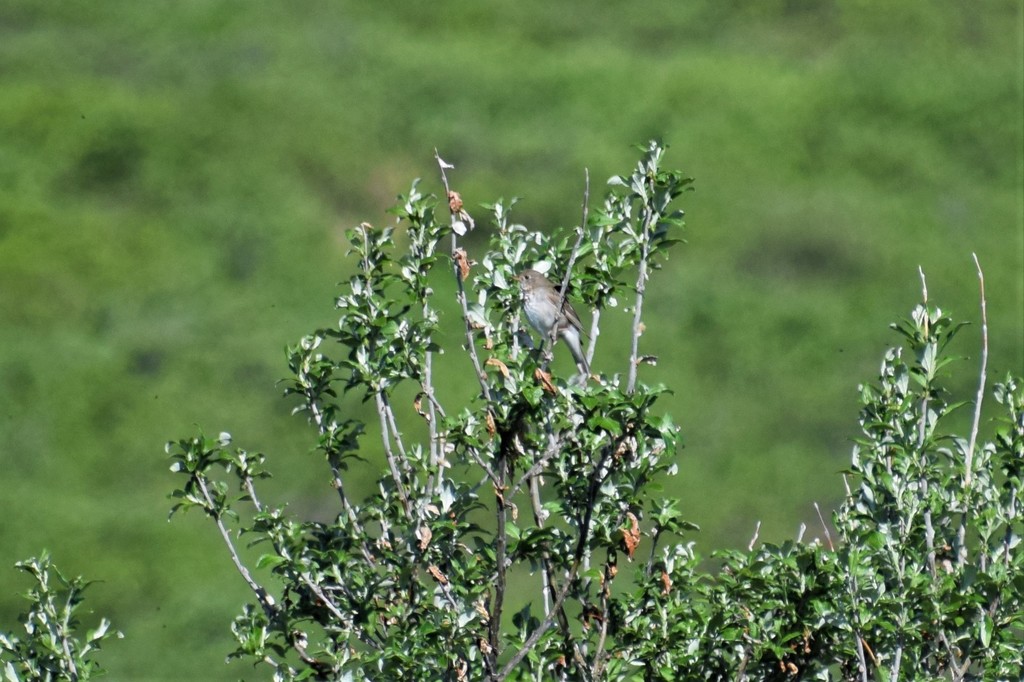
(c) Syd Cannings, some rights reserved (CC BY) · licence
Family: Turdidae · Class: Aves · Order: Passeriformes
Catharus minimus (Gray-cheeked Thrush) is a California animal in the Turdidae family.
The Gray-cheeked Thrush is a medium-sized songbird measuring 16 to 18 cm (6.3 to 7.1 inches) in length with a wingspan of 28 to 32 cm (11 to 12.6 inches). Adults weigh 26 to 35 grams (0.9 to 1.2 ounces). The species exhibits subtle plumage with brown to olive-brown upperparts and pale underparts marked by dark spots on the throat and breast. The face shows distinctive gray cheeks that give the species its common name, contrasting with a pale eye-ring that is less prominent than in the closely related Bicknell's Thrush. The bill is dark with a pale base, and the legs are pinkish-brown. The Gray-cheeked Thrush breeds across northern North America from Alaska through northern Canada. During migration, the species passes through California primarily along the Pacific Coast and Sierra Nevada ranges from late April through May and again from August through October. In California, Gray-cheeked Thrushes are uncommon transients, with most records concentrated in coastal areas from Humboldt County south to Monterey County, though scattered observations occur throughout the state's mountain regions during peak migration periods. During migration through California, Gray-cheeked Thrushes utilize diverse habitats including riparian woodlands, mixed coniferous forests, oak woodlands, and urban parks with mature trees. The species shows preference for areas with dense understory vegetation that provides cover and foraging opportunities. They are typically found from sea level to elevations of 2,400 meters (7,900 feet) in the Sierra Nevada, though most California records occur below 1,500 meters (4,900 feet). Gray-cheeked Thrushes are primarily insectivorous, foraging on the ground and in low vegetation for beetles, caterpillars, ants, and other arthropods. During migration and on wintering grounds, they supplement their diet with fruits and berries. The species exhibits secretive behavior, often remaining hidden in dense vegetation and typically detected by its distinctive call notes. Breeding occurs on the northern breeding grounds where females construct cup-shaped nests in low shrubs or on the ground, laying 3 to 5 pale blue eggs with brown markings. Incubation lasts 11 to 14 days, with young fledging after 11 to 13 days. The Gray-cheeked Thrush is not federally listed and has no special conservation status in California, where it occurs only as a migrant. According to the North American Breeding Bird Survey, populations have remained relatively stable across the species' breeding range, though some northern populations may face pressure from climate change effects on boreal forest habitats. In California, the species is considered a regular but uncommon migrant, with timing and numbers varying annually based on weather patterns and food availability. Conservation efforts focus primarily on maintaining intact forest habitats along migration corridors and protecting breeding grounds in northern regions.
Classification
Class: Aves · Order: Passeriformes · Family: Turdidae
Frequently asked questions
How is Catharus minimus classified?
Catharus minimus belongs to class Aves, order Passeriformes, family Turdidae.
What family does Catharus minimus belong to?
Catharus minimus is in the Turdidae family.
What is Catharus minimus?
The Gray-cheeked Thrush is a medium-sized songbird measuring 16 to 18 cm (6.3 to 7.1 inches) in length with a wingspan of 28 to 32 cm (11 to 12.6 inches).
Is Catharus minimus found in California?
Yes. Catharus minimus is recorded in California in The California Species Project's catalogue.
Related species
Other California species in the same genus, family, or bioregion.
Data from The California Species Project — 14,000+ California species with verified data from CNPS, CDFW, USFWS, and more.