Catharus ustulatus
Swainson's Thrush
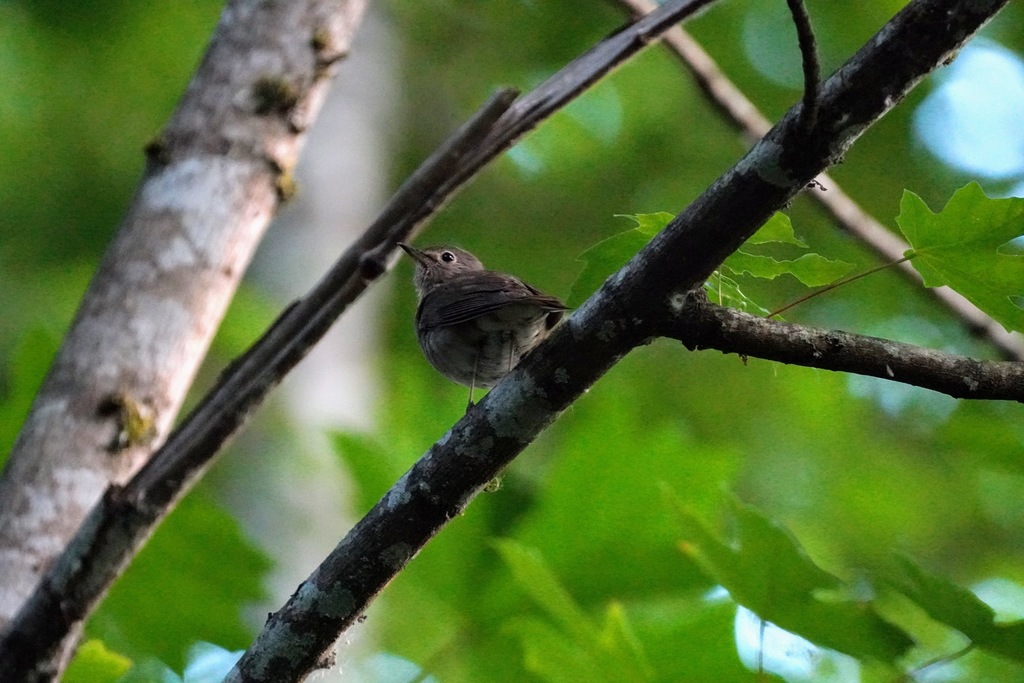
no rights reserved · CC0
Family: Turdidae · Class: Aves · Order: Passeriformes
Catharus ustulatus (Swainson's Thrush) is a California animal in the Turdidae family.
Swainson's Thrush is a medium-sized songbird measuring 16 to 20 cm (6.3 to 7.9 inches) in length with a wingspan of 28 to 31 cm (11 to 12.2 inches). Adults weigh 23 to 45 grams (0.8 to 1.6 ounces). The species displays olive-brown to russet-brown upperparts with distinctive buffy eye-rings and pale underparts marked by dark spots on the breast and throat. The tail is typically the same color as the back, distinguishing it from the closely related Hermit Thrush, which has a rufous tail. Two subspecies occur in North America: the Pacific coast form exhibits more rufous coloration, while the inland form appears more olive-brown. Swainson's Thrush breeds across a broad range from Alaska and northern Canada south through the western United States, including California's Sierra Nevada, Cascade Range, and coastal mountains. In California, breeding populations occur primarily in montane forests from Shasta County south to Tulare County, typically at elevations between 1,200 and 3,050 meters (4,000 to 10,000 feet). The species is a long-distance migrant, wintering from Mexico through Central America to South America. Breeding habitat consists of dense, moist coniferous and mixed forests with well-developed understory vegetation. The species shows strong preference for areas with dense shrub layers, fallen logs, and forest openings created by natural disturbance. Key habitat components include Douglas fir, white fir, red fir, and mixed conifer forests. During migration, Swainson's Thrush utilizes riparian corridors, oak woodlands, and urban parks with adequate cover. Swainson's Thrush feeds primarily on insects during the breeding season, including beetles, caterpillars, ants, flies, and moths, gleaning prey from foliage and the ground. Diet shifts to include substantial fruit consumption during migration and winter, particularly elderberries, blackberries, and other native berries. Breeding occurs from May through July, with females constructing cup-shaped nests 1 to 4 meters above ground in dense shrubs or low tree branches. Clutches typically contain 3 to 4 pale blue eggs with brown speckles. Incubation lasts 10 to 14 days, and nestlings fledge after 10 to 13 days. The species produces one brood per year in most areas. Swainson's Thrush is not federally or state listed in California and maintains stable populations across much of its range. The North American Breeding Bird Survey indicates relatively stable population trends from 1966 to 2019, though some regional declines have been documented. Climate change poses potential long-term threats through shifts in suitable breeding habitat to higher elevations and altered precipitation patterns affecting forest composition. Habitat loss from logging and development in low-elevation areas may impact migration stopover sites. The species benefits from forest management practices that maintain diverse age classes and understory complexity.
Classification
Class: Aves · Order: Passeriformes · Family: Turdidae
Frequently asked questions
How is Catharus ustulatus classified?
Catharus ustulatus belongs to class Aves, order Passeriformes, family Turdidae.
What family does Catharus ustulatus belong to?
Catharus ustulatus is in the Turdidae family.
What is Catharus ustulatus?
Swainson's Thrush is a medium-sized songbird measuring 16 to 20 cm (6.3 to 7.9 inches) in length with a wingspan of 28 to 31 cm (11 to 12.2 inches).
Is Catharus ustulatus found in California?
Yes. Catharus ustulatus is recorded in California in The California Species Project's catalogue.
Related species
Other California species in the same genus, family, or bioregion.
Data from The California Species Project — 14,000+ California species with verified data from CNPS, CDFW, USFWS, and more.