Catherpes mexicanus
Canyon Wren
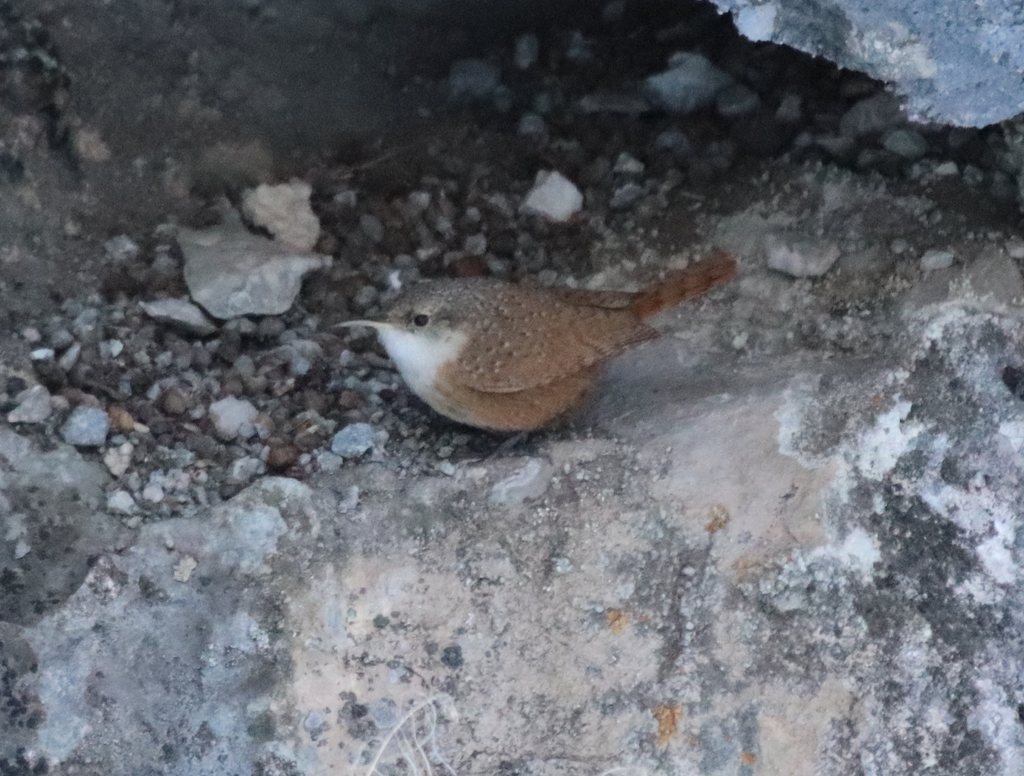
(c) Roland Godon, some rights reserved (CC BY) · licence
Family: Troglodytidae · Class: Aves · Order: Passeriformes
Catherpes mexicanus (Canyon Wren) is a California animal in the Troglodytidae family.
The Canyon Wren is a small, distinctive songbird measuring 12.5 to 14.5 centimeters (4.9 to 5.7 inches) in length with a wingspan of approximately 19 centimeters (7.5 inches). Adults weigh 9 to 18 grams. The species exhibits sexual dimorphism in size, with males being slightly larger than females. The bird's most striking feature is its bright white throat and upper breast, contrasting sharply with its rufous-brown back and wings. The head is grayish-brown with a long, slightly curved bill adapted for probing crevices. The belly displays fine barring of white and dark brown, while the tail is rusty-red with darker barring. Canyon Wrens inhabit western North America from southern British Columbia through Mexico. In California, the species occurs throughout much of the state except the Central Valley and coastal regions from San Francisco Bay northward. The range extends from the Oregon border south through the Sierra Nevada, Coast Ranges, Transverse Ranges, and Peninsular Ranges to the Mexican border. Populations are resident year-round, with some individuals making short-distance movements to lower elevations during winter. This species occupies rocky canyon walls, cliff faces, boulder fields, and steep rocky slopes from sea level to elevations of 3,400 meters (11,150 feet). Canyon Wrens show strong fidelity to areas with extensive vertical rock surfaces, including natural canyons, road cuts, quarries, and stone buildings. They require crevices and cavities for nesting and roosting, typically selecting sites in protected alcoves or deep fissures. Vegetation is generally sparse in occupied habitats, ranging from desert scrub to montane coniferous forests, with the primary requirement being suitable rock formations. Canyon Wrens are primarily insectivorous, foraging by gleaning arthropods from rock surfaces and probing crevices with their specialized bills. Their diet consists mainly of spiders, beetles, moths, ants, and other small invertebrates. The species is known for its distinctive cascading song, a series of descending whistled notes that echo through canyon environments. Breeding occurs from March through July, with pairs constructing cup-shaped nests of twigs, bark strips, and other plant materials in rock crevices. Females lay 3 to 6 white eggs spotted with brown, which are incubated for 12 to 18 days. Young fledge after 12 to 17 days in the nest. Canyon Wrens typically raise one to two broods per year, depending on environmental conditions. Canyon Wrens are not federally listed and maintain stable populations across most of their range as of December 2025. The species benefits from its specialized habitat requirements, which have remained relatively undisturbed compared to other ecosystem types. However, local populations may face threats from rock quarrying, urban development in canyon areas, and recreational climbing activities that disturb nesting sites. Climate change could potentially affect insect prey availability and alter suitable habitat at elevational extremes. The species' secretive nature and remote habitat preferences make population monitoring challenging, but Christmas Bird Count data suggest populations remain generally stable throughout California.
Classification
Class: Aves · Order: Passeriformes · Family: Troglodytidae
Frequently asked questions
How is Catherpes mexicanus classified?
Catherpes mexicanus belongs to class Aves, order Passeriformes, family Troglodytidae.
What family does Catherpes mexicanus belong to?
Catherpes mexicanus is in the Troglodytidae family.
What is Catherpes mexicanus?
The Canyon Wren is a small, distinctive songbird measuring 12.5 to 14.5 centimeters (4.9 to 5.7 inches) in length with a wingspan of approximately 19 centimeters (7.5 inches).
Is Catherpes mexicanus found in California?
Yes. Catherpes mexicanus is recorded in California in The California Species Project's catalogue.
Related species
Other California species in the same genus, family, or bioregion.
Data from The California Species Project — 14,000+ California species with verified data from CNPS, CDFW, USFWS, and more.