Catocala aholibah
Aholibah Underwing Moth
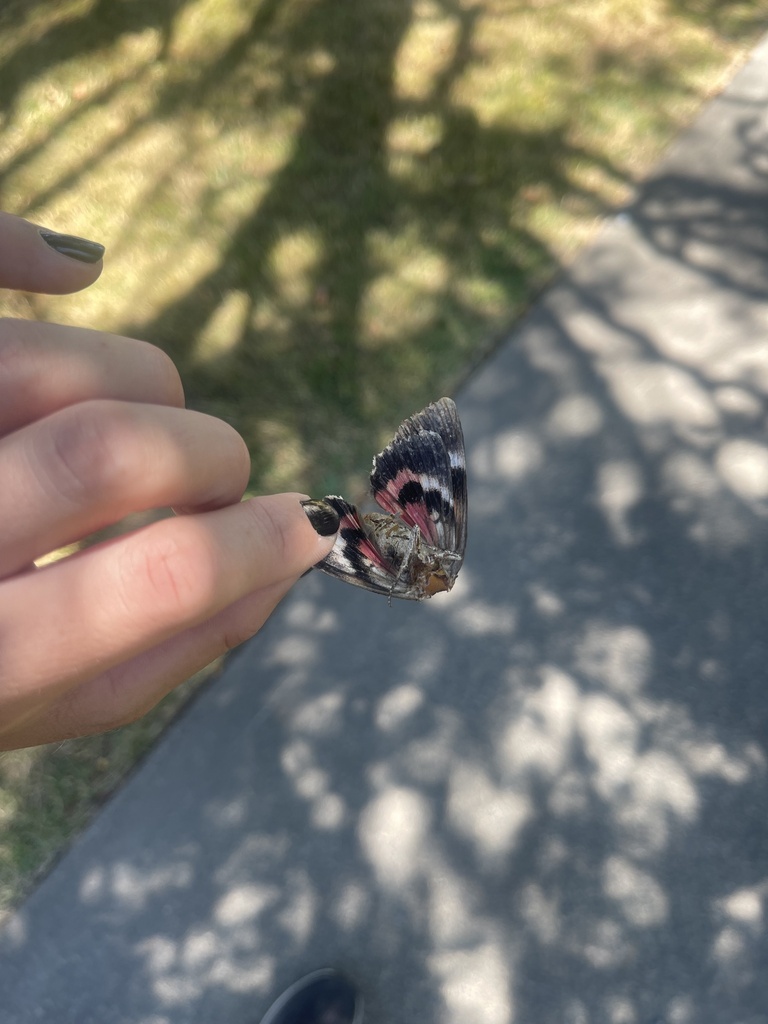
(c) Jenny Kirkpatrick, some rights reserved (CC BY) · licence
Family: Erebidae · Class: Insecta · Order: Lepidoptera
Catocala aholibah (Aholibah Underwing Moth) is a California animal in the Erebidae family.
The Aholibah Underwing Moth (Catocala aholibah) is a large nocturnal moth in the family Erebidae, subfamily Erebinae. Adults have a wingspan ranging from 50 to 75 millimeters (2.0 to 3.0 inches), with forewings displaying cryptic patterns of gray, brown, and white that provide camouflage against tree bark. The hindwings are typically bright orange-red with black bands, characteristic of the underwing moth group. When at rest, the forewings conceal the colorful hindwings, but when disturbed, the moth flashes the bright hindwings as a startle defense mechanism. Catocala aholibah occurs primarily in western North America, with populations documented in California, Oregon, Nevada, and Arizona. In California, the species is found in oak woodlands and mixed oak forests throughout much of the state, from coastal regions to interior valleys and foothills. The moth's distribution closely follows that of its oak host plants, extending from sea level to approximately 1,500 meters (4,900 feet) elevation. The species inhabits oak woodlands and mixed hardwood forests dominated by various oak species. Adults are typically found in areas with mature oak trees that provide both larval host plants and suitable microhabitats for daytime roosting. The moths prefer areas with relatively open canopy structure that allows for flight activity during evening and nighttime hours. Larvae feed exclusively on oak species (Quercus), including coast live oak (Q. agrifolia), white oak (Q. alba), Gambel oak (Q. gambelii), and Oregon white oak (Q. garryana). Caterpillars are nocturnal feeders that consume oak leaves, developing through five to six instars before pupating in soil litter or bark crevices. Adult moths are active from late spring through early fall, with peak flight activity typically occurring in summer months. Adults do not feed extensively but may visit tree sap, rotting fruit, or artificial light sources. Mating occurs during nighttime hours, with females depositing eggs on bark or near buds of host oak trees. The species exhibits univoltine life cycle in most locations, producing one generation per year. Eggs overwinter and hatch in spring when oak leaves emerge. The larval stage extends through late spring and summer, with pupation occurring in late summer or early fall. Currently, Catocala aholibah has no federal or state conservation listing status. Population trends are not well documented, but the species appears stable across much of its range where suitable oak habitat persists. Primary threats may include habitat loss from urban development, oak woodland conversion, and wildfire effects on oak ecosystems. Climate change could potentially affect the species through impacts on oak host plant phenology and distribution. The moth's dependence on oak woodlands makes it vulnerable to large-scale habitat modifications, though its relatively broad host plant range among oak species provides some ecological flexibility.
Classification
Class: Insecta · Order: Lepidoptera · Family: Erebidae
Frequently asked questions
How is Catocala aholibah classified?
Catocala aholibah belongs to class Insecta, order Lepidoptera, family Erebidae.
What family does Catocala aholibah belong to?
Catocala aholibah is in the Erebidae family.
What is Catocala aholibah?
The Aholibah Underwing Moth (Catocala aholibah) is a large nocturnal moth in the family Erebidae, subfamily Erebinae.
Is Catocala aholibah found in California?
Yes. Catocala aholibah is recorded in California in The California Species Project's catalogue.
Related species
Other California species in the same genus, family, or bioregion.
Data from The California Species Project — 14,000+ California species with verified data from CNPS, CDFW, USFWS, and more.