Catocala piatrix
The Penitent Underwing
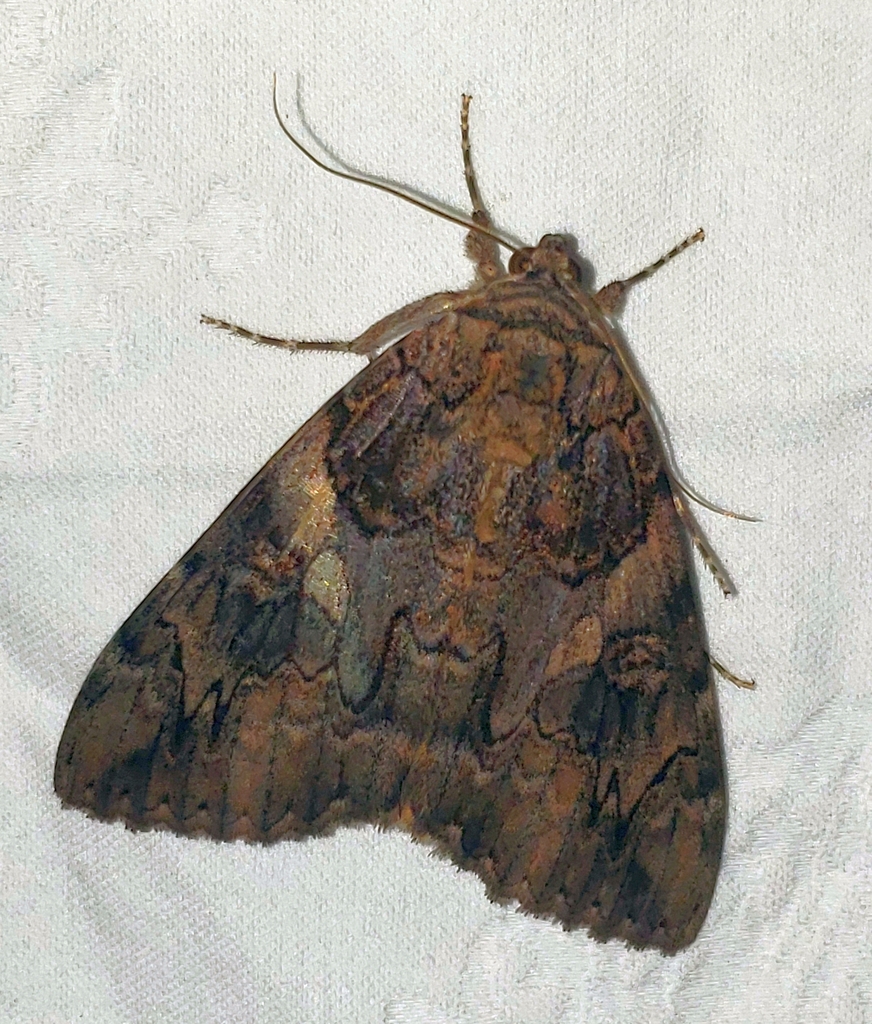
no rights reserved · CC0
Family: Erebidae · Class: Insecta · Order: Lepidoptera
Catocala piatrix (The Penitent Underwing) is a California animal in the Erebidae family.
The Penitent Underwing (Catocala piatrix) is a large noctuid moth belonging to the subfamily Erebinae. Adults have forewings ranging from 40 to 55 mm (1.6 to 2.2 inches) in length, with wingspans reaching 90 to 110 mm (3.5 to 4.3 inches). The forewings are cryptically patterned in mottled gray-brown tones with darker transverse lines and subtle whitish markings that provide effective camouflage against tree bark. The hindwings display the characteristic underwing pattern of bright orange-red bands bordered by black, which are concealed when at rest but flash conspicuously when the moth takes flight. Males possess feathered antennae, while female antennae are thread-like. The species occurs across a broad range from Maine to Florida, extending westward through southern Ontario to South Dakota and Texas. This extensive distribution encompasses much of eastern North America, with populations documented in deciduous and mixed forests throughout the region. The moth's range overlaps significantly with the distribution of its primary host plants, suggesting a close ecological relationship with specific tree species. Penitent Underwings inhabit mature deciduous forests and woodland edges where their host plants are abundant. The species utilizes ash, butternut, hickory, pecan, persimmon, and walnut trees as larval food sources. Adults are typically found in areas with dense canopy cover during daylight hours, seeking shelter on tree trunks where their cryptic coloration provides protection from predators. The moths prefer habitats with diverse tree species composition and are often associated with riparian areas and floodplain forests where walnut and ash species are common. Adults are nocturnal and emerge during late summer and early fall, typically from July through September. Females deposit eggs singly or in small clusters on host tree bark, where they overwinter. Larvae hatch in spring and feed on emerging leaves, developing through five instars before pupating in late spring or early summer. The caterpillars are gray-brown with subtle striping and reach lengths of 60 to 70 mm (2.4 to 2.8 inches) when mature. Adults are attracted to artificial lights and sugar baits, behaviors that facilitate both mating encounters and dispersal. Males locate females through chemical communication using pheromones released by females during evening hours. The Penitent Underwing is not federally listed or considered a species of conservation concern. However, like many forest-dependent Lepidoptera, populations may face pressure from habitat fragmentation and loss of mature deciduous forests. The emerald ash borer (Agrilus planipennis), an invasive beetle that has killed millions of ash trees across North America since 2002, potentially threatens populations dependent on ash species as host plants. Forest management practices that maintain diverse tree species composition and preserve mature woodland habitats support stable populations of this and other underwing moths throughout their range.
Classification
Class: Insecta · Order: Lepidoptera · Family: Erebidae
Frequently asked questions
How is Catocala piatrix classified?
Catocala piatrix belongs to class Insecta, order Lepidoptera, family Erebidae.
What family does Catocala piatrix belong to?
Catocala piatrix is in the Erebidae family.
What is Catocala piatrix?
The Penitent Underwing (Catocala piatrix) is a large noctuid moth belonging to the subfamily Erebinae.
Is Catocala piatrix found in California?
Yes. Catocala piatrix is recorded in California in The California Species Project's catalogue.
Related species
Other California species in the same genus, family, or bioregion.
Data from The California Species Project — 14,000+ California species with verified data from CNPS, CDFW, USFWS, and more.