Catocala semirelicta
Semirelict Underwing
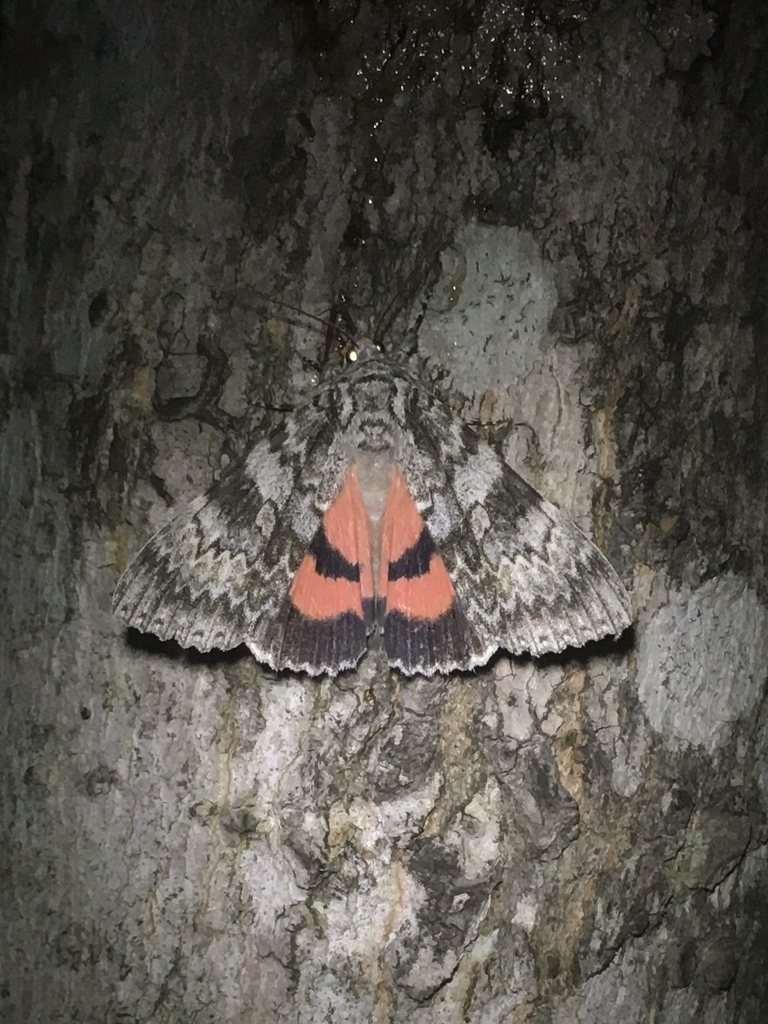
(c) brendanboyd, some rights reserved (CC BY) · licence
Family: Erebidae · Class: Insecta · Order: Lepidoptera
Catocala semirelicta (Semirelict Underwing) is a California animal in the Erebidae family.
The Semirelict Underwing (Catocala semirelicta) is a large moth in the family Erebidae, subfamily Erebinae. Adults exhibit a wingspan of 70-85 mm (2.8-3.3 inches), with forewings displaying cryptic gray-brown coloration marked by intricate wavy lines and patterns that provide camouflage against tree bark. The hindwings are bright orange-red with distinctive black bands, characteristic of underwing moths. When at rest, the forewings conceal the colorful hindwings, but when disturbed, the moth flashes the bright underwings to startle potential predators. The species name 'semirelicta' reflects its distribution pattern as a remnant of a once more widespread range. The Semirelict Underwing occurs across a boreal distribution from Nova Scotia and Maine westward across Canada, extending south into northern Michigan. This range represents the northern tier of North America, primarily within the boreal forest region. The species appears to be restricted to cooler climates and has not been recorded from California or other western states, despite the presence of suitable host plants in those regions. This moth inhabits deciduous and mixed forests where its host plants occur. The species is associated with areas containing poplars (Populus species) and willows (Salix species), which serve as larval food sources. Adults are typically found in mature forest environments with established poplar and willow stands, often near wetlands or riparian areas where these trees naturally occur. The species appears to prefer cooler, northern forest habitats rather than warmer temperate regions. Semirelict Underwing moths are nocturnal and attracted to artificial lights. Adults emerge in late summer, typically from July through September, with peak activity in August. Females deposit eggs on bark of host trees, where they overwinter. Larvae hatch in spring and feed on poplar and willow foliage, developing through several instars before pupating in soil or leaf litter. The caterpillars are well-camouflaged stick mimics, remaining motionless along branches during daylight hours. Adults feed on tree sap, rotting fruit, and may visit flowers for nectar. The conservation status of Catocala semirelicta has not been formally assessed by federal or state agencies, and it currently lacks any special conservation designations. Population trends are largely unknown due to limited systematic monitoring of underwing moths. The species may face threats from forest management practices that reduce mature poplar and willow stands, particularly in riparian areas. Climate change could potentially impact the species by altering the distribution of suitable boreal forest habitat northward. Like many moths, the Semirelict Underwing may be susceptible to artificial light pollution, which can disrupt normal behavioral patterns. Conservation efforts would benefit from surveys to better understand current distribution and population status across its range.
Classification
Class: Insecta · Order: Lepidoptera · Family: Erebidae
Frequently asked questions
How is Catocala semirelicta classified?
Catocala semirelicta belongs to class Insecta, order Lepidoptera, family Erebidae.
What family does Catocala semirelicta belong to?
Catocala semirelicta is in the Erebidae family.
What is Catocala semirelicta?
The Semirelict Underwing (Catocala semirelicta) is a large moth in the family Erebidae, subfamily Erebinae.
Is Catocala semirelicta found in California?
Yes. Catocala semirelicta is recorded in California in The California Species Project's catalogue.
Related species
Other California species in the same genus, family, or bioregion.
Data from The California Species Project — 14,000+ California species with verified data from CNPS, CDFW, USFWS, and more.