Catostomus santaanae
Santa Ana sucker
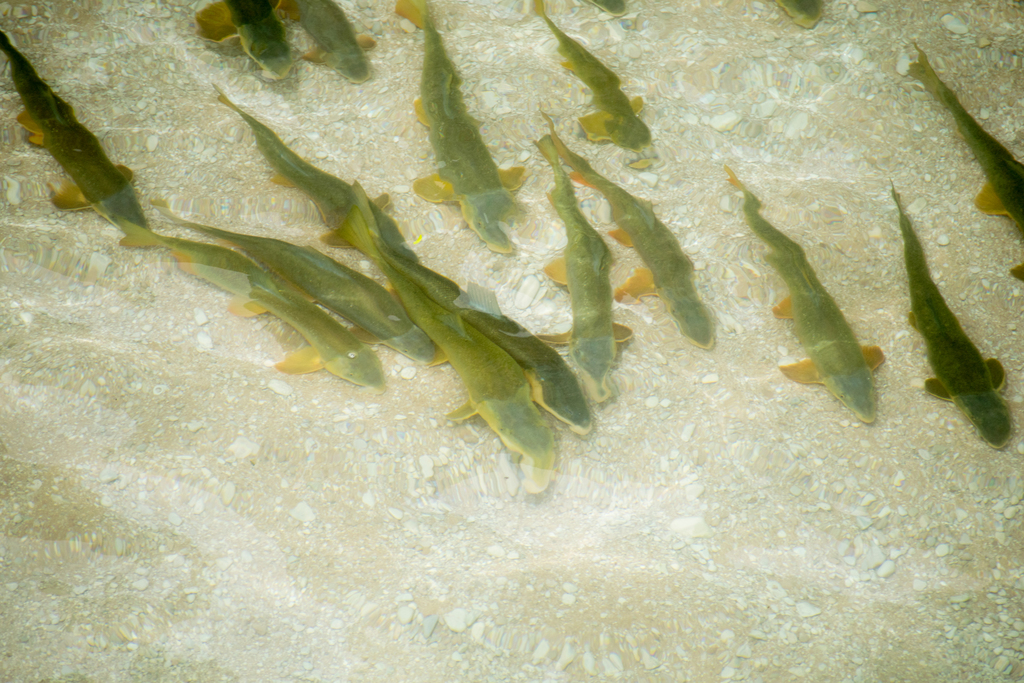
(c) Boris Grozev, some rights reserved (CC BY) · licence
Family: Catostomidae · Class: Actinopterygii · Order: Cypriniformes
Conservation status: Threatened · G1 S1
Catostomus santaanae (Santa Ana sucker) is a California animal in the Catostomidae family.
The Santa Ana sucker is a small freshwater fish endemic to three river basins in southern California. Adults typically measure 100 to 200 mm (4 to 8 inches) in total length, with a maximum recorded length of 250 mm (10 inches). The body is cylindrical and elongated, with a subterminal mouth positioned on the underside of the head for bottom feeding. Coloration varies from olive-brown to dark gray dorsally, fading to yellowish-white ventrally. The species exhibits typical catostomid characteristics including thick, fleshy lips and pharyngeal teeth adapted for scraping algae and detritus from substrate surfaces. Historically, Santa Ana sucker populations occupied the Los Angeles, San Gabriel, and Santa Ana River basins in Los Angeles, Orange, Riverside, and San Bernardino counties. According to the California Department of Fish and Wildlife, populations currently persist in portions of all three river basins, though distribution has been severely fragmented. The species now occupies approximately 56 kilometers of stream habitat, representing less than 10 percent of its historical range. Current populations are restricted to upstream reaches that maintain suitable habitat conditions and water quality. Santa Ana suckers inhabit cool, clear streams and rivers with rocky or gravel substrates. The species requires flowing water with depths ranging from 0.3 to 1.5 meters and temperatures below 22 degrees Celsius (72 degrees Fahrenheit). Suitable habitat includes pools, runs, and riffles with adequate cover provided by boulders, undercut banks, or overhanging vegetation. Elevation range extends from near sea level to approximately 670 meters (2,200 feet). The species demonstrates strong site fidelity, with individuals often remaining within specific stream reaches throughout their lives. Santa Ana suckers are benthic omnivores, feeding primarily on algae, diatoms, organic detritus, and aquatic invertebrates scraped from rock and gravel surfaces. Spawning occurs from March through August, with peak activity during April and May when water temperatures reach 15 to 18 degrees Celsius (59 to 64 degrees Fahrenheit). Females broadcast adhesive eggs over gravel substrates in shallow riffles, with clutch sizes ranging from 1,000 to 4,000 eggs. Sexual maturity is typically reached at 2 to 3 years of age, and maximum lifespan approaches 8 years. The U.S. Fish and Wildlife Service listed the Santa Ana sucker as threatened under the Endangered Species Act in 2000. Population surveys conducted in 2019 estimated fewer than 2,500 adult individuals across all three river basins. Primary threats include habitat modification through channelization and dam construction, water diversions that reduce streamflow, degraded water quality from urban runoff, and competition with non-native fish species. Climate change poses additional challenges through increased temperatures and altered precipitation patterns. Recovery efforts focus on habitat restoration, water quality improvement, and invasive species management. Critical habitat was designated in 2005, encompassing 599 kilometers of stream reaches across the three river basins.
Classification
Class: Actinopterygii · Order: Cypriniformes · Family: Catostomidae
Conservation status
Threatened · G1 S1
Frequently asked questions
How is Catostomus santaanae classified?
Catostomus santaanae belongs to class Actinopterygii, order Cypriniformes, family Catostomidae.
What family does Catostomus santaanae belong to?
Catostomus santaanae is in the Catostomidae family.
Is Catostomus santaanae protected or of conservation concern?
Catostomus santaanae carries the following status: Threatened · G1 S1.
What is Catostomus santaanae?
The Santa Ana sucker is a small freshwater fish endemic to three river basins in southern California.
Is Catostomus santaanae found in California?
Yes. Catostomus santaanae is recorded in California in The California Species Project's catalogue.
Related species
Other California species in the same genus, family, or bioregion.
Data from The California Species Project — 14,000+ California species with verified data from CNPS, CDFW, USFWS, and more.