Celastrina echo
Echo Azure
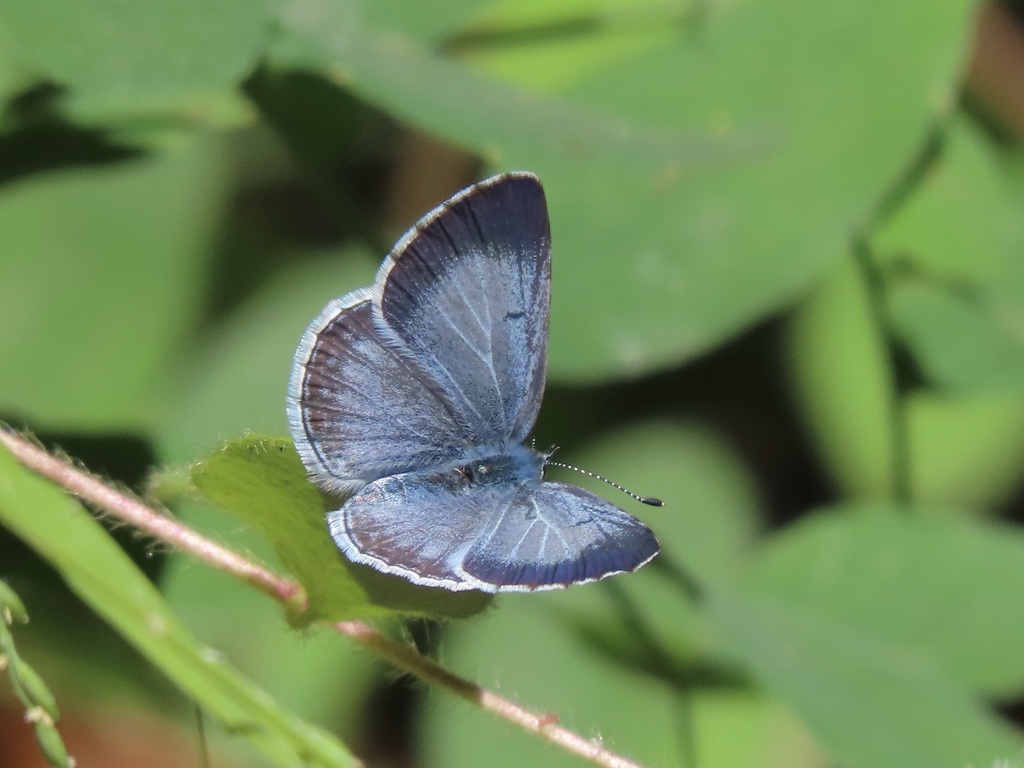
(c) John Hibbard, some rights reserved (CC BY) · licence
Family: Lycaenidae · Class: Insecta · Order: Lepidoptera
Celastrina echo (Echo Azure) is a California animal in the Lycaenidae family.
The Echo Azure is a small butterfly in the family Lycaenidae, subfamily Polyommatinae. Adults have a wingspan measuring 18 to 25 mm (0.7 to 1.0 inches). Males display bright blue dorsal wing surfaces with narrow black wing borders, while females are typically brownish-blue with broader dark margins and orange spots near the wing edges. The ventral surfaces of both sexes are pale gray to white with small dark spots arranged in irregular patterns. The Echo Azure can be distinguished from similar azure species by its specific wing pattern and the arrangement of spots on the undersides of the wings. The Echo Azure ranges from southern British Columbia south along the Pacific Coast states to Baja California Norte, Mexico. The distribution includes the Carson Range in Nevada, just east of Lake Tahoe. In California, populations occur in suitable habitat throughout much of the state, from coastal regions to montane areas. The species demonstrates a relatively broad latitudinal distribution along the western North American coast, spanning approximately 2,000 kilometers from Canada to Mexico. This species inhabits diverse ecosystems including chaparral, oak woodlands, riparian areas, and mixed coniferous forests. Echo Azures are found from sea level to elevations exceeding 2,100 meters (6,900 feet) in mountainous regions. Adults frequent areas with abundant flowering plants for nectar sources, particularly favoring sunny openings and edges within forested habitats. The species shows a preference for areas with moderate moisture levels and partial shade. Echo Azure larvae feed on various host plants including wild lilacs (Ceanothus species), California buckeye (Aesculus californica), blackberries (Rubus species), and several other shrubs and trees. The caterpillars are typically green with short setae and feed on flower buds, flowers, and young fruits of their host plants. Adults are active during daylight hours and males engage in territorial behavior, perching on shrubs and chasing intruders. The flight period varies by location and elevation but generally occurs from March through September, with peak activity in late spring and early summer. Multiple broods per year are typical in warmer regions. The Echo Azure is not currently listed under federal or state endangered species acts. The species maintains stable populations across much of its range, benefiting from its ability to utilize multiple host plant species and diverse habitat types. However, localized populations may face pressure from habitat loss due to urban development, particularly in coastal California regions. Fire management practices and climate change may affect some populations, especially those at higher elevations or in fire-prone areas. The species' broad ecological tolerance and extensive distribution provide resilience against many environmental threats, though continued monitoring of population trends would be valuable for long-term conservation assessment.
Classification
Class: Insecta · Order: Lepidoptera · Family: Lycaenidae
Frequently asked questions
How is Celastrina echo classified?
Celastrina echo belongs to class Insecta, order Lepidoptera, family Lycaenidae.
What family does Celastrina echo belong to?
Celastrina echo is in the Lycaenidae family.
What is Celastrina echo?
The Echo Azure is a small butterfly in the family Lycaenidae, subfamily Polyommatinae.
Is Celastrina echo found in California?
Yes. Celastrina echo is recorded in California in The California Species Project's catalogue.
Related species
Other California species in the same genus, family, or bioregion.
Data from The California Species Project — 14,000+ California species with verified data from CNPS, CDFW, USFWS, and more.