Centrocercus urophasianus
Greater sage- grouse
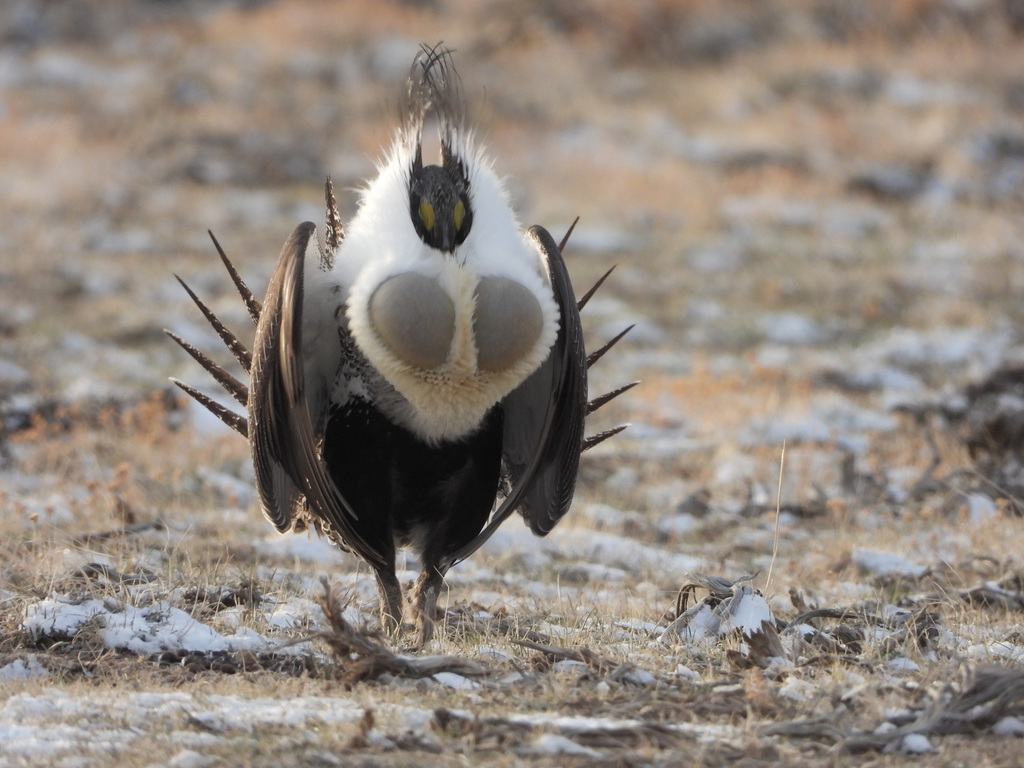
(c) Jared Shorma, some rights reserved (CC BY) · licence
Family: Phasianidae · Class: Aves · Order: Galliformes
Conservation status: Proposed Threatened · G3G4 S2S3
Centrocercus urophasianus (Greater sage- grouse) is a California animal in the Phasianidae family.
The greater sage-grouse is the largest grouse species in North America, with males weighing 2 to 3 kilograms (4.4 to 6.6 pounds) and measuring 65 to 75 centimeters (26 to 30 inches) in length. Females are smaller, weighing 1.2 to 1.8 kilograms (2.6 to 4.0 pounds). Males display distinctive features including inflatable yellow air sacs on the neck, a spiky tail that fans upward during courtship, and mottled brown and gray plumage with white breast patches. Females are more uniformly mottled brown and gray, providing camouflage during nesting. Both sexes have feathered legs and feet adapted for walking on snow. In California, greater sage-grouse are restricted to the Bi-State Distinct Population Segment, which occurs in the Mono Basin region spanning California and Nevada. According to the California Department of Fish and Wildlife, this population is found in Mono, Alpine, and Inyo counties. The species historically occupied approximately 1.2 million square kilometers across western North America but has experienced range contraction of roughly 56 percent since European settlement. Greater sage-grouse require large expanses of sagebrush habitat, particularly big sagebrush (Artemisia tridentata) ecosystems. They inhabit areas with 15 to 25 percent sagebrush canopy cover and an understory of native grasses and forbs. Breeding areas, called leks, are typically located on ridgetops or in open areas within sagebrush habitat. Nesting occurs under sagebrush shrubs that provide overhead cover of 15 to 25 percent. Winter habitat requires taller sagebrush stands that extend above snow cover, allowing access to foliage. Greater sage-grouse are primarily herbivorous, with sagebrush comprising 60 to 80 percent of their adult diet year-round. During spring and summer, they supplement with forbs, grasses, and insects. Chicks require a diet high in insects and forbs during their first few weeks. Males gather at traditional lek sites from March through May to perform elaborate courtship displays, producing distinctive popping sounds with their air sacs. Females typically lay 6 to 9 eggs in ground nests and incubate them for 25 to 27 days. The species exhibits high site fidelity, with birds often returning to the same seasonal habitats annually. The U.S. Fish and Wildlife Service proposed listing the Bi-State Distinct Population Segment as threatened under the Endangered Species Act in 2013, with the proposal remaining active as of December 2025. California lists the species as a candidate for state protection. The Bi-State population consists of approximately 3,000 to 5,000 individuals across six subpopulations. Primary threats include habitat loss and fragmentation from energy development, livestock grazing, invasive annual grasses, wildfire, and climate change. Pinyon and juniper encroachment into sagebrush habitats reduces habitat quality. Conservation efforts include habitat restoration, fire management, and collaborative partnerships between agencies and private landowners to maintain connected sagebrush landscapes.
Classification
Class: Aves · Order: Galliformes · Family: Phasianidae
Conservation status
Proposed Threatened · G3G4 S2S3
Frequently asked questions
How is Centrocercus urophasianus classified?
Centrocercus urophasianus belongs to class Aves, order Galliformes, family Phasianidae.
What family does Centrocercus urophasianus belong to?
Centrocercus urophasianus is in the Phasianidae family.
Is Centrocercus urophasianus protected or of conservation concern?
Centrocercus urophasianus carries the following status: Proposed Threatened · G3G4 S2S3.
What is Centrocercus urophasianus?
The greater sage-grouse is the largest grouse species in North America, with males weighing 2 to 3 kilograms (4.4 to 6.6 pounds) and measuring 65 to 75 centimeters (26 to 30 inches) in length.
Is Centrocercus urophasianus found in California?
Yes. Centrocercus urophasianus is recorded in California in The California Species Project's catalogue.
Related species
Other California species in the same genus, family, or bioregion.
Data from The California Species Project — 14,000+ California species with verified data from CNPS, CDFW, USFWS, and more.