Centrodera spurca
Yellow Douglas-fir Borer
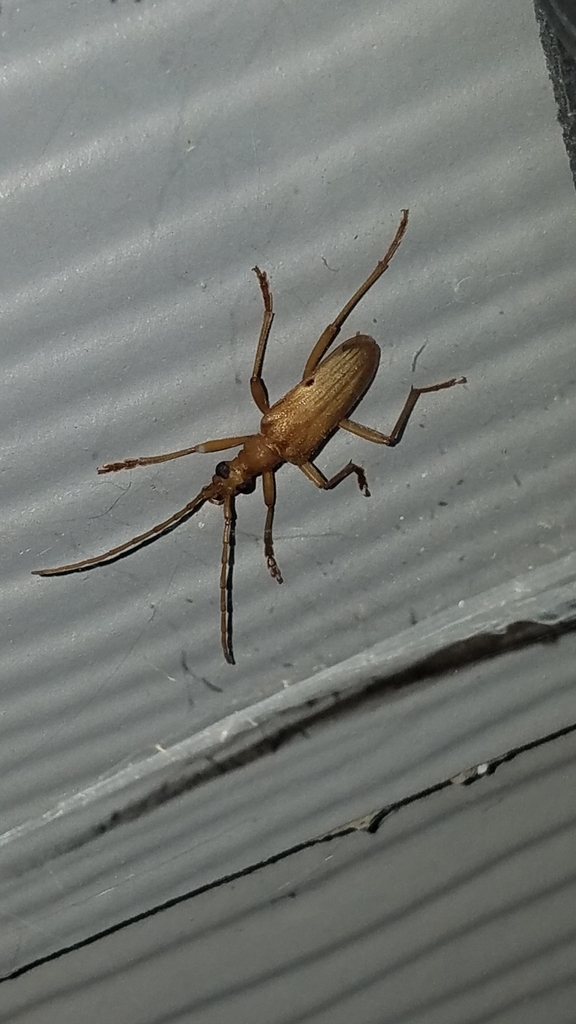
(c) RJ Baltierra, some rights reserved (CC BY) · licence
Family: Cerambycidae · Class: Insecta · Order: Coleoptera
Centrodera spurca (Yellow Douglas-fir Borer) is a California animal in the Cerambycidae family.
The Yellow Douglas-fir Borer is a medium-sized longhorn beetle in the family Cerambycidae, subfamily Lepturinae. Adults typically measure 20 to 25 mm (0.8 to 1.0 inches) in length, with a robust, elongated body characteristic of flower longhorn beetles. The elytra display a yellowish-brown coloration, often with variable dark markings or spots laterally, though some individuals may lack these distinctive markings entirely (BugGuide observations). Centrodera spurca occurs along the Pacific Coast from California through Oregon and into Washington. In California, the species has been documented in coastal and foothill regions, with confirmed records from San Benito County and other areas of the central coast. The species extends northward through Oregon, where it is considered relatively common, particularly in areas with suitable host trees (BugGuide 2025). This beetle inhabits mixed coniferous forests, oak woodlands, and chaparral communities where Douglas-fir and associated tree species are present. Documented elevations range from near sea level to mid-elevation montane zones. Adults have been observed in live oak and chaparral habitat, suggesting the species utilizes diverse forest types within its range. The larvae develop as wood borers in dead or dying coniferous trees, particularly Douglas-fir, which provides the primary larval host substrate. Adults are attracted to artificial lights and may be encountered at black light traps during their active period, which includes at least June through July based on collection records (BugGuide 2011). Like other longhorn beetles, the larvae bore through wood, creating galleries as they feed and develop. The complete life cycle likely requires one to two years, though specific developmental timing has not been well documented. Adults are presumed to feed on flowers and pollen, consistent with other flower longhorn beetles in the subfamily Lepturinae. Centrodera spurca does not currently hold federal or state conservation status in California. The species appears to maintain stable populations throughout much of its range, with regular observations reported from Oregon and California. However, like many forest-dependent insects, the Yellow Douglas-fir Borer could potentially face habitat pressures from logging, wildfire, and forest management practices that remove dead wood essential for larval development. The species' dependence on Douglas-fir and other coniferous trees makes it vulnerable to large-scale forest disturbances, though its apparent adaptability to various forest types may provide some resilience. Detailed ecological studies of this species remain limited. The information presented here synthesizes available observations from taxonomic databases and community science reports. More research is needed to fully understand the species' host plant relationships, developmental biology, and population trends across its geographic range.
Classification
Class: Insecta · Order: Coleoptera · Family: Cerambycidae
Frequently asked questions
How is Centrodera spurca classified?
Centrodera spurca belongs to class Insecta, order Coleoptera, family Cerambycidae.
What family does Centrodera spurca belong to?
Centrodera spurca is in the Cerambycidae family.
What is Centrodera spurca?
The Yellow Douglas-fir Borer is a medium-sized longhorn beetle in the family Cerambycidae, subfamily Lepturinae.
Is Centrodera spurca found in California?
Yes. Centrodera spurca is recorded in California in The California Species Project's catalogue.
Related species
Other California species in the same genus, family, or bioregion.
Data from The California Species Project — 14,000+ California species with verified data from CNPS, CDFW, USFWS, and more.