Cepphus columba
Pigeon Guillemot
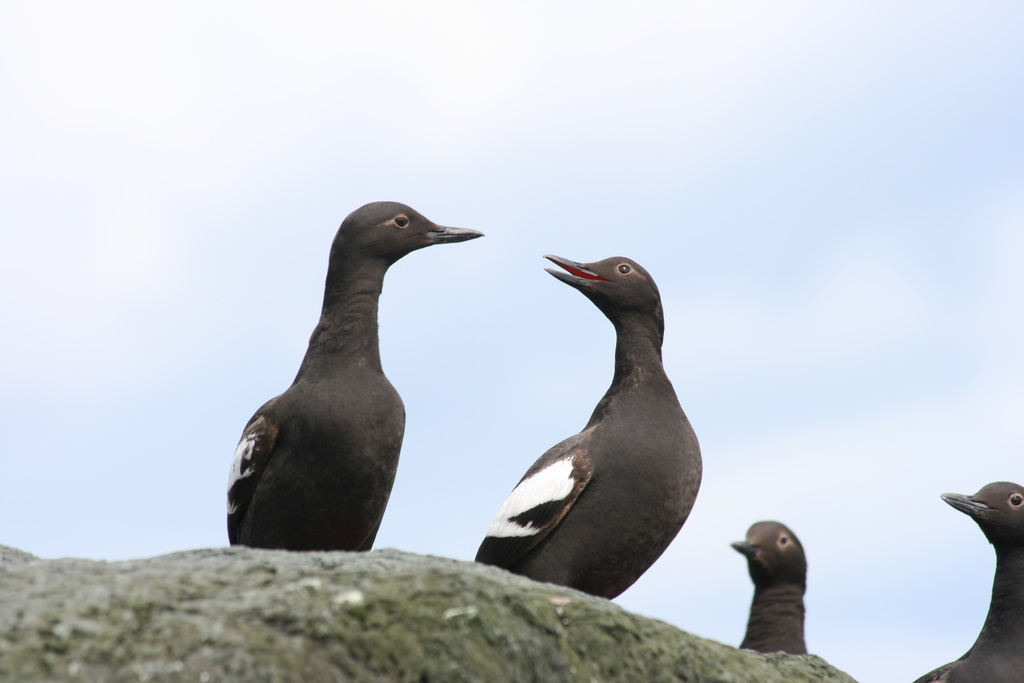
no rights reserved · CC0
Family: Alcidae · Class: Aves · Order: Charadriiformes
Cepphus columba (Pigeon Guillemot) is a California animal in the Alcidae family.
The Pigeon Guillemot is a medium-sized seabird of the auk family, measuring 30 to 37 centimeters (12 to 14.5 inches) in length with a wingspan of 58 to 63 centimeters (23 to 25 inches). Adults weigh between 450 and 550 grams (16 to 19 ounces). During breeding season, adults display distinctive black plumage with prominent white wing patches that form a distinctive oval shape, visible both in flight and at rest. The legs and feet are bright red-orange, and the interior of the mouth is similarly colored. In winter, the plumage becomes mottled gray and white on the head and underparts while retaining the characteristic white wing patches. Juveniles resemble winter adults but with more brownish tones. Pigeon Guillemots inhabit the rocky coastlines and nearshore waters of the North Pacific. In California, they breed along the entire coast from the Oregon border south to the Channel Islands, with concentrations at the Farallon Islands, Point Reyes, Monterey Bay, and the northern Channel Islands including Anacapa and Santa Cruz Islands. The species also occurs along the coasts of Oregon, Washington, British Columbia, Alaska, and across the North Pacific to Japan and Russia. California represents the southern extent of their breeding range along the eastern Pacific. This species requires rocky coastal habitat with suitable crevices and cavities for nesting. Breeding colonies are established on sea cliffs, rocky offshore islands, and occasionally on artificial structures such as jetties and breakwaters. Nests are typically placed in rock crevices, under boulders, or in caves, usually within 30 meters (100 feet) of the high tide line. Foraging occurs in nearshore waters, generally within 2 kilometers (1.2 miles) of shore and at depths less than 45 meters (150 feet). Pigeon Guillemots are pursuit divers, using their wings to propel themselves underwater while hunting for small fish, particularly sculpins, cod, herring, and rockfish. They also consume marine invertebrates including crustaceans and polychaete worms. Breeding occurs from May through August, with pairs typically laying one to two eggs in rocky crevices. Both parents incubate eggs for 28 to 32 days and feed chicks for approximately 35 to 40 days until fledging. Unlike many alcids, Pigeon Guillemots do not migrate long distances, instead remaining near breeding areas year-round or moving only short distances along the coast. The Pigeon Guillemot is not federally listed and is considered stable across most of its range. However, the species faces threats from oil spills, marine pollution, disturbance at nesting colonies, and predation by introduced mammals on nesting islands. Climate change may affect prey availability and distribution. In California, breeding populations are monitored at several locations, with the Farallon Islands supporting one of the largest colonies. Conservation efforts focus on protecting nesting habitat and managing human disturbance at breeding sites.
Classification
Class: Aves · Order: Charadriiformes · Family: Alcidae
Frequently asked questions
How is Cepphus columba classified?
Cepphus columba belongs to class Aves, order Charadriiformes, family Alcidae.
What family does Cepphus columba belong to?
Cepphus columba is in the Alcidae family.
What is Cepphus columba?
The Pigeon Guillemot is a medium-sized seabird of the auk family, measuring 30 to 37 centimeters (12 to 14.5 inches) in length with a wingspan of 58 to 63 centimeters (23 to 25 inches).
Is Cepphus columba found in California?
Yes. Cepphus columba is recorded in California in The California Species Project's catalogue.
Related species
Other California species in the same genus, family, or bioregion.
Data from The California Species Project — 14,000+ California species with verified data from CNPS, CDFW, USFWS, and more.