Ceratochrysis gracilis
Piute Mountains Cuckoo Wasp
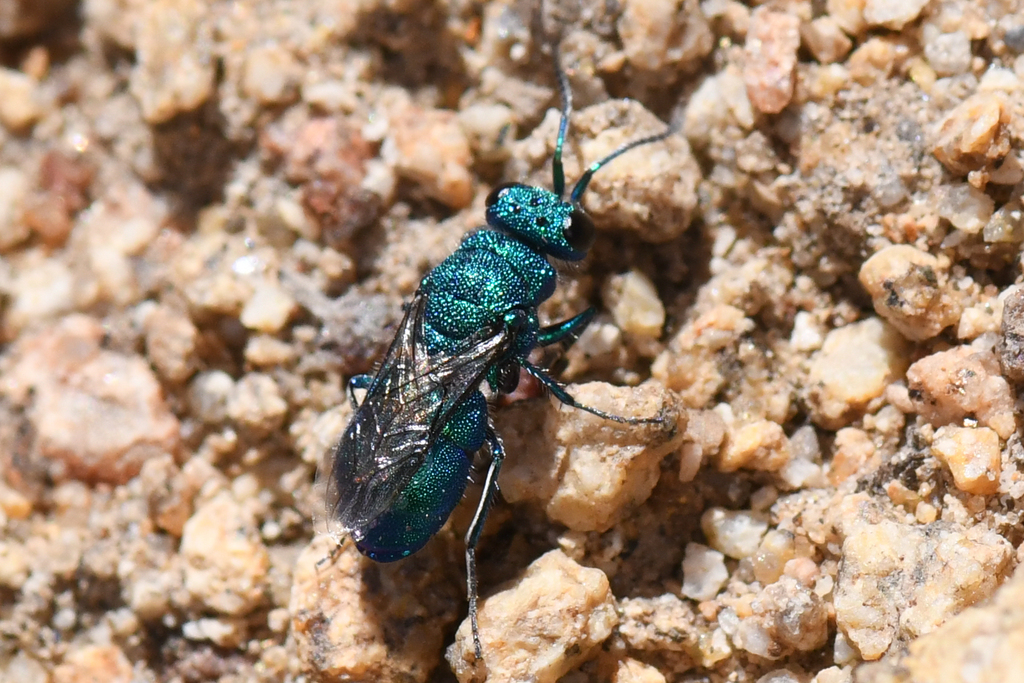
(c) Trevor Van Loon, some rights reserved (CC BY) · licence
Family: Chrysididae · Class: Insecta · Order: Hymenoptera
Conservation status: G1 S1
Ceratochrysis gracilis (Piute Mountains Cuckoo Wasp) is a California animal in the Chrysididae family.
Ceratochrysis gracilis, commonly known as the Piute Mountains Cuckoo Wasp, is a member of the Chrysididae family, distinguished by the metallic coloration typical of cuckoo wasps. Like other species in this family, it likely displays iridescent green, blue, or bronze hues on its exoskeleton, though specific morphological details for this species remain poorly documented in the scientific literature. Adult cuckoo wasps typically measure 3-12 mm in length, with a compact, robust body structure adapted for their parasitoid lifestyle. This species is endemic to the Piute Mountains region of California, representing one of the most geographically restricted cuckoo wasps in North America. The Piute Mountains are located in the southern Sierra Nevada, primarily within Kern County. Given its extremely limited range, C. gracilis likely occupies a narrow elevational and ecological niche within this mountainous region. The habitat requirements of C. gracilis have not been well documented, though it presumably occurs in the mixed coniferous forests, chaparral, or montane shrubland communities characteristic of the Piute Mountains. Cuckoo wasps in the genus Ceratochrysis typically inhabit areas where their host species are present, suggesting this species may be associated with specific microhabitats that support its target host insects. The elevation range and specific vegetation associations remain undetermined for this species. As a member of the Chrysididae, C. gracilis is presumably a cleptoparasitoid or parasitoid of other hymenopteran species, likely targeting the larvae or pupae of solitary bees or wasps. Adult cuckoo wasps are typically active during warm months and may be observed visiting flowers for nectar, though specific host relationships and seasonal activity patterns for C. gracilis have not been documented. The species likely has a univoltine life cycle, with adults emerging during spring or summer months to locate suitable host nests. Ceratochrysis gracilis holds a conservation ranking of G1 S1, indicating it is critically imperiled both globally and within California. This ranking reflects the species' extremely restricted range and presumed small population size. The limited distribution within the Piute Mountains makes this species particularly vulnerable to habitat alteration, climate change, and other environmental disturbances. The specific threats facing this species have not been assessed, though habitat fragmentation and altered fire regimes could potentially impact populations. No specific conservation measures are currently known to be in place for this species. Scientific documentation for this species remains extremely limited despite its critical conservation status. The information presented here synthesizes available taxonomic and distributional data. Detailed ecological studies, population assessments, and habitat characterization are urgently needed to support conservation planning for this critically imperiled endemic species. Field surveys to confirm current distribution and abundance would provide essential baseline data for future monitoring and protection efforts.
Classification
Class: Insecta · Order: Hymenoptera · Family: Chrysididae
Conservation status
G1 S1
Frequently asked questions
How is Ceratochrysis gracilis classified?
Ceratochrysis gracilis belongs to class Insecta, order Hymenoptera, family Chrysididae.
What family does Ceratochrysis gracilis belong to?
Ceratochrysis gracilis is in the Chrysididae family.
Is Ceratochrysis gracilis protected or of conservation concern?
Ceratochrysis gracilis carries the following status: G1 S1.
What is Ceratochrysis gracilis?
Ceratochrysis gracilis, commonly known as the Piute Mountains Cuckoo Wasp, is a member of the Chrysididae family, distinguished by the metallic coloration typical of cuckoo wasps.
Is Ceratochrysis gracilis found in California?
Yes. Ceratochrysis gracilis is recorded in California in The California Species Project's catalogue.
Related species
Other California species in the same genus, family, or bioregion.
Data from The California Species Project — 14,000+ California species with verified data from CNPS, CDFW, USFWS, and more.