Ceratochrysis longimala
Desert Cuckoo Wasp
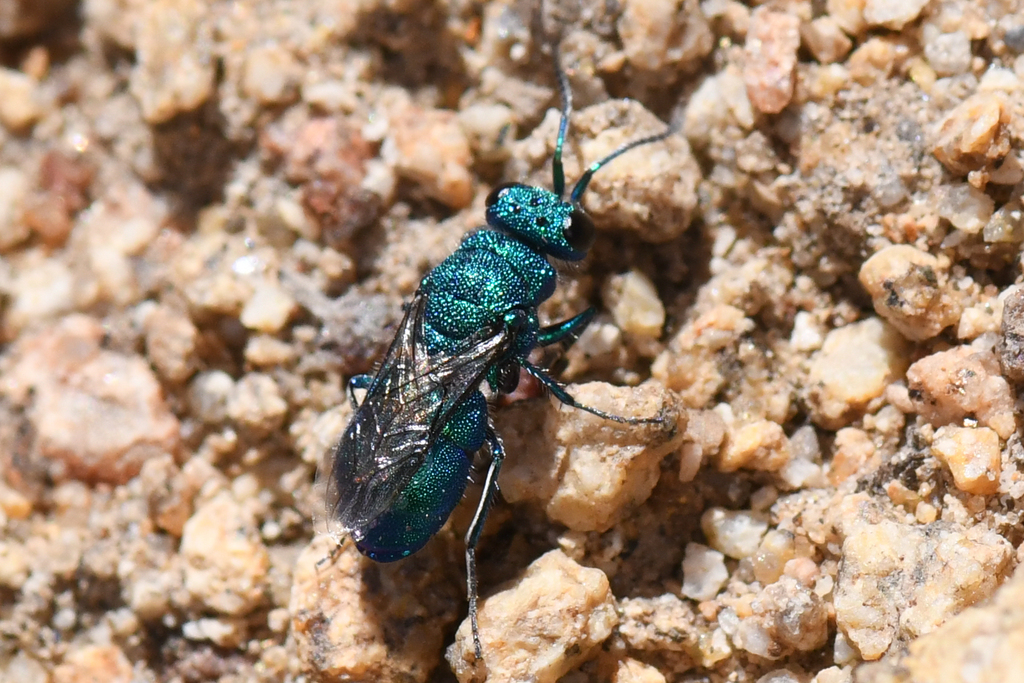
(c) Trevor Van Loon, some rights reserved (CC BY) · licence
Family: Chrysididae · Class: Insecta · Order: Hymenoptera
Conservation status: G1 S1
Ceratochrysis longimala (Desert Cuckoo Wasp) is a California animal in the Chrysididae family.
Ceratochrysis longimala is a small cuckoo wasp in the family Chrysididae, distinguished by its metallic coloration and parasitic lifestyle. Adult females possess elongated mandibles, as suggested by the species epithet 'longimala,' which aids in their specialized reproductive behavior. Like other chrysidids, this species displays the characteristic metallic blue-green to golden iridescence typical of cuckoo wasps, with a compact body measuring approximately 4-8 mm in length. The desert cuckoo wasp appears to have an extremely limited distribution, contributing to its G1 S1 conservation ranking indicating global and state rarity. The species' range and specific localities in California remain poorly documented in available literature, though the common name suggests an association with arid environments typical of California's desert regions. Habitat requirements for C. longimala are not well characterized in current scientific documentation. Based on the desert designation and the ecology of related chrysidid species, this wasp likely inhabits sandy or rocky desert substrates where its host species construct nests. Desert-dwelling cuckoo wasps typically require areas with suitable nesting sites for their hosts, often in exposed soil, cliff faces, or similar substrates that provide protection for developing larvae. As a cuckoo wasp, C. longimala exhibits kleptoparasitic behavior, with females seeking out the nests of solitary bees or wasps to deposit their eggs. The female wasp enters the host's nest and lays eggs near or on the host's provision mass or developing larva. Upon hatching, the cuckoo wasp larva consumes the host's food stores and may also consume the host larva itself. Adult wasps are typically active during warm months when their hosts are constructing nests and provisioning offspring. Males and females likely mate near host nesting sites, with females spending considerable time searching for suitable host nests. The conservation status of Ceratochrysis longimala reflects significant concern, with both global and state rankings of G1 S1 indicating this species is critically imperiled. Fewer than 6 viable occurrences or populations are estimated to exist globally and within California. The extreme rarity suggests this species faces substantial extinction risk from habitat loss, climate change, or other environmental pressures affecting desert ecosystems. The species does not appear to have federal or state protected status under endangered species legislation as of December 2025. Primary threats to desert-dwelling insects include habitat conversion, urban development, invasive species, and climate-driven changes to precipitation patterns and temperature extremes. For specialist parasites like cuckoo wasps, population declines in host species directly impact parasite survival. The lack of detailed ecological studies hampers conservation planning for this species. Scientific documentation for this species remains extremely limited. Comprehensive surveys of California's desert regions may reveal additional populations, while taxonomic studies could clarify relationships within the genus Ceratochrysis. We welcome contributions of verified scientific data, photographs, or field observations to enhance understanding of this critically rare species.
Classification
Class: Insecta · Order: Hymenoptera · Family: Chrysididae
Conservation status
G1 S1
Frequently asked questions
How is Ceratochrysis longimala classified?
Ceratochrysis longimala belongs to class Insecta, order Hymenoptera, family Chrysididae.
What family does Ceratochrysis longimala belong to?
Ceratochrysis longimala is in the Chrysididae family.
Is Ceratochrysis longimala protected or of conservation concern?
Ceratochrysis longimala carries the following status: G1 S1.
What is Ceratochrysis longimala?
Ceratochrysis longimala is a small cuckoo wasp in the family Chrysididae, distinguished by its metallic coloration and parasitic lifestyle.
Is Ceratochrysis longimala found in California?
Yes. Ceratochrysis longimala is recorded in California in The California Species Project's catalogue.
Related species
Other California species in the same genus, family, or bioregion.
Data from The California Species Project — 14,000+ California species with verified data from CNPS, CDFW, USFWS, and more.