Ceratochrysis menkei
Menke's Cuckoo Wasp
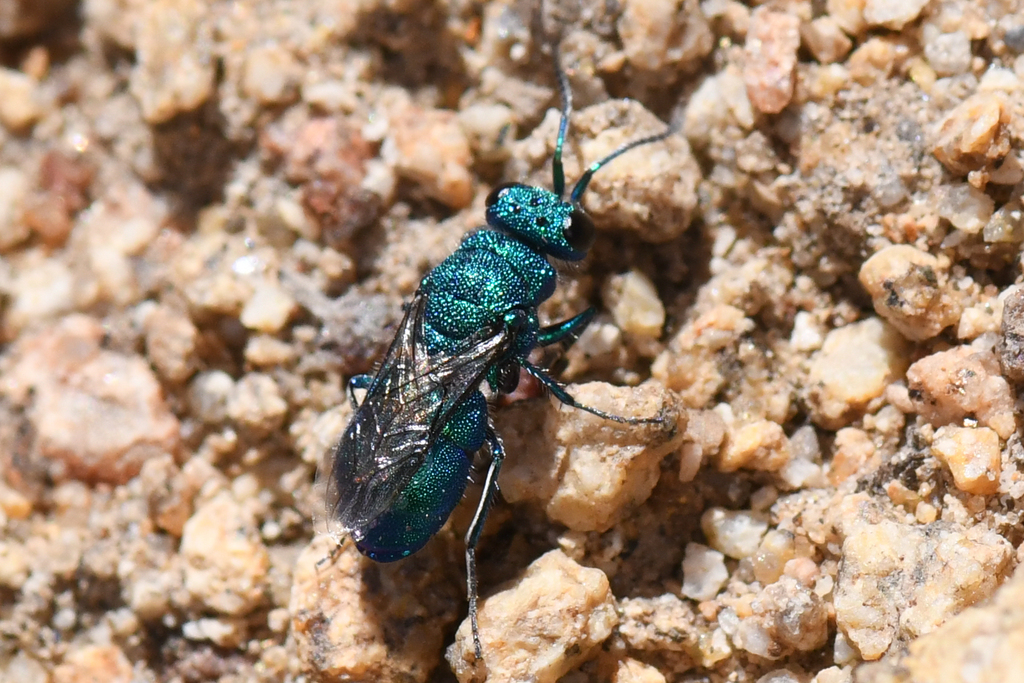
(c) Trevor Van Loon, some rights reserved (CC BY) · licence
Family: Chrysididae · Class: Insecta · Order: Hymenoptera
Conservation status: G2 S2
Ceratochrysis menkei (Menke's Cuckoo Wasp) is a California animal in the Chrysididae family.
Ceratochrysis menkei is a small parasitic wasp in the family Chrysididae, commonly known as cuckoo wasps due to their reproductive behavior of laying eggs in other insects' nests. Adults typically measure 4-8 mm in length and display the characteristic metallic coloration of chrysidid wasps, with iridescent blue-green to golden body surfaces. The species exhibits the family's distinctive sculptured integument, with deeply punctate surfaces and a compact, robust build adapted for entering host nests. This species has an extremely limited distribution, known from only two widely separated locations according to NatureServe. The disjunct range pattern suggests either a relict distribution of a once more widespread species or potential taxonomic issues requiring further investigation. Specific locality data for California populations remains incompletely documented in available literature. Habitat requirements for C. menkei are closely tied to those of its hosts, as cuckoo wasps are obligate kleptoparasites. The species likely inhabits areas where suitable host species construct their nests, potentially including sandy soils, exposed banks, or areas with existing insect burrows. Chrysidid wasps typically require open, sunny locations where their hosts are active, suggesting this species may occupy disturbed areas, field edges, or naturally sparse vegetation communities. As a member of the Chrysididae, C. menkei exhibits typical cuckoo wasp behavior patterns. Adult females seek out the nests of host species, likely other solitary wasps or bees, where they deposit their eggs. The developing larvae consume the host's provisioned food stores and may also parasitize the host larvae directly. Adult wasps are most active during warm, sunny periods when they search for nectar sources and potential host nests. The species' flight period and specific host associations have not been well documented, though most chrysidids in temperate regions are active during summer months. Ceratochrysis menkei holds a conservation status of G2 S2, indicating it is imperiled both globally and within California (NatureServe 2022). This ranking reflects the species' apparently small population size and limited distribution to two known locations. The rarity may be due to several factors including specialized host requirements, habitat loss, or simply inadequate survey effort for this taxonomic group. Parasitic wasps are often overlooked in biological surveys, and the true distribution and abundance of many chrysidid species remains poorly understood. Primary threats likely include habitat modification that affects host species populations, as the survival of C. menkei depends entirely on the presence of suitable hosts. Climate change may pose additional risks through altered seasonal timing that could disrupt the synchronization between this species and its hosts. The disjunct distribution pattern makes populations particularly vulnerable to local extinctions, as recolonization between distant sites would be unlikely. Detailed ecological studies of this species are lacking. The above information synthesizes available data from NatureServe and general knowledge of chrysidid biology. Enhanced survey efforts and taxonomic research are needed to better understand this species' distribution, host relationships, and conservation needs.
Classification
Class: Insecta · Order: Hymenoptera · Family: Chrysididae
Conservation status
G2 S2
Frequently asked questions
How is Ceratochrysis menkei classified?
Ceratochrysis menkei belongs to class Insecta, order Hymenoptera, family Chrysididae.
What family does Ceratochrysis menkei belong to?
Ceratochrysis menkei is in the Chrysididae family.
Is Ceratochrysis menkei protected or of conservation concern?
Ceratochrysis menkei carries the following status: G2 S2.
What is Ceratochrysis menkei?
Ceratochrysis menkei is a small parasitic wasp in the family Chrysididae, commonly known as cuckoo wasps due to their reproductive behavior of laying eggs in other insects' nests.
Is Ceratochrysis menkei found in California?
Yes. Ceratochrysis menkei is recorded in California in The California Species Project's catalogue.
Related species
Other California species in the same genus, family, or bioregion.
Data from The California Species Project — 14,000+ California species with verified data from CNPS, CDFW, USFWS, and more.