Cerceris convergens
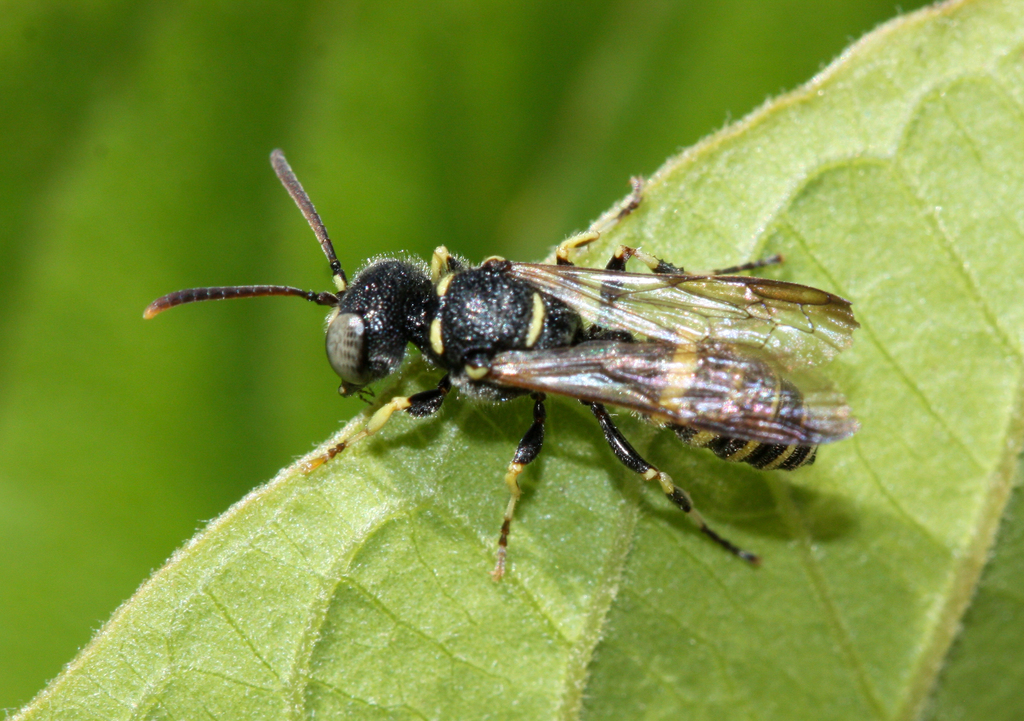
(c) Andrew Meeds, some rights reserved (CC BY) · licence
Family: Philanthidae · Class: Insecta · Order: Hymenoptera
Cerceris convergens is a California animal in the Philanthidae family.
Cerceris convergens is a small solitary wasp in the family Philanthidae, subfamily Philanthinae. Adults measure approximately 5 mm in length, with females displaying the characteristic square-headed appearance typical of the genus. Like other members of Cerceris, this species exhibits abdominal segments that are constricted at the margins, and the outer veinlet of submarginal cell 3 meets the marginal cell within its outer third (BugGuide.Net). Females possess modified facial projections that distinguish them from males and aid in species identification. Cerceris convergens occurs across western North America, with documented populations in California, Arizona, and likely extending into adjacent regions. In California, the species has been recorded from Orange County, where specimens have been observed in Irvine Park. The species also occurs in Arizona, with records from Yavapai County near Cottonwood (BugGuide.Net). The full extent of its California range remains incompletely documented, though it likely occurs in suitable habitat throughout much of the state's lower elevations. This wasp inhabits areas with sandy or well-drained soils suitable for ground nesting. Observations indicate adults visit flowering plants, including buckwheat (Eriogonum species), where they feed on nectar (BugGuide.Net). The species appears to favor open habitats with sparse vegetation and exposed soil areas that facilitate nest construction. Elevation preferences have not been thoroughly documented, but existing records suggest occurrence in foothill and valley environments. As a member of the tribe Cercerini, C. convergens is likely a specialist predator, though its specific prey preferences have not been well documented. Many Cerceris species are known as "weevil wasps" due to their specialization on beetles, particularly weevils (Curculionidae) and other Coleoptera. Females typically excavate ground nests where they provision cells with paralyzed prey for their developing larvae. Adults are active during summer months, with records from June and July indicating peak activity during this period. Mating and nesting behaviors follow the typical pattern for the genus, with females constructing individual nests and provisioning them independently. Cerceris convergens does not appear on federal or state endangered species lists, and its conservation status has not been formally assessed. The species' distribution and population trends remain poorly understood due to limited scientific study. Like many ground-nesting wasps, potential threats may include habitat loss from development, agricultural practices that disturb nesting sites, and pesticide applications that affect both adults and their beetle prey. The species would benefit from additional surveys to better understand its distribution, abundance, and ecological requirements throughout its range. Scientific documentation for this species remains limited. The information presented here is based on available sources including BugGuide.Net community observations and taxonomic records. If you have additional verified information about this species' biology, distribution, or ecology, please contact us to help improve this species account.
Classification
Class: Insecta · Order: Hymenoptera · Family: Philanthidae
Frequently asked questions
How is Cerceris convergens classified?
Cerceris convergens belongs to class Insecta, order Hymenoptera, family Philanthidae.
What family does Cerceris convergens belong to?
Cerceris convergens is in the Philanthidae family.
What is Cerceris convergens?
Cerceris convergens is a small solitary wasp in the family Philanthidae, subfamily Philanthinae.
Is Cerceris convergens found in California?
Yes. Cerceris convergens is recorded in California in The California Species Project's catalogue.
Related species
Other California species in the same genus, family, or bioregion.
Data from The California Species Project — 14,000+ California species with verified data from CNPS, CDFW, USFWS, and more.