Cercyonis meadii
Mead's Wood-Nymph
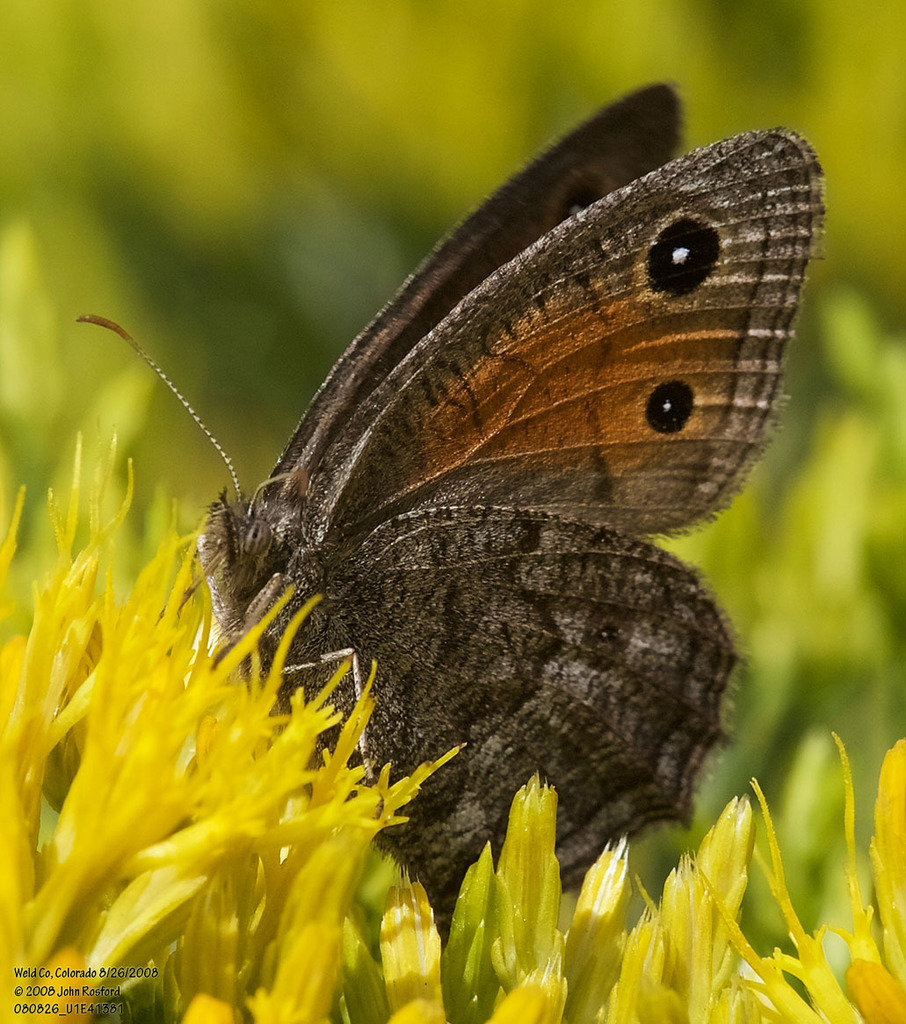
(c) John Rosford, some rights reserved (CC BY) · licence
Family: Nymphalidae · Class: Insecta · Order: Lepidoptera
Cercyonis meadii (Mead's Wood-Nymph) is a California animal in the Nymphalidae family.
Mead's Wood-Nymph is a medium-sized butterfly in the family Nymphalidae, subfamily Satyrinae. Adults have a wingspan ranging from 45 to 60 mm (1.8 to 2.4 inches). The dorsal wing surfaces are primarily brown with distinctive eyespots. Forewings display one to two prominent black eyespots with white pupils, typically positioned in the outer third of the wing. Hindwings feature smaller, less conspicuous eyespots. The ventral surfaces are lighter brown to grayish-brown with cryptic patterns that provide effective camouflage when the butterfly rests with wings closed. Males are generally smaller and darker than females, with more pronounced scent patches on the forewings. Mead's Wood-Nymph occurs across a broad geographic range in western North America, extending from eastern Montana and western North Dakota south through eastern Wyoming and central Colorado to central Utah, central Arizona, southeast New Mexico, west Texas, and northwest Chihuahua, Mexico. The species is absent from California, with its western distribution limit occurring in Utah and Arizona. This distribution pattern reflects the butterfly's adaptation to interior western grassland and woodland ecosystems. The species inhabits grasslands, prairie edges, open woodlands, and meadows, typically at elevations ranging from 1,200 to 2,400 meters (4,000 to 8,000 feet). Adults prefer areas with mixed grass and forb communities, often near woodland borders or riparian zones. Larvae develop exclusively on grasses, with various native grass species serving as hosts throughout the range. The specific grass species utilized may vary regionally, but typically include members of genera such as Festuca, Poa, and other cool-season grasses. Mead's Wood-Nymph is univoltine, producing one generation per year. Adults emerge in mid to late summer, typically from July through September, with peak flight activity occurring in August. Females deposit eggs singly on or near host grass plants. Eggs overwinter, and larvae begin feeding in spring, developing through five instars before pupating in late spring to early summer. Larvae are primarily nocturnal feeders, remaining hidden at the base of grass clumps during daylight hours. Adults are most active during warm, sunny conditions and feed on nectar from various wildflowers, including composites and legumes. Currently, Mead's Wood-Nymph does not hold federal or state listing status in any jurisdiction within its range. The species appears to maintain stable populations across much of its distribution, though localized declines may occur due to habitat conversion and grazing pressure. Primary threats include agricultural conversion of native grasslands, urban development, altered fire regimes, and intensive livestock grazing that degrades grass communities. Climate change may affect the species through shifts in precipitation patterns and temperature regimes that influence host plant communities and larval development timing. Conservation efforts focus on maintaining native grassland ecosystems and implementing appropriate grazing management practices.
Classification
Class: Insecta · Order: Lepidoptera · Family: Nymphalidae
Frequently asked questions
How is Cercyonis meadii classified?
Cercyonis meadii belongs to class Insecta, order Lepidoptera, family Nymphalidae.
What family does Cercyonis meadii belong to?
Cercyonis meadii is in the Nymphalidae family.
What is Cercyonis meadii?
Mead's Wood-Nymph is a medium-sized butterfly in the family Nymphalidae, subfamily Satyrinae.
Is Cercyonis meadii found in California?
Yes. Cercyonis meadii is recorded in California in The California Species Project's catalogue.
Related species
Other California species in the same genus, family, or bioregion.
Data from The California Species Project — 14,000+ California species with verified data from CNPS, CDFW, USFWS, and more.