Cercyonis pegala
Common Wood-Nymph
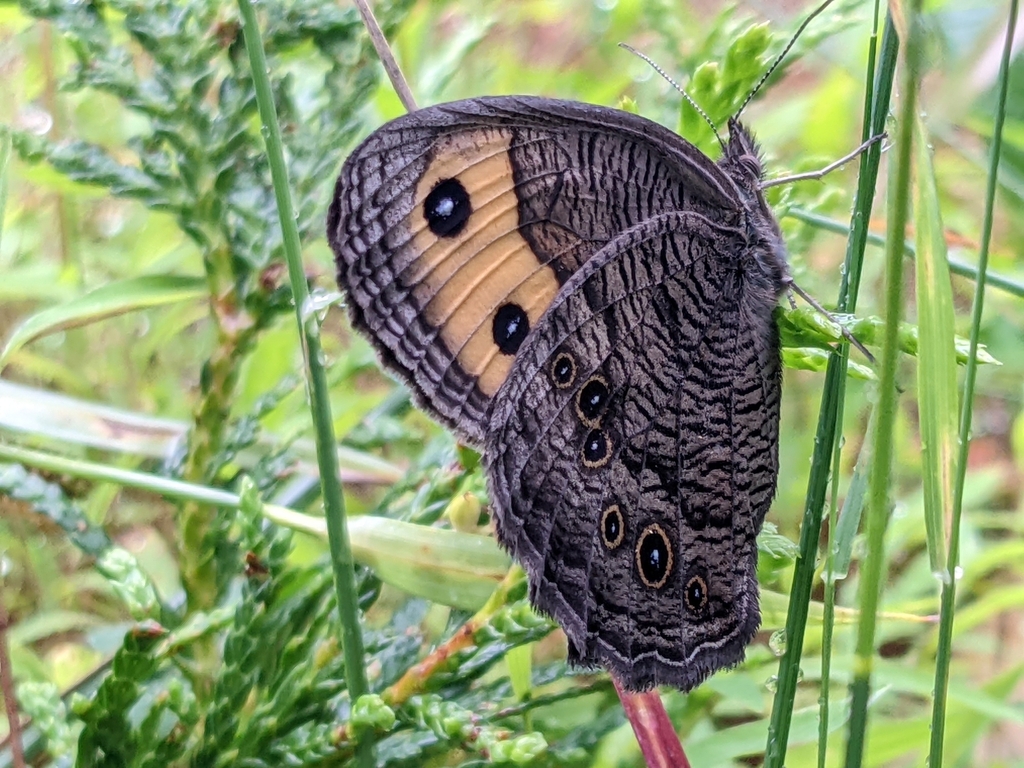
(c) Matthew Gerke, some rights reserved (CC BY) · licence
Family: Nymphalidae · Class: Insecta · Order: Lepidoptera
Cercyonis pegala (Common Wood-Nymph) is a California animal in the Nymphalidae family.
The Common Wood-Nymph is a medium-sized butterfly with a wingspan ranging from 50 to 70 mm (2.0 to 2.8 inches). Males display brown wings with prominent yellow patches on the forewings containing one to two black eyespots with white centers. Females are typically larger and lighter brown, often with more extensive yellow patches and additional smaller eyespots on the hindwings. The undersides of the wings show a mottled pattern of brown, gray, and tan that provides effective camouflage when the butterfly rests with wings closed. Sexual dimorphism is pronounced, with females generally showing more variable coloration and eyespot patterns than males. The Common Wood-Nymph has an extensive range across southern Canada and the continental United States, with notable exceptions in most of the Southwest and Texas, southern peninsular Florida, and northern Maine. In California, the species occurs primarily in the northern and central regions, including the Sierra Nevada foothills, Central Valley grasslands, and coastal ranges. The species shows considerable geographic variation across its range, with western populations often displaying reduced yellow coloration compared to eastern subspecies. This species inhabits a variety of open and semi-open habitats including grasslands, prairies, meadows, woodland clearings, and forest edges. The butterfly shows a preference for areas with mixed grass species and scattered shrubs or trees that provide shelter and roosting sites. Elevation ranges from near sea level to approximately 2,100 meters (7,000 feet) in mountainous regions. Adults favor areas with both nectar sources and suitable egg-laying sites on host grasses. Common Wood-Nymphs are univoltine, producing one generation per year. Adults emerge in mid to late summer, typically from June through September, with peak flight periods varying by latitude and elevation. Mating occurs after males establish territories and engage in patrolling behavior through suitable habitat. Females lay eggs singly on or near host plants, primarily Purpletop and other grass species in the family Poaceae. Larvae overwinter in early instars and complete development the following spring. Adults are primarily nectarivores, feeding on various flowering plants including milkweeds, dogbane, and composites. Flight patterns are characteristically slow and undulating, with frequent stops to bask in sunny openings. The Common Wood-Nymph is not federally or state listed and maintains stable populations across most of its range. However, like many grassland species, it faces ongoing pressure from habitat conversion, agricultural intensification, and urban development. Fire suppression and invasive plant species can alter grassland composition and reduce suitable habitat. Climate change may affect the species' northern range limits and elevational distribution. Conservation efforts focus on maintaining grassland ecosystems and implementing management practices that preserve native grass communities essential for larval development.
Classification
Class: Insecta · Order: Lepidoptera · Family: Nymphalidae
Frequently asked questions
How is Cercyonis pegala classified?
Cercyonis pegala belongs to class Insecta, order Lepidoptera, family Nymphalidae.
What family does Cercyonis pegala belong to?
Cercyonis pegala is in the Nymphalidae family.
What is Cercyonis pegala?
The Common Wood-Nymph is a medium-sized butterfly with a wingspan ranging from 50 to 70 mm (2.0 to 2.8 inches).
Is Cercyonis pegala found in California?
Yes. Cercyonis pegala is recorded in California in The California Species Project's catalogue.
Related species
Other California species in the same genus, family, or bioregion.
Data from The California Species Project — 14,000+ California species with verified data from CNPS, CDFW, USFWS, and more.