Cercyonis pegala carsonensis
Carson Valley Wood Nymph
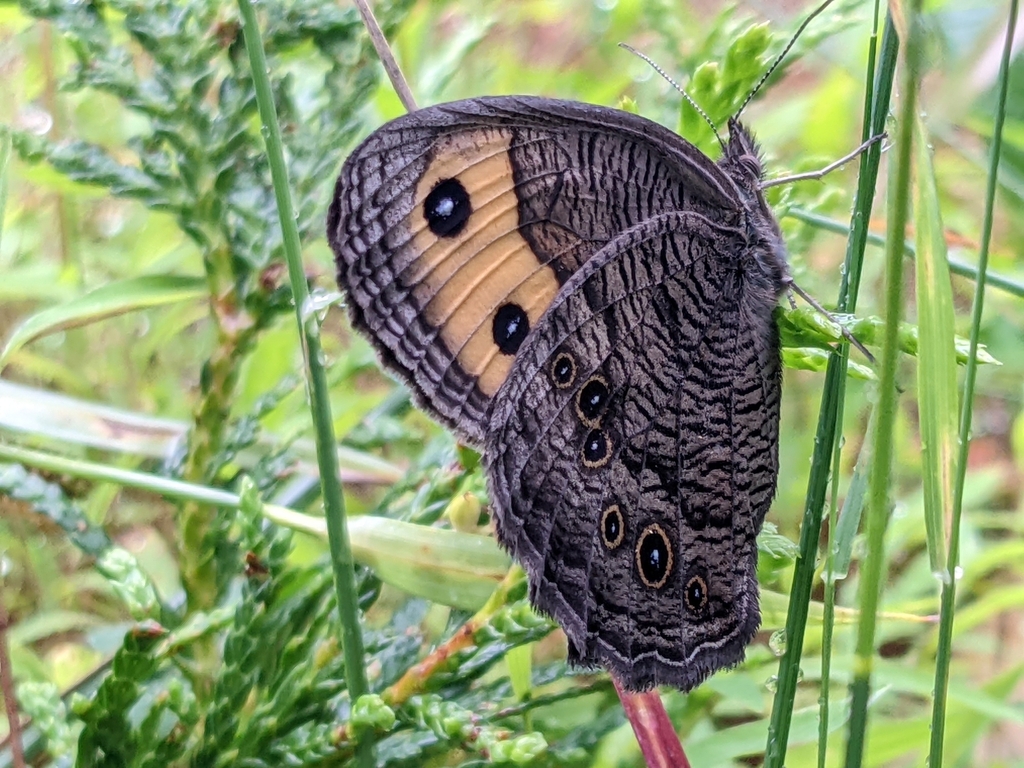
(c) Matthew Gerke, some rights reserved (CC BY) · licence
Family: Nymphalidae · Class: Insecta · Order: Lepidoptera
Conservation status: G5T1T2 S1S2
Cercyonis pegala carsonensis (Carson Valley Wood Nymph) is a California animal in the Nymphalidae family.
The Carson Valley wood nymph is a subspecies of the common wood nymph butterfly endemic to a small region of California and Nevada. Adults have a wingspan of 45-65 mm (1.8-2.6 inches), with males typically smaller than females. The dorsal wing surfaces are dark brown to blackish-brown, while the ventral hindwings display a mottled gray-brown pattern with subtle light and dark banding that provides camouflage against tree bark and dried vegetation. Males possess distinctive eyespots on the forewings, typically one large ocellus with a white center surrounded by yellow and black rings. Females often show two eyespots on each forewing, though eyespot size and number can vary among individuals. The Carson Valley wood nymph occupies an extremely limited range in the Carson Valley region along the California-Nevada border. In California, populations are restricted to a small area in Alpine County near the Nevada state line. The subspecies also occurs in adjacent portions of Douglas County, Nevada. This represents one of the most geographically restricted butterfly subspecies in North America, with suitable habitat covering fewer than 50 square kilometers. This subspecies inhabits riparian meadows and adjacent sagebrush-grassland ecotones at elevations between 1,400-1,500 meters (4,600-4,900 feet). The butterflies require areas with a combination of native grasses for larval development and nectar sources for adults. Habitat typically consists of moist meadows dominated by sedges and native bunch grasses, bordered by Great Basin sagebrush communities. Adults show strong fidelity to areas with rabbitbrush, which serves as a primary nectar source during the flight period. Adults emerge from late June through August, with peak flight activity occurring in July. Males establish territories in sunny openings within or adjacent to meadow habitats, where they engage in patrolling behavior to locate females. Mating occurs during mid-morning to early afternoon hours when temperatures are optimal. Females deposit eggs singly on or near host grasses, primarily native bunch grasses including Poa secunda and Festuca species. Larvae develop through five instars, overwintering as third or fourth instars in the soil or leaf litter. The species completes one generation annually. The Carson Valley wood nymph faces significant conservation challenges due to its extremely limited distribution and habitat specificity. According to NatureServe, the subspecies is critically imperiled to imperiled in California and globally as a subspecies, despite the species as a whole being secure. Primary threats include habitat degradation from livestock grazing, residential development pressure in the Carson Valley, water diversions affecting meadow hydrology, and invasion by non-native plant species. Climate change poses additional risks through altered precipitation patterns and increased drought frequency, which could reduce the availability of moist meadow habitats essential for population persistence. The subspecies' narrow ecological requirements and limited dispersal ability make it particularly vulnerable to habitat modifications and environmental changes.
Classification
Class: Insecta · Order: Lepidoptera · Family: Nymphalidae
Conservation status
G5T1T2 S1S2
Frequently asked questions
How is Cercyonis pegala carsonensis classified?
Cercyonis pegala carsonensis belongs to class Insecta, order Lepidoptera, family Nymphalidae.
What family does Cercyonis pegala carsonensis belong to?
Cercyonis pegala carsonensis is in the Nymphalidae family.
Is Cercyonis pegala carsonensis protected or of conservation concern?
Cercyonis pegala carsonensis carries the following status: G5T1T2 S1S2.
What is Cercyonis pegala carsonensis?
The Carson Valley wood nymph is a subspecies of the common wood nymph butterfly endemic to a small region of California and Nevada.
Is Cercyonis pegala carsonensis found in California?
Yes. Cercyonis pegala carsonensis is recorded in California in The California Species Project's catalogue.
Related species
Other California species in the same genus, family, or bioregion.
Data from The California Species Project — 14,000+ California species with verified data from CNPS, CDFW, USFWS, and more.