Cercyonis sthenele
Great Basin Wood-Nymph
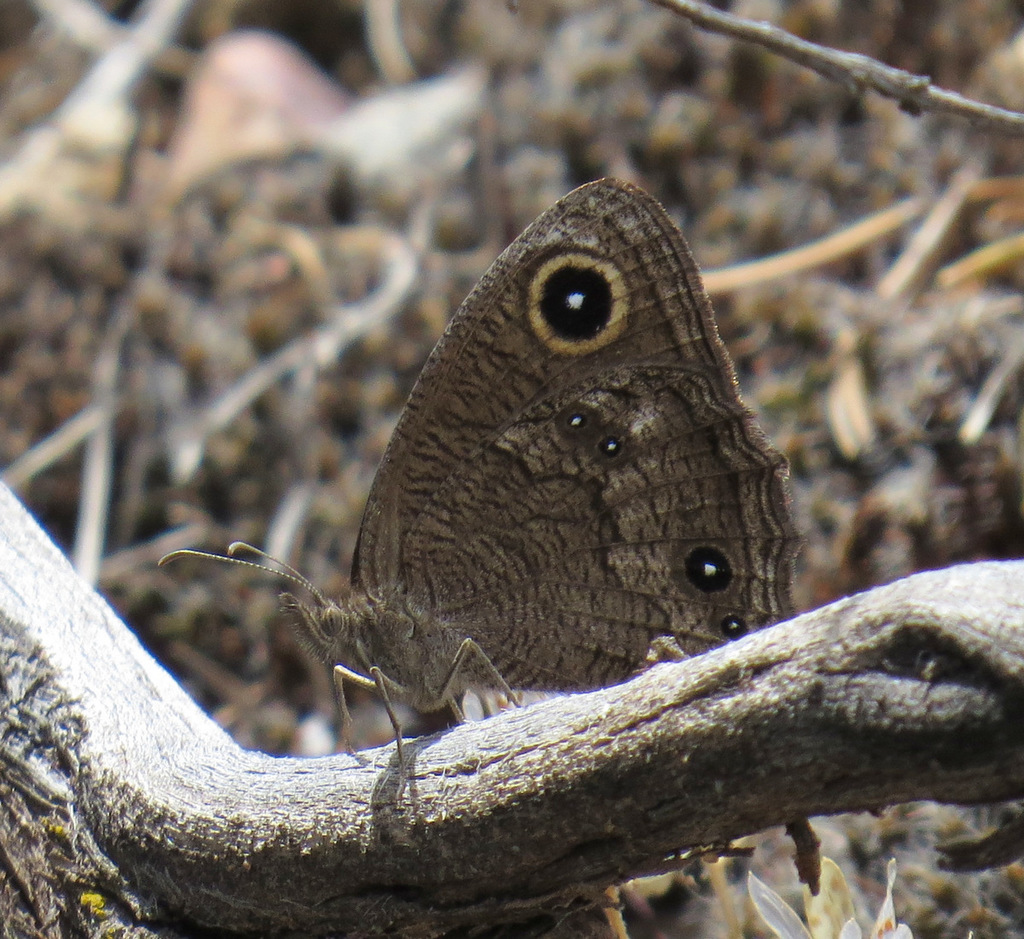
(c) Nick Block, some rights reserved (CC BY) · licence
Family: Nymphalidae · Class: Insecta · Order: Lepidoptera
Cercyonis sthenele (Great Basin Wood-Nymph) is a California animal in the Nymphalidae family.
The Great Basin Wood-Nymph (Cercyonis sthenele) is a medium-sized butterfly belonging to the family Nymphalidae, subfamily Satyrinae. Adults have a wingspan ranging from 50 to 65 mm (2.0 to 2.6 inches). The dorsal wing surfaces are brown with a distinctive pattern of eyespots. The forewings display one to two prominent eyespots with yellow rings and white centers, while the hindwings typically show smaller eyespots or may lack them entirely. The ventral surfaces are lighter brown to grayish-brown with cryptic mottling that provides camouflage when the butterfly is at rest. Sexual dimorphism is evident, with males generally smaller and having more subdued coloration compared to females, who display brighter yellow patches around the forewing eyespots. The species ranges from southern British Columbia south through California to Baja California Norte, extending eastward to Wyoming, Colorado, and Arizona. In California, populations occur primarily in mountainous regions and higher elevation areas throughout much of the state. The distribution encompasses diverse geographic regions from the Cascade Range and Sierra Nevada to scattered populations in southern California mountains. Great Basin Wood-Nymphs inhabit a variety of montane and high desert environments, typically at elevations ranging from 1,200 to 3,000 meters (4,000 to 10,000 feet). The species occurs in open woodlands, forest clearings, meadows, and grasslands where host plants are present. Preferred habitats include areas with scattered trees, particularly pine and oak woodlands, as well as sagebrush scrub communities. Adults are often found in proximity to springs, seeps, or other moisture sources in otherwise arid environments. Larvae feed exclusively on grasses, though the specific host plant species remain unknown. Adults are active during the summer months, typically from June through August, with peak flight activity occurring in July. Males establish territories and patrol areas where females are likely to oviposit. Courtship involves aerial pursuits and ground-based interactions where males approach perched females. Females deposit eggs singly on or near host grass plants. The species overwinters in the larval stage, with caterpillars feeding primarily at night and seeking shelter during daylight hours. Adults nectar on various flowering plants including rabbitbrush, asters, and other composites. Currently, Cercyonis sthenele does not hold federal or state listing status in California. The species appears to maintain stable populations across much of its range, though specific population data are limited. Local populations may face pressure from habitat alteration, particularly in areas subject to urban development, recreational activities, or changes in land management practices. Climate change could potentially affect the species through alterations to precipitation patterns and temperature regimes in montane habitats. The butterfly's dependence on unknown grass species for larval development highlights the need for additional research to better understand habitat requirements and potential conservation needs.
Classification
Class: Insecta · Order: Lepidoptera · Family: Nymphalidae
Frequently asked questions
How is Cercyonis sthenele classified?
Cercyonis sthenele belongs to class Insecta, order Lepidoptera, family Nymphalidae.
What family does Cercyonis sthenele belong to?
Cercyonis sthenele is in the Nymphalidae family.
What is Cercyonis sthenele?
The Great Basin Wood-Nymph (Cercyonis sthenele) is a medium-sized butterfly belonging to the family Nymphalidae, subfamily Satyrinae.
Is Cercyonis sthenele found in California?
Yes. Cercyonis sthenele is recorded in California in The California Species Project's catalogue.
Related species
Other California species in the same genus, family, or bioregion.
Data from The California Species Project — 14,000+ California species with verified data from CNPS, CDFW, USFWS, and more.