Ceuthophilus californianus
California Camel Cricket
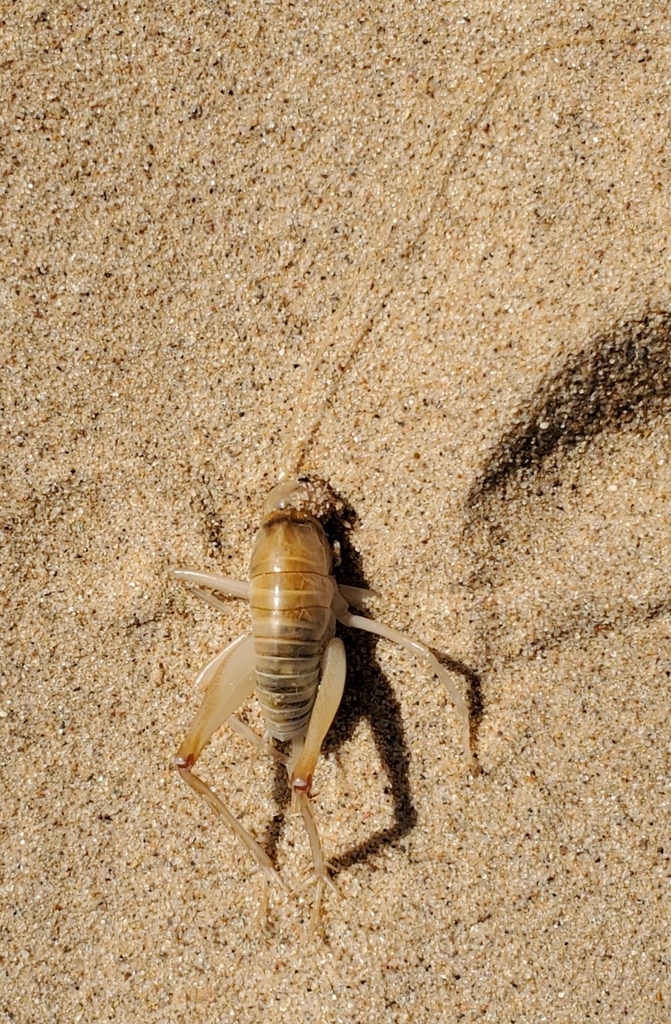
(c) Bob Miller, some rights reserved (CC BY) · licence
Family: Rhaphidophoridae · Class: Insecta · Order: Orthoptera
Ceuthophilus californianus (California Camel Cricket) is a California animal in the Rhaphidophoridae family.
The California camel cricket is a wingless orthopteran belonging to the family Rhaphidophoridae. Like other camel crickets, this species exhibits the characteristic hump-backed appearance with extremely long antennae and elongated legs. The body typically measures up to 25 mm in length, with a dark coloration and the distinctive arched thorax that gives camel crickets their common name. As wingless insects, California camel crickets are unable to produce the chirping sounds associated with other cricket families. Ceuthophilus californianus occurs along California's coastal regions, with documented populations on sand dunes from the Los Angeles area extending northward. Historical records indicate the species was present on the Playa del Rey dunes and in areas that are now part of Venice. The species has been distinguished from related undescribed Ceuthophilus species found in freshwater marsh habitats, with C. californianus specifically associated with coastal dune ecosystems (Mattoni 1991). The range appears to be restricted to near-coastal environments in southern and central California. This species inhabits coastal sand dune systems, showing a strong preference for sandy substrates characteristic of these specialized ecosystems. Unlike cave-dwelling camel crickets that favor cool, damp environments under logs and rocks, C. californianus has adapted to the more exposed and variable conditions of coastal dunes. The species requires the specific plant communities and microhabitats present in these threatened coastal ecosystems. Like other members of Rhaphidophoridae, California camel crickets are likely omnivorous, feeding on decaying plant material, small arthropods, and organic debris typical of dune environments. The species' biology and life history remain poorly documented in scientific literature. Reproductive behavior, seasonal activity patterns, and specific ecological relationships within dune communities have not been thoroughly studied. The long legs and antennae suggest adaptations for navigating through sandy substrates and detecting prey or mates in the loose sand environment. While not federally listed, the California camel cricket faces conservation challenges typical of coastal dune species. Massive coastal development has eliminated much of the historical dune habitat throughout California. The Ballona Wetlands region, where the species has been documented, represents one of the few remaining coastal dune systems in the Los Angeles area. The conversion of dune habitats to urban development poses the primary threat to this species. The restricted range and habitat specialization make C. californianus vulnerable to further habitat loss. Coastal dune systems in California have experienced severe reduction over the past century, with many historical dune complexes completely eliminated by development. The species' dependence on these increasingly rare ecosystems suggests that conservation of remaining coastal dune habitats is critical for its long-term survival. Detailed ecological studies of this species remain limited. Scientific documentation would benefit from research into population dynamics, habitat requirements, and specific conservation needs within remaining coastal dune systems.
Classification
Class: Insecta · Order: Orthoptera · Family: Rhaphidophoridae
Frequently asked questions
How is Ceuthophilus californianus classified?
Ceuthophilus californianus belongs to class Insecta, order Orthoptera, family Rhaphidophoridae.
What family does Ceuthophilus californianus belong to?
Ceuthophilus californianus is in the Rhaphidophoridae family.
What is Ceuthophilus californianus?
The California camel cricket is a wingless orthopteran belonging to the family Rhaphidophoridae.
Is Ceuthophilus californianus found in California?
Yes. Ceuthophilus californianus is recorded in California in The California Species Project's catalogue.
Related species
Other California species in the same genus, family, or bioregion.
Data from The California Species Project — 14,000+ California species with verified data from CNPS, CDFW, USFWS, and more.