Chaetura pelagica
Chimney Swift
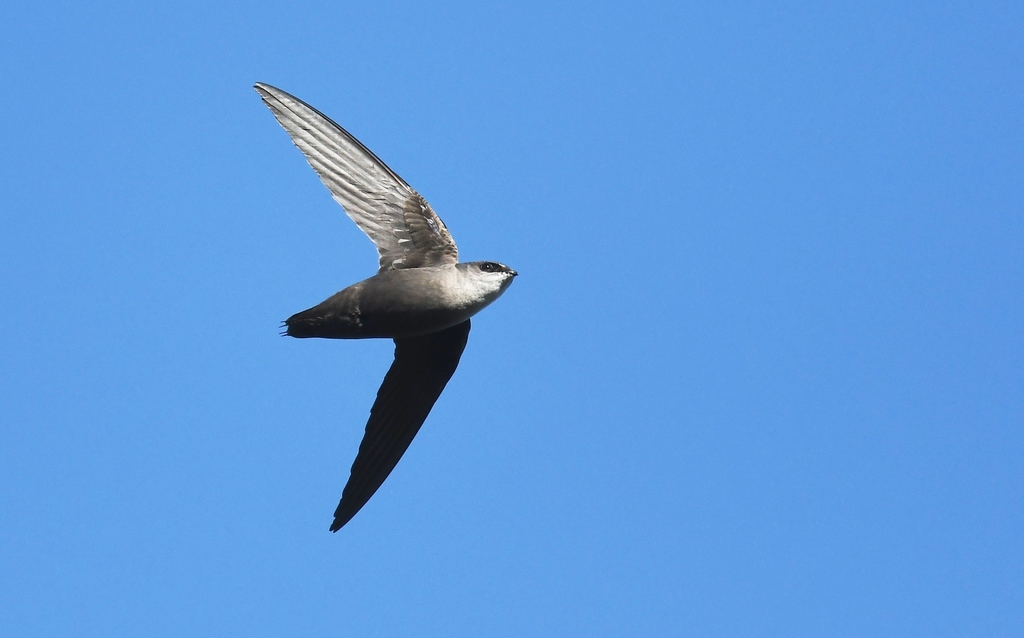
no rights reserved · CC0
Family: Apodidae · Class: Aves · Order: Apodiformes
Chaetura pelagica (Chimney Swift) is a California animal in the Apodidae family.
The Chimney Swift is a small, aerial insectivore measuring 12 to 15 centimeters (4.7 to 5.9 inches) in length with a wingspan of 27 to 30 centimeters (10.6 to 11.8 inches). The species weighs 17 to 30 grams (0.6 to 1.1 ounces). Adults display uniform dark brown to sooty gray plumage with a slightly paler throat. The wings are long, narrow, and curved, resembling a boomerang in flight. The tail is short and squared, with stiff, spine-tipped feathers that serve as props when roosting on vertical surfaces. The bill is small and black, adapted for catching insects in flight. Chimney Swifts breed across eastern North America from southern Canada to the Gulf of Mexico. In California, the species occurs primarily as a vagrant or rare migrant, with most records from the eastern desert regions and Central Valley. Historical breeding records exist for a few locations in northern California, but current breeding populations are extremely limited or absent. The species winters in the upper Amazon Basin of Peru, Ecuador, and Brazil. During the breeding season, Chimney Swifts inhabit urban and suburban areas where suitable nesting structures are available. Originally adapted to nest in hollow trees and cliff crevices, the species now relies almost exclusively on human-made structures including chimneys, abandoned buildings, air shafts, and silos. Foraging occurs over open areas including parks, agricultural fields, wetlands, and forest clearings where flying insects are abundant. The species ranges from sea level to elevations exceeding 2,500 meters (8,200 feet). Chimney Swifts are exclusively aerial, feeding entirely on flying insects captured during flight. Their diet consists primarily of flying ants, beetles, flies, mosquitoes, mayflies, and flying termites. The species exhibits exceptional aerial maneuverability and can feed, drink, bathe, and collect nesting material without landing. Breeding occurs from April through August, with pairs constructing bracket-shaped nests of small twigs cemented together with saliva and attached to vertical walls. Females lay 3 to 5 white eggs, incubated for 18 to 21 days. Young remain in the nest for 28 to 35 days before fledging. The species is highly social during migration and winter, forming large communal roosts. Chimney Swifts are not federally listed but have experienced significant population declines across their range. According to the North American Breeding Bird Survey, populations declined by approximately 2.9 percent annually between 1966 and 2019, representing a cumulative decline of more than 65 percent. Primary threats include loss of nesting sites due to chimney capping and building demolition, reduced insect prey from pesticide use and habitat loss, and climate change affecting insect populations and migration timing. Conservation efforts focus on maintaining suitable nesting structures and promoting swift-friendly building practices in urban environments.
Classification
Class: Aves · Order: Apodiformes · Family: Apodidae
Frequently asked questions
How is Chaetura pelagica classified?
Chaetura pelagica belongs to class Aves, order Apodiformes, family Apodidae.
What family does Chaetura pelagica belong to?
Chaetura pelagica is in the Apodidae family.
What is Chaetura pelagica?
The Chimney Swift is a small, aerial insectivore measuring 12 to 15 centimeters (4.7 to 5.9 inches) in length with a wingspan of 27 to 30 centimeters (10.6 to 11.8 inches).
Is Chaetura pelagica found in California?
Yes. Chaetura pelagica is recorded in California in The California Species Project's catalogue.
Related species
Other California species in the same genus, family, or bioregion.
Data from The California Species Project — 14,000+ California species with verified data from CNPS, CDFW, USFWS, and more.