Chalcophora angulicollis
Western Sculptured Pine Borer
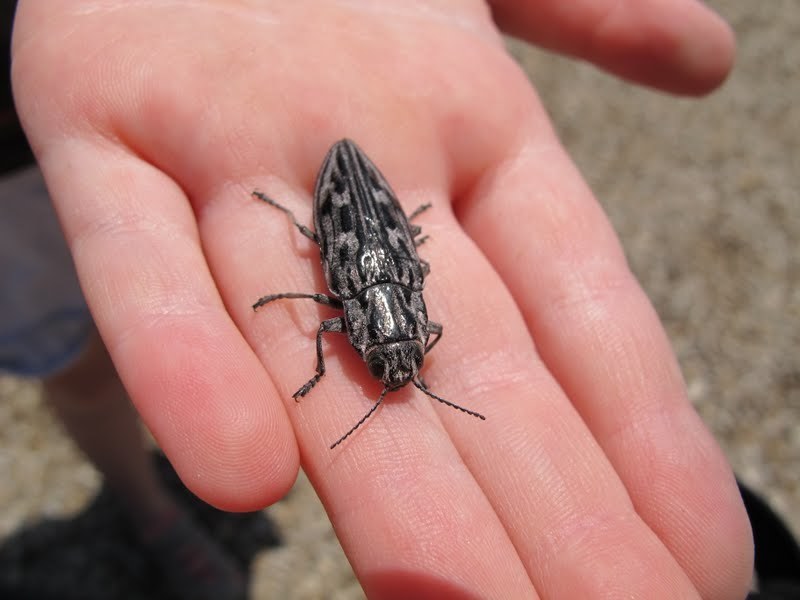
no rights reserved · CC0
Family: Buprestidae · Class: Insecta · Order: Coleoptera
Chalcophora angulicollis (Western Sculptured Pine Borer) is a California animal in the Buprestidae family.
The Western Sculptured Pine Borer (Chalcophora angulicollis) is a large metallic wood-boring beetle in the family Buprestidae. Adults are robust beetles measuring 15-25 mm (0.6-1.0 inches) in length, characterized by their distinctive sculptured appearance and metallic bronze to copper coloration (BugGuide). The elytra (wing covers) display intricate raised patterns and ridges that give the species its common name. The pronotum is notably angular, contributing to the beetle's sculptured appearance. Like other buprestids, adults have a somewhat flattened, elongated body shape adapted for their wood-boring lifestyle. This species occurs across western North America, with documented populations extending from British Columbia south through the western United States (BugGuide). In California, the Western Sculptured Pine Borer has been recorded in mountainous regions where suitable host trees are present. The species' distribution closely follows that of its primary host plants, limiting its range to coniferous forest ecosystems. The Western Sculptured Pine Borer inhabits coniferous forests, particularly those dominated by pine species. Adults are typically found on or near dead, dying, or stressed pine trees where they seek mates and oviposition sites (Pacific Northwest Pest Management Handbooks). The species shows a preference for areas with recent tree mortality, whether from drought stress, fire damage, or other disturbances that weaken host trees. According to forest entomology research, buprestid beetles generally prefer trees under stress as these provide optimal conditions for larval development (USFS Forest Health Protection). Adults are active during warm months, typically appearing from late spring through early fall, following the general pattern documented for western North American buprestids (BugGuide). Females deposit eggs in bark crevices of suitable host trees, primarily pine species (Pinus spp.) (USFS Forest Health Protection). Larvae develop as wood borers, creating galleries beneath the bark and in the outer sapwood of dead or dying conifers. The larval stage can extend over multiple years depending on environmental conditions and host tree quality. Adults feed on pine foliage and may be observed on host trees during daylight hours. Like many buprestids, this species plays an ecological role in forest decomposition processes by accelerating the breakdown of dead and dying trees. The Western Sculptured Pine Borer is not currently listed under federal or state endangered species legislation. As a native wood-boring beetle, it is considered part of the natural forest ecosystem and typically does not reach pest status under normal conditions. However, climate change-induced forest stress, including increased drought frequency and bark beetle outbreaks, may affect host tree availability and subsequently influence population dynamics. The species may benefit from increased tree mortality in some areas while potentially facing habitat loss in regions where entire forest stands are eliminated. Specific population trends and conservation needs have not been extensively studied, reflecting the limited research attention given to many native buprestid species despite their ecological importance in forest ecosystems.
Classification
Class: Insecta · Order: Coleoptera · Family: Buprestidae
Frequently asked questions
How is Chalcophora angulicollis classified?
Chalcophora angulicollis belongs to class Insecta, order Coleoptera, family Buprestidae.
What family does Chalcophora angulicollis belong to?
Chalcophora angulicollis is in the Buprestidae family.
What is Chalcophora angulicollis?
The Western Sculptured Pine Borer (Chalcophora angulicollis) is a large metallic wood-boring beetle in the family Buprestidae.
Is Chalcophora angulicollis found in California?
Yes. Chalcophora angulicollis is recorded in California in The California Species Project's catalogue.
Related species
Other California species in the same genus, family, or bioregion.
Data from The California Species Project — 14,000+ California species with verified data from CNPS, CDFW, USFWS, and more.