Chalybion californicum
Nearctic Blue Mud-dauber Wasp
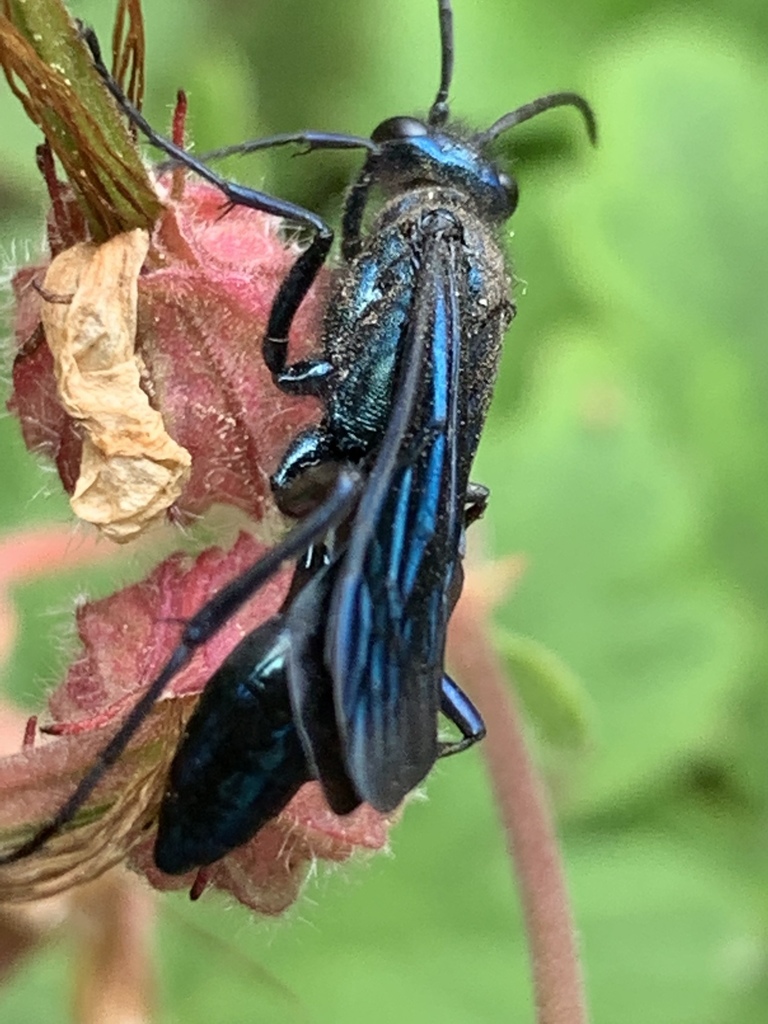
(c) Healthy Yards, some rights reserved (CC BY) · licence
Family: Sphecidae · Class: Insecta · Order: Hymenoptera
Chalybion californicum (Nearctic Blue Mud-dauber Wasp) is a California animal in the Sphecidae family.
The Nearctic Blue Mud-dauber Wasp is a solitary wasp species distinguished by its metallic blue coloration and mud-nesting behavior. Adults typically measure 10-25 mm in length with a slender body and thread-like waist characteristic of sphecid wasps. The entire body displays an iridescent blue-black metallic sheen that distinguishes it from other mud dauber species. The wings appear dark with a blue or purple iridescence, and the antennae are relatively short and thread-like. Chalybion californicum occurs throughout much of North America, with its range extending from southern Canada through the United States to northern Mexico. Despite its scientific name suggesting a California origin, the species is widely distributed across the continent. In California, it can be found in various habitats from coastal areas to inland valleys and foothills, typically at elevations below 2,000 meters. This species inhabits diverse environments including urban areas, gardens, agricultural lands, woodlands, and riparian zones. Adults are commonly observed around buildings, particularly under eaves, porches, and other sheltered structures where they construct their nests. The wasps show a preference for areas with abundant spider populations and access to mud sources for nest construction. They are frequently found near water sources such as streams, ponds, or irrigation systems that provide the moist soil necessary for nest building. Female Nearctic Blue Mud-dauber Wasps exhibit distinctive nesting behavior, constructing cylindrical mud cells in protected locations (BugGuide). These nests are often built under building eaves, in garages, sheds, or other sheltered areas. Females may also refurbish abandoned nests of other mud dauber species rather than building entirely new structures (BugGuide). Each mud cell is provisioned with paralyzed spiders, primarily orb weavers and other web-building species, which serve as food for developing larvae. A single egg is laid on the spider provisions within each cell before the female seals it with mud. The species is univoltine in most regions, with adults active from late spring through early fall. Males do not participate in nest construction but may be observed patrolling territories near nesting sites. The Nearctic Blue Mud-dauber Wasp currently has no formal conservation status designation at federal or state levels. The species appears to maintain stable populations throughout its range and has successfully adapted to human-modified environments. Its ability to utilize artificial structures for nesting sites has likely contributed to its persistence in urban and suburban areas. The species may actually benefit from human activities that create suitable nesting sites and maintain diverse spider communities in managed landscapes. No specific conservation concerns have been identified for this species as of December 2025.
Classification
Class: Insecta · Order: Hymenoptera · Family: Sphecidae
Frequently asked questions
How is Chalybion californicum classified?
Chalybion californicum belongs to class Insecta, order Hymenoptera, family Sphecidae.
What family does Chalybion californicum belong to?
Chalybion californicum is in the Sphecidae family.
What is Chalybion californicum?
The Nearctic Blue Mud-dauber Wasp is a solitary wasp species distinguished by its metallic blue coloration and mud-nesting behavior.
Is Chalybion californicum found in California?
Yes. Chalybion californicum is recorded in California in The California Species Project's catalogue.
Related species
Other California species in the same genus, family, or bioregion.
Data from The California Species Project — 14,000+ California species with verified data from CNPS, CDFW, USFWS, and more.