Chamaea fasciata
Wrentit
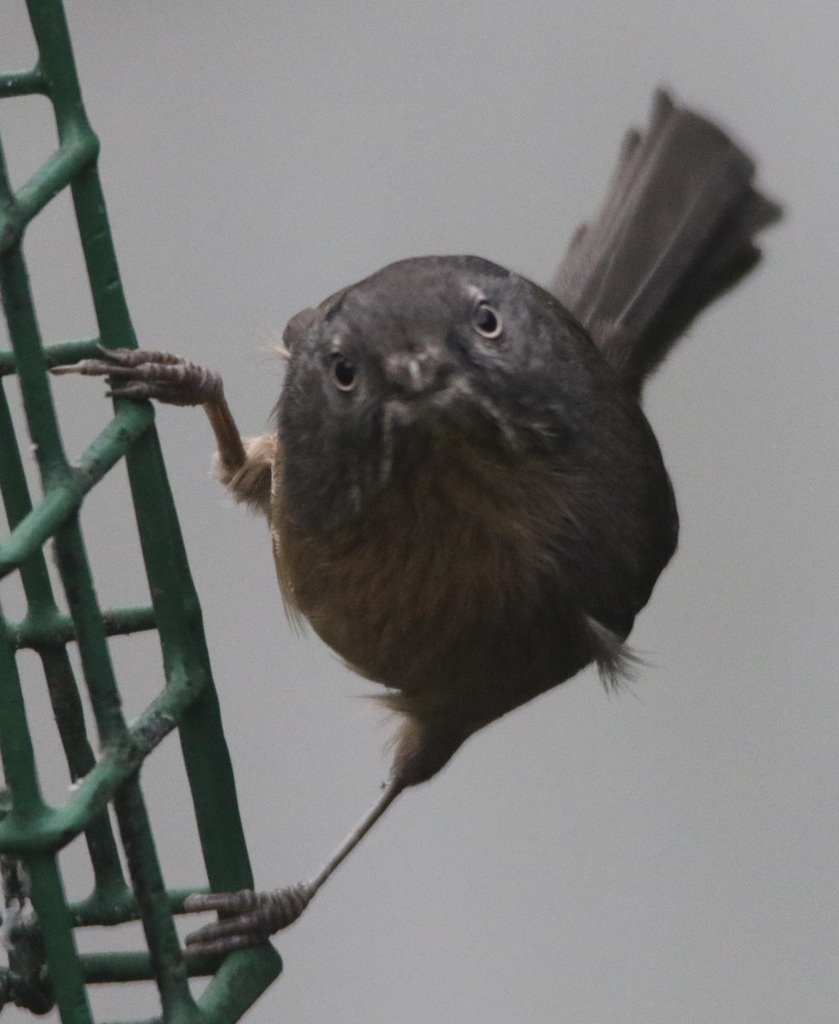
(c) Cricket Raspet, some rights reserved (CC BY) · licence
Family: Paradoxornithidae · Class: Aves · Order: Passeriformes
Chamaea fasciata (Wrentit) is a California animal in the Paradoxornithidae family.
The Wrentit is a small, distinctive passerine bird endemic to the Pacific Coast of North America. Adults measure 14 to 17 cm (5.5 to 6.7 inches) in length and weigh approximately 13 to 16 grams. The species exhibits a uniform brownish-gray plumage with subtle streaking on the underparts. The tail is notably long and rounded, often held cocked upward. Wrentits possess a short, slightly curved bill adapted for insectivory and a distinctive pale yellow eye. Sexual dimorphism is minimal, though males may appear slightly larger and possess marginally darker plumage. The Wrentit's range extends along the Pacific Coast from southern Oregon through California to Baja California, Mexico. In California, the species occurs from sea level to approximately 2,000 meters (6,500 feet) elevation, primarily west of the Sierra Nevada crest and Cascade Range. Populations are found throughout the Coast Ranges, San Francisco Bay Area, Central Valley foothills, and southern California mountains including the Transverse and Peninsular Ranges. The species is largely sedentary, with individuals maintaining territories year-round. Wrentits inhabit dense chaparral, coastal scrub, and oak woodland environments. They show strong preference for areas with continuous shrub cover, particularly chaparral dominated by chamise, manzanita, ceanothus, and scrub oak species. The species also occurs in riparian woodland edges and mixed evergreen forests with substantial understory development. Optimal habitat features include shrub heights of 1 to 4 meters with dense branching patterns that provide foraging opportunities and protection from predators. Wrentits are highly social, living in mated pairs that defend territories averaging 1 to 3 hectares throughout the year. Pairs engage in distinctive duetting behavior, with males and females producing coordinated vocalizations that strengthen pair bonds and advertise territory ownership. The species feeds primarily on small insects, spiders, and larvae gleaned from foliage and bark surfaces. During autumn and winter, Wrentits supplement their diet with small berries and seeds. Breeding occurs from February through July, with peak activity in April and May. Females construct cup-shaped nests in dense shrub branches 0.3 to 4 meters above ground, using twigs, bark strips, and spider webs bound with plant fibers. Clutch size ranges from 3 to 5 pale blue eggs, which are incubated for 15 to 16 days. Both parents feed nestlings, which fledge after 15 to 16 days but remain dependent on adults for several additional weeks. The Wrentit is not federally or state listed and maintains stable populations throughout most of its range. According to North American Breeding Bird Survey data, populations have remained relatively stable over the past five decades, though some localized declines have occurred in urban interface areas. Primary threats include habitat fragmentation from residential development, conversion of chaparral to agriculture, and increased fire frequency that prevents shrubland maturation. Climate change poses potential long-term risks through altered precipitation patterns affecting chaparral ecosystem dynamics.
Classification
Class: Aves · Order: Passeriformes · Family: Paradoxornithidae
Frequently asked questions
How is Chamaea fasciata classified?
Chamaea fasciata belongs to class Aves, order Passeriformes, family Paradoxornithidae.
What family does Chamaea fasciata belong to?
Chamaea fasciata is in the Paradoxornithidae family.
What is Chamaea fasciata?
The Wrentit is a small, distinctive passerine bird endemic to the Pacific Coast of North America.
Is Chamaea fasciata found in California?
Yes. Chamaea fasciata is recorded in California in The California Species Project's catalogue.
More California species
This species has no close relatives in our California data — here are other species to explore.
Data from The California Species Project — 14,000+ California species with verified data from CNPS, CDFW, USFWS, and more.