Charadrius hiaticula
Common Ringed Plover
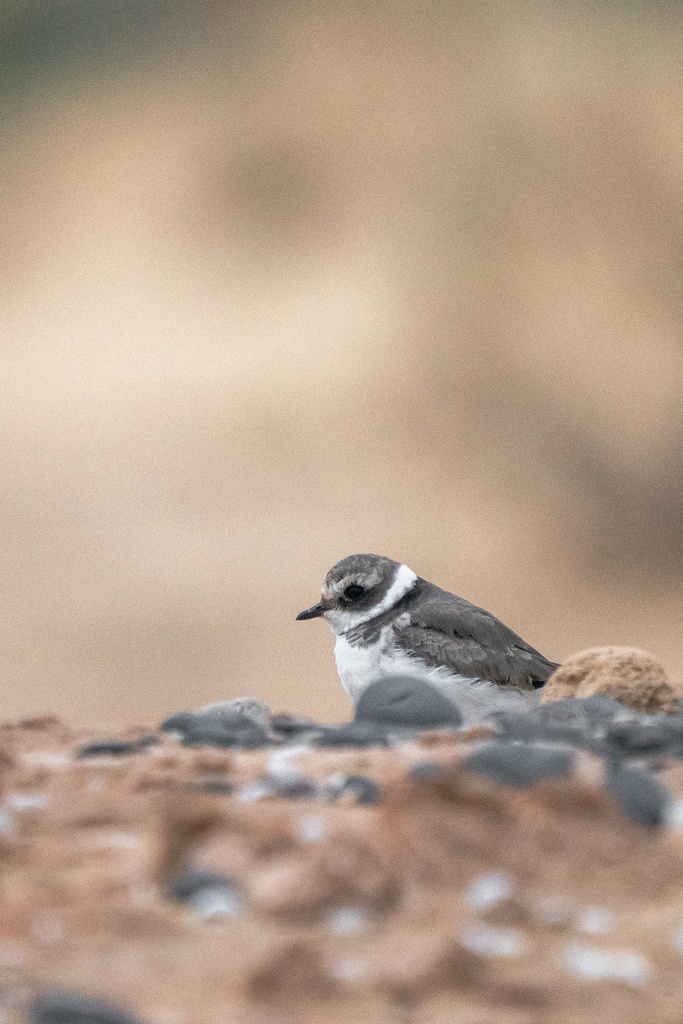
(c) Joeb, some rights reserved (CC BY) · licence
Family: Charadriidae · Class: Aves · Order: Charadriiformes
Charadrius hiaticula (Common Ringed Plover) is a California animal in the Charadriidae family.
The Common Ringed Plover is a small, compact shorebird measuring 17-20 cm (6.7-7.9 inches) in length with a wingspan of 35-41 cm (13.8-16.1 inches). Adults weigh 55-75 grams. The species displays distinctive breeding plumage with a white forehead bordered by a black band that extends from the bill to above the eye, connecting to a complete black breast band. The upperparts are sandy brown, while the underparts are white. The legs are bright orange-yellow, and the bill is orange with a black tip. Non-breeding adults show duller coloration with brownish breast bands. Juveniles lack the complete breast band and display scaly upperpart patterns. The Common Ringed Plover breeds across northern Europe, Greenland, and the eastern Canadian Arctic. In North America, the species is primarily found in Alaska, with breeding populations extending from the Arctic coast south to the Alaska Peninsula. During migration and winter, individuals occur along both Atlantic and Pacific coastlines. In California, the species appears as a rare but regular migrant and winter visitor, primarily along coastal areas from August through May. Most California records come from sandy beaches, mudflats, and coastal lagoons in the northern and central portions of the state. This species inhabits sandy and pebbly beaches, coastal mudflats, salt marshes, and tidal pools. During the breeding season, Common Ringed Plovers prefer arctic and subarctic tundra near water bodies, including lakeshores, river deltas, and coastal plains. They select nesting sites on bare or sparsely vegetated ground with scattered pebbles or shells. Wintering birds frequent intertidal zones, particularly areas with mixed sand and mud substrates that support abundant invertebrate prey. Common Ringed Plovers are visual foragers, employing the characteristic stop-run-peck feeding behavior typical of plovers. They consume marine worms, mollusks, crustaceans, and insects, with diet varying seasonally based on prey availability. The species exhibits a distinctive territorial display during breeding, involving elaborate flight patterns and vocalizations. Breeding occurs from May through July, with females laying 3-4 eggs in a shallow scrape lined with pebbles, shells, or vegetation fragments. Incubation lasts 23-25 days, shared by both parents. Chicks are precocial and capable of feeding themselves shortly after hatching, though parental care continues for 24-35 days until fledging. The Common Ringed Plover is not federally listed in the United States and is classified as Least Concern by the International Union for Conservation of Nature. Global populations appear stable, with an estimated 1.5-2 million individuals worldwide. However, some regional populations face pressures from habitat loss due to coastal development, human disturbance at nesting sites, and climate change impacts on Arctic breeding grounds. In California, the species remains uncommon, with records typically involving single individuals or small groups during migration periods.
Classification
Class: Aves · Order: Charadriiformes · Family: Charadriidae
Frequently asked questions
How is Charadrius hiaticula classified?
Charadrius hiaticula belongs to class Aves, order Charadriiformes, family Charadriidae.
What family does Charadrius hiaticula belong to?
Charadrius hiaticula is in the Charadriidae family.
What is Charadrius hiaticula?
The Common Ringed Plover is a small, compact shorebird measuring 17-20 cm (6.7-7.9 inches) in length with a wingspan of 35-41 cm (13.8-16.1 inches).
Is Charadrius hiaticula found in California?
Yes. Charadrius hiaticula is recorded in California in The California Species Project's catalogue.
Related species
Other California species in the same genus, family, or bioregion.
Data from The California Species Project — 14,000+ California species with verified data from CNPS, CDFW, USFWS, and more.