Charadrius melodus
Piping Plover
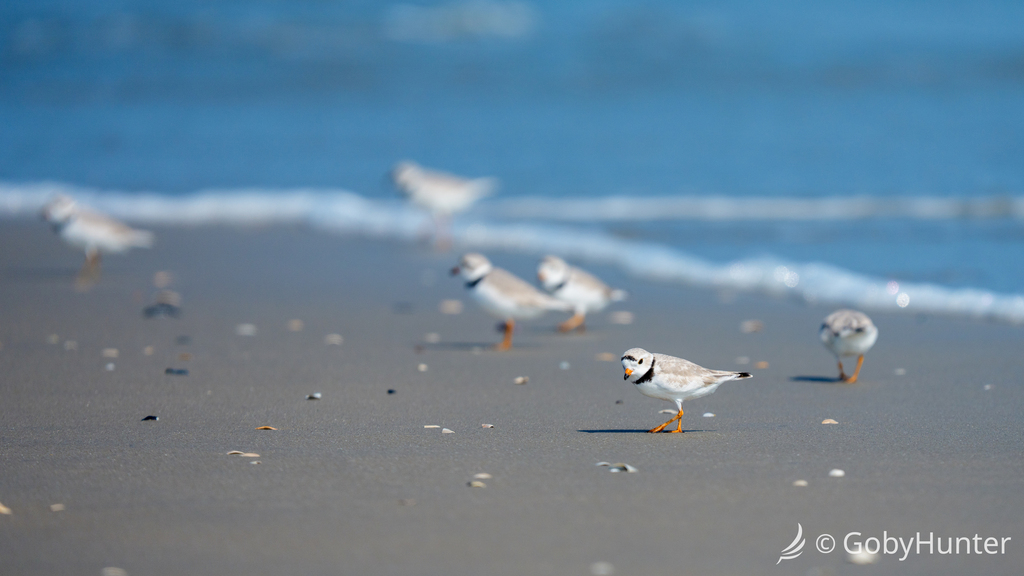
(c) GobyHunter, some rights reserved (CC BY) · licence
Family: Charadriidae · Class: Aves · Order: Charadriiformes
Charadrius melodus (Piping Plover) is a California animal in the Charadriidae family.
The Piping Plover is a small, stocky shorebird measuring 17-18 cm (6.7-7.1 inches) in length with a wingspan of 35-41 cm (14-16 inches). Adults have pale sandy-brown upperparts and white underparts. During breeding season, males develop a distinctive black band across the forehead and a partial black collar around the neck. The legs are bright orange-yellow, and the bill is orange with a black tip. Non-breeding adults and juveniles lack the distinctive black markings and have duller leg coloration. The Piping Plover breeds across three distinct populations in North America. The Great Lakes population nests along the shores of Lakes Superior, Huron, and Michigan. The Northern Great Plains population breeds from Alberta, Canada south through the central United States to Colorado, Nebraska, and Kansas. The Atlantic Coast population nests from Newfoundland south to North Carolina. In winter, all populations migrate to coastal areas along the Atlantic, Gulf, and Caribbean coasts. California serves primarily as wintering habitat, with birds occurring along sandy beaches from September through April. Breeding habitat consists of wide, sandy beaches, alkali flats, sandflats, and shorelines of lakes and reservoirs with minimal vegetation cover, typically less than 20% (Haig 1986). Nesting areas feature a mix of substrates including sand, pebbles, and shell fragments. In the Great Plains, birds utilize both alkaline and freshwater lakes and reservoirs. Wintering habitat includes coastal sandy beaches, mudflats, sandflats, and occasionally interior alkali lakes. The species requires open areas with good visibility for foraging and predator detection. Piping Plovers are ground-nesters that create simple scrapes in sand or gravel, often lined with small shells, pebbles, or vegetation. Breeding occurs from April through August, with females typically laying 3-4 eggs. Incubation lasts 25-31 days, with both parents sharing duties. Chicks are precocial and leave the nest within hours of hatching but remain dependent on parents for 25-35 days until fledging. The species feeds primarily on marine worms, crustaceans, mollusks, and insects, employing a characteristic stop-and-go foraging behavior. The Piping Plover is federally listed as Endangered (Great Lakes population) and Threatened (Northern Great Plains and Atlantic Coast populations) under the Endangered Species Act. The species experienced severe population declines due to habitat loss, human disturbance, and predation. According to the U.S. Fish and Wildlife Service, fewer than 3,000 breeding pairs were detected in the U.S. and Canada in 2001. Critical habitat has been designated for all three breeding populations as well as wintering areas. Recovery efforts focus on habitat protection, nest monitoring, predator management, and reducing human disturbance through seasonal closures and public education programs.
Classification
Class: Aves · Order: Charadriiformes · Family: Charadriidae
Frequently asked questions
How is Charadrius melodus classified?
Charadrius melodus belongs to class Aves, order Charadriiformes, family Charadriidae.
What family does Charadrius melodus belong to?
Charadrius melodus is in the Charadriidae family.
What is Charadrius melodus?
The Piping Plover is a small, stocky shorebird measuring 17-18 cm (6.7-7.1 inches) in length with a wingspan of 35-41 cm (14-16 inches).
Is Charadrius melodus found in California?
Yes. Charadrius melodus is recorded in California in The California Species Project's catalogue.
Related species
Other California species in the same genus, family, or bioregion.
Data from The California Species Project — 14,000+ California species with verified data from CNPS, CDFW, USFWS, and more.