Charadrius vociferus
Killdeer
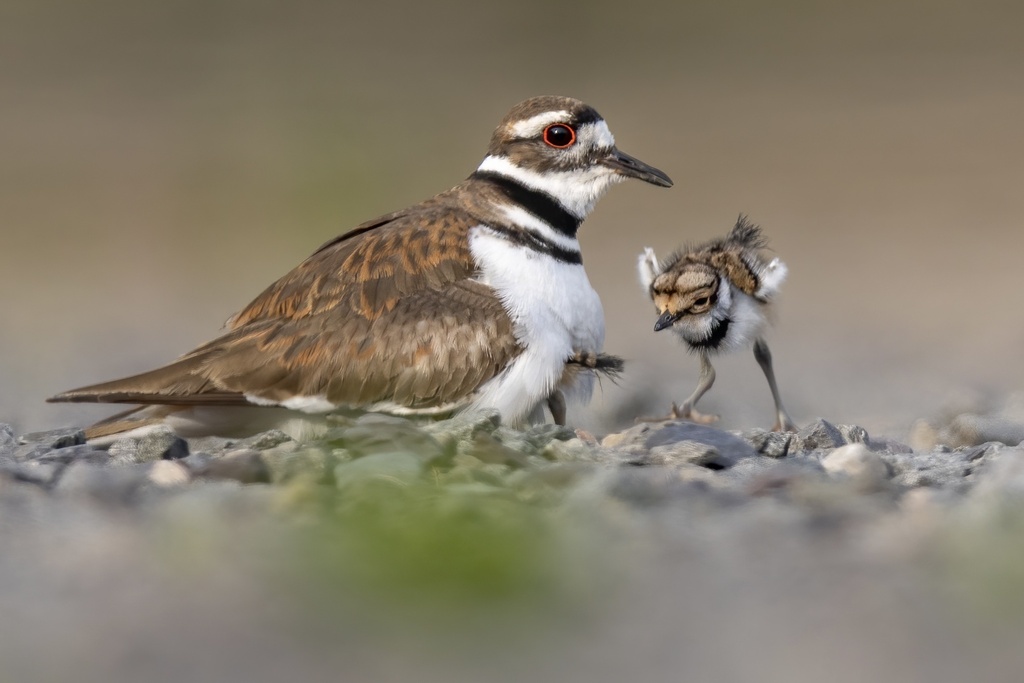
(c) Matt Felperin, some rights reserved (CC BY) · licence
Family: Charadriidae · Class: Aves · Order: Charadriiformes
Charadrius vociferus (Killdeer) is a California animal in the Charadriidae family.
The Killdeer is a medium-sized shorebird measuring 20 to 28 centimeters (8 to 11 inches) in length with a wingspan of 46 to 48 centimeters (18 to 19 inches). Adults weigh 72 to 121 grams (2.5 to 4.3 ounces). The species displays distinctive plumage with a brown back and wings, white underparts, and two prominent black breast bands that distinguish it from other plovers. The head features a white forehead bordered by black bands above and below, creating a striking facial pattern. The bill is short, straight, and black, while the legs are pale flesh-colored to yellow. During flight, the wings reveal bright rufous-orange patches and white wing stripes. Killdeer have one of the largest breeding ranges of any North American shorebird, extending from southern Alaska and Canada south through the United States to northern South America. In California, the species breeds throughout the state from sea level to elevations exceeding 2,100 meters (7,000 feet). Populations are year-round residents in most of California, though northern breeding populations migrate south for winter. The species occurs in all 58 California counties, with highest densities in agricultural areas of the Central Valley. Unlike most shorebirds, Killdeer inhabit terrestrial environments rather than coastal wetlands. The species occupies open areas with sparse vegetation, including agricultural fields, pastures, golf courses, parking lots, gravel roads, airports, and disturbed ground. They prefer areas with short grass or bare soil that provide clear sightlines for predator detection. Nesting occurs on open ground with minimal vegetation, often on gravel, sand, or dirt surfaces. Killdeer are primarily insectivorous, feeding on beetles, fly larvae, caterpillars, grasshoppers, and other invertebrates. They employ a characteristic stop-and-go foraging behavior, running short distances then pausing to pick prey from the surface. The species is monogamous during the breeding season, which extends from March through August in California. Females lay 3 to 5 buff-colored eggs with dark spots in a shallow scrape lined with small stones, shell fragments, or vegetation. Incubation lasts 24 to 26 days, with both parents sharing duties. Killdeer are famous for their broken-wing distraction display, where adults feign injury to lead potential predators away from nests or young. Chicks are precocial, leaving the nest within hours of hatching and capable of feeding themselves while remaining under parental protection for 25 to 35 days. The Killdeer is not federally or state listed and maintains stable populations across most of its range. According to the North American Breeding Bird Survey, continental populations have remained relatively stable since 1966, though some regional declines have been documented. The species benefits from human-modified landscapes, particularly agriculture, which creates suitable open habitat. Primary threats include habitat loss from urban development, pesticide use in agricultural areas, and ground predation at nest sites. Climate change may affect northern populations through altered precipitation patterns and temperature extremes, but the species' adaptability and broad habitat tolerance provide resilience against environmental changes.
Classification
Class: Aves · Order: Charadriiformes · Family: Charadriidae
Frequently asked questions
How is Charadrius vociferus classified?
Charadrius vociferus belongs to class Aves, order Charadriiformes, family Charadriidae.
What family does Charadrius vociferus belong to?
Charadrius vociferus is in the Charadriidae family.
What is Charadrius vociferus?
The Killdeer is a medium-sized shorebird measuring 20 to 28 centimeters (8 to 11 inches) in length with a wingspan of 46 to 48 centimeters (18 to 19 inches).
Is Charadrius vociferus found in California?
Yes. Charadrius vociferus is recorded in California in The California Species Project's catalogue.
Related species
Other California species in the same genus, family, or bioregion.
Data from The California Species Project — 14,000+ California species with verified data from CNPS, CDFW, USFWS, and more.