Charina umbratica
Southern rubber boa
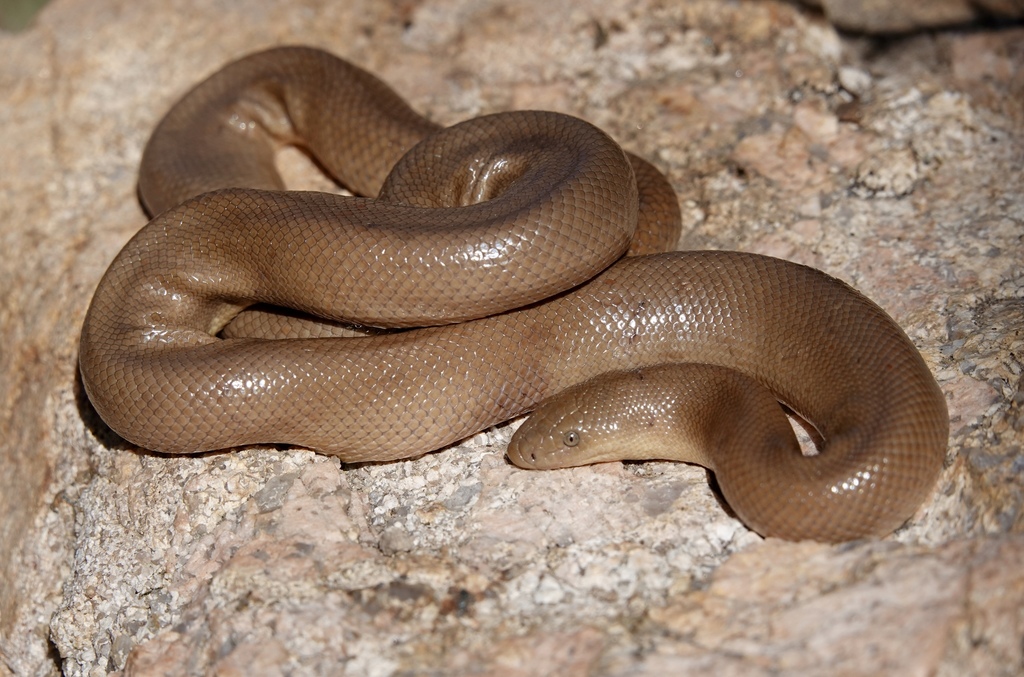
(c) nmoorhatch, some rights reserved (CC BY) · licence
Family: Boidae · Class: Reptilia · Order: Squamata
Conservation status: ST · G2G3 S2
Charina umbratica (Southern rubber boa) is a California animal in the Boidae family.
The Southern rubber boa (Charina umbratica) is a small, non-venomous constrictor snake endemic to the mountains of Southern California. Adults typically measure 35 to 84 centimeters (14 to 33 inches) in total length, with females generally larger than males. The body is cylindrical and uniform in diameter, with a distinctly blunt tail that resembles the head shape. Dorsally, the snake displays brown, tan, or olive coloration with a smooth, rubbery texture created by small, overlapping scales. The ventral surface is cream to yellow. The head is small and poorly differentiated from the neck, with small eyes and vertical pupils adapted for crepuscular activity. The Southern rubber boa occupies a highly restricted range in the mountains of Los Angeles, Riverside, and San Bernardino counties. Historically considered a subspecies of the Northern rubber boa (Charina bottae), it was recognized as a distinct species in 2001 based on genetic and morphological differences. The species occurs primarily in the San Bernardino Mountains, San Jacinto Mountains, and Palomar Mountains, with isolated populations in the Santa Ana Mountains and Peninsular Ranges. This species inhabits coniferous and mixed forests at elevations ranging from 1,200 to 2,750 meters (3,900 to 9,000 feet). Preferred habitat includes areas with loose soil, leaf litter, and decomposing logs that facilitate burrowing behavior. The snake is commonly found under rocks, logs, and bark, particularly in areas with Jeffrey pine, ponderosa pine, white fir, and oak woodlands. Riparian zones and meadow edges within forested landscapes provide important habitat components. Southern rubber boas are fossorial and primarily nocturnal, spending most daylight hours underground or beneath surface cover objects. They are powerful constrictors that feed primarily on small mammals, particularly rodents, shrews, and occasionally bird nestlings. Reproduction is ovoviviparous, with females retaining eggs internally until hatching. Mating occurs in spring following emergence from winter dormancy, with females giving birth to 2 to 8 live young in late summer or early fall after a gestation period of approximately four to five months. Neonates measure 19 to 23 centimeters (7.5 to 9 inches) at birth. The Southern rubber boa was listed as threatened by the California Fish and Game Commission in 1971, making it one of the first reptile species to receive state protection. According to the California Department of Fish and Wildlife, the species faces significant conservation challenges due to habitat loss, fragmentation, and degradation from urban development, logging, and recreational activities. Climate change poses additional threats through altered precipitation patterns and increased wildfire frequency in montane habitats. Fire suppression activities and associated road building have further impacted suitable habitat. Population estimates remain uncertain due to the species' secretive nature and limited survey efforts, though available data suggest declining trends across much of the historical range. Conservation efforts focus on habitat protection, fire management planning, and research to better understand population dynamics and ecological requirements.
Classification
Class: Reptilia · Order: Squamata · Family: Boidae
Conservation status
ST · G2G3 S2
Frequently asked questions
How is Charina umbratica classified?
Charina umbratica belongs to class Reptilia, order Squamata, family Boidae.
What family does Charina umbratica belong to?
Charina umbratica is in the Boidae family.
Is Charina umbratica protected or of conservation concern?
Charina umbratica carries the following status: ST · G2G3 S2.
What is Charina umbratica?
The Southern rubber boa (Charina umbratica) is a small, non-venomous constrictor snake endemic to the mountains of Southern California.
Is Charina umbratica found in California?
Yes. Charina umbratica is recorded in California in The California Species Project's catalogue.
Related species
Other California species in the same genus, family, or bioregion.
Data from The California Species Project — 14,000+ California species with verified data from CNPS, CDFW, USFWS, and more.