Chelifer cancroides
House Pseudoscorpion
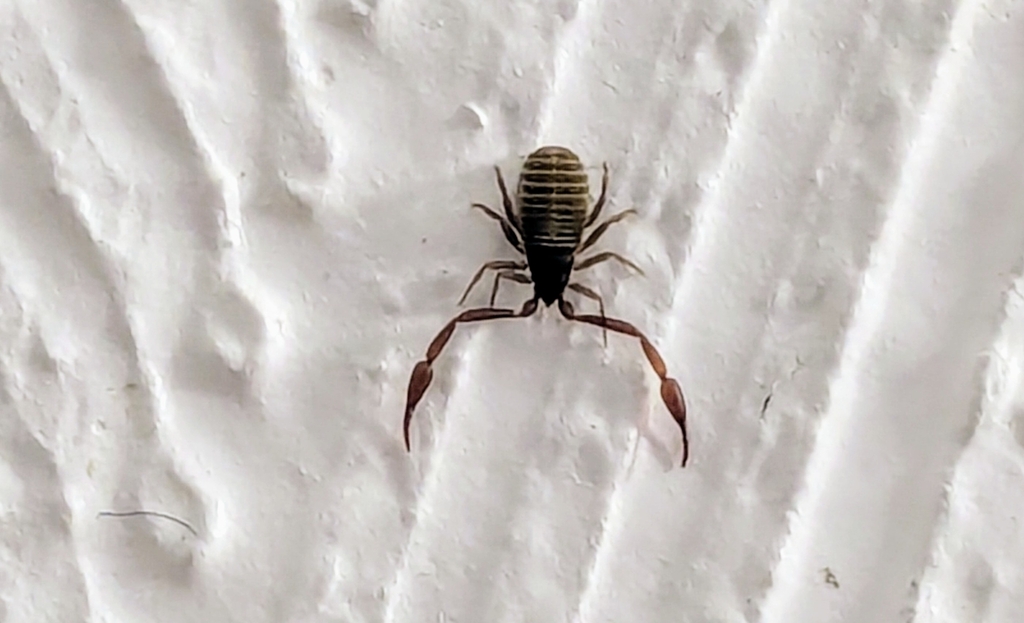
(c) Jason Hill, some rights reserved (CC BY) · licence
Family: Cheliferidae · Class: Arachnida · Order: Pseudoscorpiones
Chelifer cancroides (House Pseudoscorpion) is a California animal in the Cheliferidae family.
The house pseudoscorpion is a small arachnid belonging to the order Pseudoscorpiones, family Cheliferidae. Adults typically measure 2-4 mm (0.08-0.16 inches) in body length, with a flattened, oval-shaped cephalothorax and segmented abdomen. The species possesses two prominent pedipalps that resemble miniature scorpion claws, though it lacks the tail and stinger characteristic of true scorpions. The body coloration ranges from pale yellow to reddish-brown, with darker markings on the dorsal surface. Eight walking legs and chelate pedipalps distinguish this species from other small household arthropods. Chelifer cancroides has a cosmopolitan distribution and occurs throughout California and much of North America. According to NatureServe, the species has a global conservation rank of G4-G5, indicating it is apparently secure to secure globally (NatureServe Explorer). The species has been documented across multiple biogeographic regions, from coastal areas to inland valleys, though specific California county records require additional documentation. This pseudoscorpion inhabits a wide variety of microhabitats, showing particular association with human-modified environments. The species commonly occurs in houses, barns, libraries, and other buildings where it finds suitable prey and shelter. Natural habitats include leaf litter, under bark of dead trees, in bird nests, and among debris in various terrestrial ecosystems. The species tolerates a broad range of environmental conditions, contributing to its widespread distribution. House pseudoscorpions are predatory arachnids that feed primarily on small arthropods including mites, springtails, booklice, and small flies. They capture prey using their chelate pedipalps, which contain venom glands for subduing victims (Harvey 2013). Reproduction involves indirect sperm transfer through spermatophores, with males performing elaborate courtship displays (Weygoldt 1969). Females carry developing young in a brood pouch, and juveniles undergo several molts before reaching sexual maturity. The species exhibits positive thigmotaxis, preferring confined spaces and crevices for shelter (Muchmore 1990). Chelifer cancroides has no federal or state conservation listing status and is not considered a species of conservation concern. The species' synanthropic habits and broad ecological tolerance have likely contributed to stable or expanding populations in association with human development. Unlike many native arthropods, this cosmopolitan species appears to benefit from urbanization and the creation of novel habitats. No specific conservation measures are currently needed, though the species may serve as an indicator of ecosystem health in urban and suburban environments. The house pseudoscorpion represents one of the most widespread and well-adapted pseudoscorpion species in North America. Its ability to colonize human-associated environments while maintaining populations in natural habitats demonstrates significant ecological plasticity. Research on this species contributes to understanding pseudoscorpion biology and their role as predators in various ecosystems.
Classification
Class: Arachnida · Order: Pseudoscorpiones · Family: Cheliferidae
Frequently asked questions
How is Chelifer cancroides classified?
Chelifer cancroides belongs to class Arachnida, order Pseudoscorpiones, family Cheliferidae.
What family does Chelifer cancroides belong to?
Chelifer cancroides is in the Cheliferidae family.
What is Chelifer cancroides?
The house pseudoscorpion is a small arachnid belonging to the order Pseudoscorpiones, family Cheliferidae.
Is Chelifer cancroides found in California?
Yes. Chelifer cancroides is recorded in California in The California Species Project's catalogue.
More California species
This species has no close relatives in our California data — here are other species to explore.
Data from The California Species Project — 14,000+ California species with verified data from CNPS, CDFW, USFWS, and more.