Chelinidea vittiger
Cactus Coreid Bug
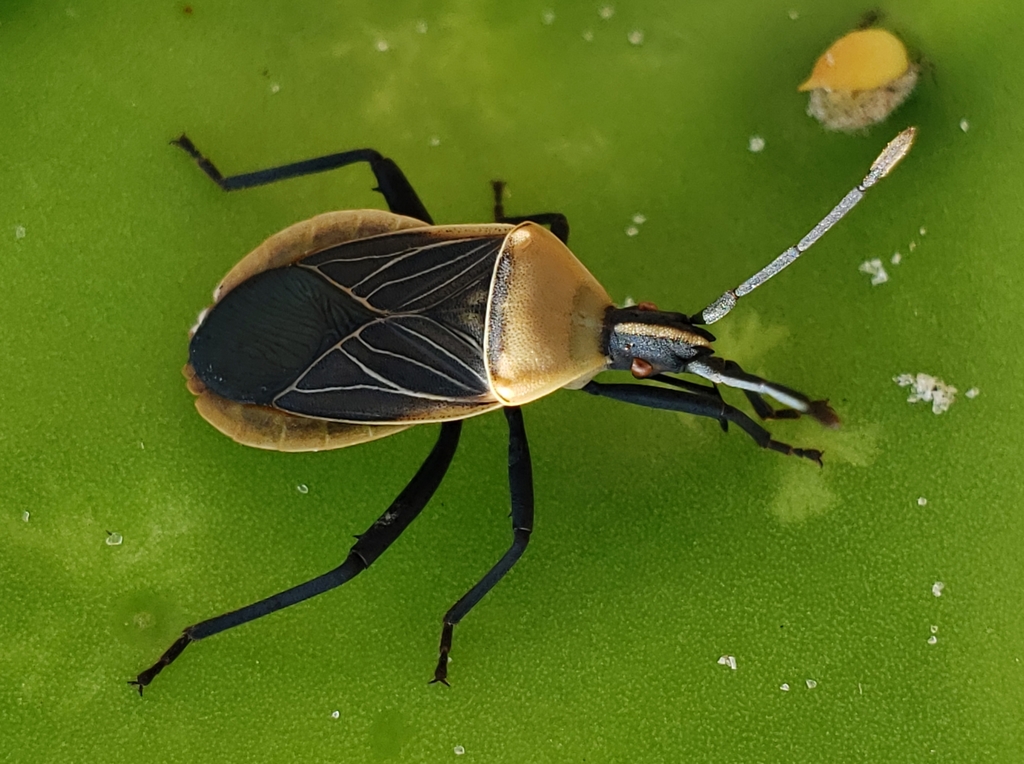
(c) Arturo Santos, some rights reserved (CC BY) · licence
Family: Coreidae · Class: Insecta · Order: Hemiptera
Chelinidea vittiger (Cactus Coreid Bug) is a California animal in the Coreidae family.
The Cactus Coreid Bug is a small true bug in the leaf-footed bug family Coreidae. Adults measure 12 to 15 millimeters (0.47 to 0.59 inches) in length (BugGuide). The species name 'vittiger' translates to 'stripe-bearing,' referring to distinctive striped markings on the body. As members of the Coreidae family, these insects possess the characteristic leaf-like expansions on their hind legs, though specific morphological details for this species require further documentation. Chelinidea vittiger has an extensive North American range, occurring from Quebec to Virginia and Florida in the east, extending west through Saskatchewan and Alberta to Oregon and California, and south into Mexico (BugGuide). In California, the species is present throughout suitable habitat areas where host plants occur. The subspecies C. v. aequoris represents populations in the southeastern United States (BugGuide). This species demonstrates strict host plant specialization, feeding exclusively on prickly pear cacti (Opuntia species) (BugGuide). The bugs inhabit desert and semi-arid environments where these cacti naturally occur, including desert scrublands, chaparral margins, and disturbed areas where Opuntia has established. Their distribution closely follows that of their cactus hosts, limiting them to areas with appropriate climate conditions for these succulent plants. The Cactus Coreid Bug exhibits a complex annual life cycle tied to its host plants. Reproduction begins in March when females deposit eggs longitudinally on the undersides of prickly pear spines (BugGuide). The egg-laying period for each generation extends over two to three months, allowing for staggered development. Nymphal development rates vary considerably depending on environmental conditions, with adults being notably long-lived, surviving nine to twelve months (BugGuide). This extended adult lifespan allows individuals to persist through harsh environmental conditions and multiple reproductive cycles. Both nymphs and adults feed by piercing cactus pads and stems with their needle-like mouthparts, extracting plant fluids. The species plays a notable role in biological control programs. Chelinidea vittiger was introduced to Australia as part of efforts to control invasive prickly pear cacti that had become serious agricultural pests (BugGuide). The bug's host specificity made it a suitable candidate for classical biological control, demonstrating the ecological importance of specialized herbivore relationships. Chelinidea vittiger appears on recovery planning documents as an herbivore affecting federally protected plant species, specifically mentioned in connection with Black Lace Cactus (Echinocereus reichenbachii var. albertii) recovery efforts (USFWS Recovery Plan Amendment). While not itself listed under the Endangered Species Act, the species' interactions with rare cacti highlight the complex ecological relationships in desert ecosystems. Current conservation status appears stable across most of its range, with NatureServe ranking it as apparently secure to secure (G4-G5) (NatureServe Explorer). However, habitat loss and fragmentation of desert ecosystems may pose localized threats to populations, particularly in rapidly developing regions of California and the southwestern United States.
Classification
Class: Insecta · Order: Hemiptera · Family: Coreidae
Frequently asked questions
How is Chelinidea vittiger classified?
Chelinidea vittiger belongs to class Insecta, order Hemiptera, family Coreidae.
What family does Chelinidea vittiger belong to?
Chelinidea vittiger is in the Coreidae family.
What is Chelinidea vittiger?
The Cactus Coreid Bug is a small true bug in the leaf-footed bug family Coreidae.
Is Chelinidea vittiger found in California?
Yes. Chelinidea vittiger is recorded in California in The California Species Project's catalogue.
Related species
Other California species in the same genus, family, or bioregion.
Data from The California Species Project — 14,000+ California species with verified data from CNPS, CDFW, USFWS, and more.