Chelonia mydas
Green turtle
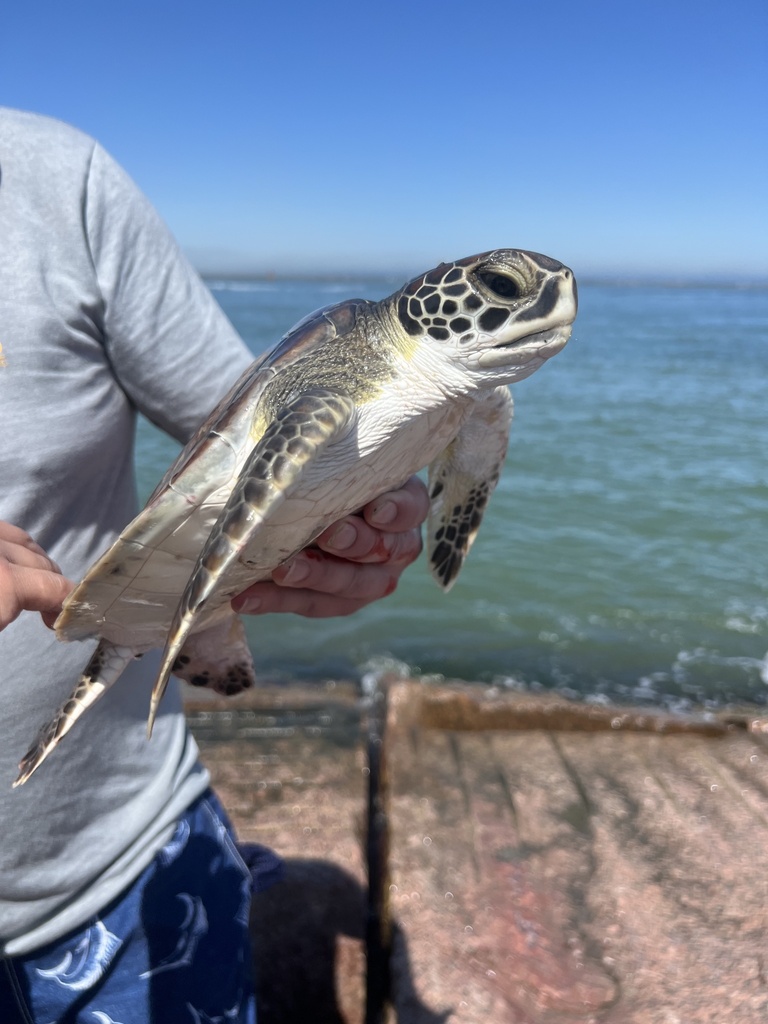
(c) Jared Shorma, some rights reserved (CC BY) · licence
Family: Cheloniidae · Class: Reptilia · Order: Testudines
Conservation status: Threatened · G3 S1
Chelonia mydas (Green turtle) is a California animal in the Cheloniidae family.
The green turtle is a large marine reptile and one of the most widely distributed sea turtle species. Adults typically measure 100 to 150 cm (39 to 59 inches) in carapace length and weigh 110 to 230 kg (240 to 510 pounds), with some individuals exceeding 300 kg (660 pounds). The carapace varies from olive to brown, sometimes with radiating patterns, while the plastron is typically cream or yellow. The species is distinguished by its single pair of prefrontal scales and four pairs of lateral scutes on the carapace. The common name derives from the greenish color of the fat beneath the carapace, not the shell itself. Green turtles inhabit tropical and subtropical waters worldwide. The East Pacific Distinct Population Segment, which includes California waters, ranges throughout the Central North Pacific Ocean within coordinates bounded by 41 degrees N., 169 degrees E. in the northwest; 41 degrees N., 143 degrees W. in the northeast; 9 degrees N., 125 degrees W. in the southeast; and 9 degrees N., 175 degrees W. in the southwest, extending to the Pacific coast of Mexico. In California, green turtles are observed primarily in nearshore waters along the coast, with concentrations in areas such as San Diego Bay, the Channel Islands, and foraging areas off central California. Adults inhabit shallow coastal waters including bays, lagoons, and nearshore reefs where seagrass beds and algal communities are present. Juveniles often utilize pelagic environments, associating with floating debris and convergence zones. Nesting occurs on sandy beaches in warmer climates, though the East Pacific population primarily nests on beaches in Mexico, particularly Michoacán, and Costa Rica. Green turtles exhibit ontogenetic dietary shifts. Juveniles are omnivorous, consuming jellyfish, crustaceans, fish eggs, and various invertebrates. Adults are primarily herbivorous, feeding on seagrasses, algae, and marine vegetation. This shift typically occurs when individuals reach 35 to 40 cm carapace length. Females reach sexual maturity at 20 to 40 years and return to natal beaches to nest every 2 to 4 years. Clutches contain 100 to 200 eggs, with multiple nesting events per season occurring at 12 to 14 day intervals. According to the California Department of Fish and Wildlife, green sea turtles were originally listed as federally threatened in 1978. In 2016, distinct population segments were detailed, and the East Pacific DPS was confirmed as federally threatened under the Endangered Species Act. Primary threats include fisheries bycatch, coastal development affecting nesting beaches, marine pollution including plastic debris, boat strikes, and climate change impacts on nesting sites and food sources. Fibropapillomatosis, a tumor-causing disease, also affects populations. Recovery efforts include nest protection programs, fishery modifications to reduce bycatch, and international cooperation for migratory species management across the Pacific.
Classification
Class: Reptilia · Order: Testudines · Family: Cheloniidae
Conservation status
Threatened · G3 S1
Frequently asked questions
How is Chelonia mydas classified?
Chelonia mydas belongs to class Reptilia, order Testudines, family Cheloniidae.
What family does Chelonia mydas belong to?
Chelonia mydas is in the Cheloniidae family.
Is Chelonia mydas protected or of conservation concern?
Chelonia mydas carries the following status: Threatened · G3 S1.
What is Chelonia mydas?
The green turtle is a large marine reptile and one of the most widely distributed sea turtle species.
Is Chelonia mydas found in California?
Yes. Chelonia mydas is recorded in California in The California Species Project's catalogue.
Related species
Other California species in the same genus, family, or bioregion.
Data from The California Species Project — 14,000+ California species with verified data from CNPS, CDFW, USFWS, and more.