Chionactis occipitalis
Western Shove-nosed Snake
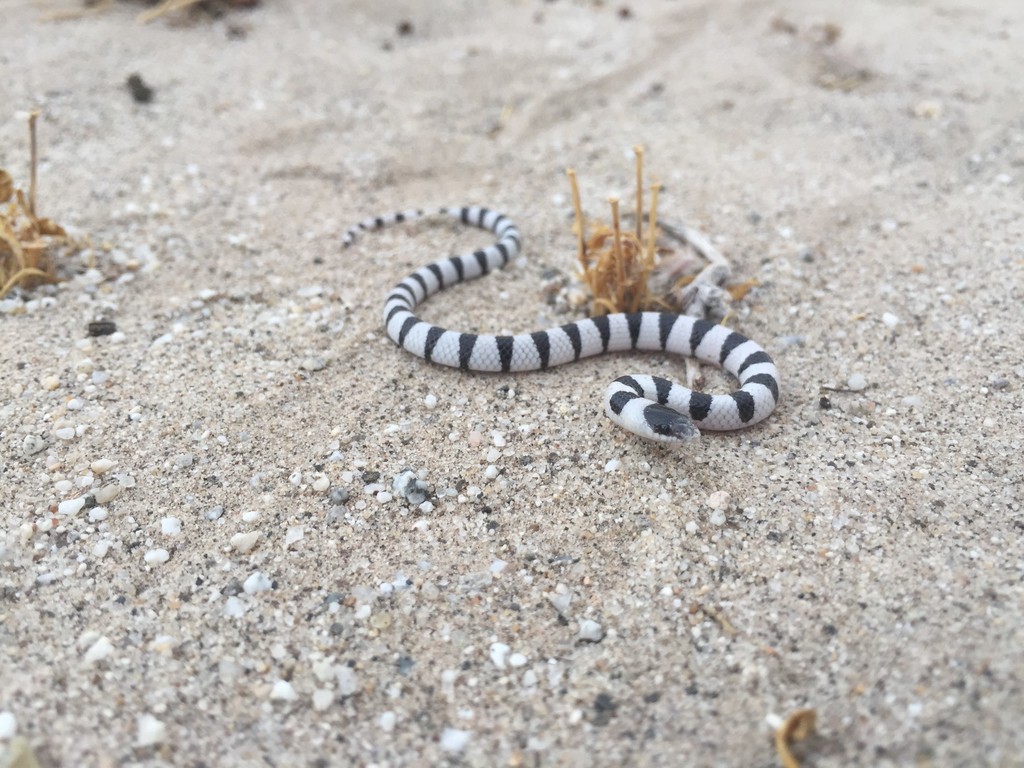
(c) Danny Mccamish, some rights reserved (CC BY) · licence
Family: Colubridae · Class: Reptilia · Order: Squamata
Chionactis occipitalis (Western Shove-nosed Snake) is a California animal in the Colubridae family.
The Western Shove-nosed Snake (Chionactis occipitalis), also known as the Mohave Shovel-nosed Snake, is a small, fossorial colubrid snake endemic to the southwestern United States and northwestern Mexico. Adults typically measure 254 to 432 mm (10 to 17 inches) in total length, with females generally larger than males. The species exhibits a distinctive cylindrical body form with a flattened, shovel-shaped snout adapted for burrowing. The dorsal surface displays alternating bands of cream or yellow with black crossbands, while the ventral surface is uniformly pale. The head is small and continuous with the neck, lacking a distinct cervical constriction. The eyes are proportionally small with round pupils, and the nasal scale is enlarged and projects forward. The Western Shove-nosed Snake occurs in the Sonoran and Mojave deserts of southeastern California, southern Nevada, southwestern Arizona, and northwestern Mexico. In California, the species is documented from Imperial, Riverside, and San Bernardino counties, extending from the Salton Sea region eastward to the Colorado River. The northern range limit reaches approximately 35°N latitude in the Mojave Desert. Historical records indicate a continuous distribution across suitable habitat within this range. This species inhabits sandy desert washes, alluvial fans, and flat desert floors with loose, sandy soils. Elevation ranges from below sea level in the Salton Basin to approximately 610 meters (2,000 feet) in upland desert areas. The substrate preference is critical, as the snake requires fine sand or sandy loam for effective burrowing. Associated vegetation includes creosote bush scrub, desert saltbush, and sparse desert annual communities. Areas with scattered desert shrubs providing minimal surface cover are preferred. Western Shove-nosed Snakes are primarily nocturnal and fossorial, spending daylight hours buried in sand 15 to 45 cm (6 to 18 inches) below the surface. Surface activity occurs during warm nights from April through October, with peak activity during summer months when ambient temperatures exceed 21°C (70°F). The diet consists primarily of small arthropods, including beetle larvae, moth caterpillars, crickets, and occasionally small lizards and snake eggs. Reproduction occurs in spring, with females depositing 2 to 4 elongate eggs in sandy soil from May through July. Incubation requires approximately 45 to 60 days, with hatchlings measuring 152 to 203 mm (6 to 8 inches) in length. The Western Shove-nosed Snake has no federal or state conservation status designation and is considered relatively stable throughout its range. Population trends are poorly documented due to the species' secretive nature and specialized habitat requirements. Primary threats include habitat fragmentation from urban development, off-road vehicle activity that compacts sand substrates, and alteration of natural wash systems. Climate change may affect the species through increased temperatures and altered precipitation patterns affecting desert ecosystem dynamics.
Classification
Class: Reptilia · Order: Squamata · Family: Colubridae
Frequently asked questions
How is Chionactis occipitalis classified?
Chionactis occipitalis belongs to class Reptilia, order Squamata, family Colubridae.
What family does Chionactis occipitalis belong to?
Chionactis occipitalis is in the Colubridae family.
What is Chionactis occipitalis?
The Western Shove-nosed Snake (Chionactis occipitalis), also known as the Mohave Shovel-nosed Snake, is a small, fossorial colubrid snake endemic to the southwestern United States and northwestern Mexico.
Is Chionactis occipitalis found in California?
Yes. Chionactis occipitalis is recorded in California in The California Species Project's catalogue.
Related species
Other California species in the same genus, family, or bioregion.
Data from The California Species Project — 14,000+ California species with verified data from CNPS, CDFW, USFWS, and more.