Chlorion aerarium
Steel-blue Cricket-hunter Wasp
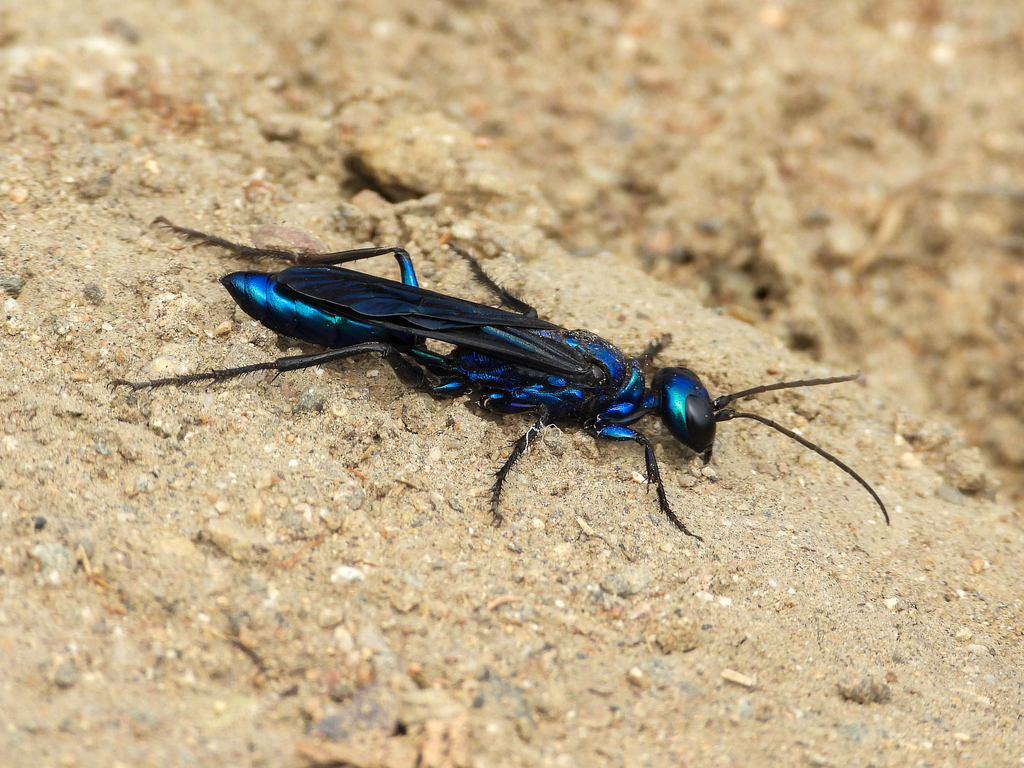
(c) James M. Maley, some rights reserved (CC BY) · licence
Family: Sphecidae · Class: Insecta · Order: Hymenoptera
Chlorion aerarium (Steel-blue Cricket-hunter Wasp) is a California animal in the Sphecidae family.
The Steel-blue Cricket-hunter Wasp (Chlorion aerarium) is a large, solitary wasp in the family Sphecidae. Adults measure 20-25 mm in length and display distinctive metallic blue-black coloration across the head, thorax, and abdomen. The species exhibits sexual dimorphism in facial features, with males lacking silvery pubescence on the face, a characteristic that distinguishes them from the closely related Chlorion cyaneum (BugGuide). Females have smooth mesopleuron surfaces between punctures and fine, scattered punctures on the pronotum and scutum. Chlorion aerarium occurs across much of North America, with documented populations extending from southern Canada to Mexico. In California, the species has been recorded from San Diego County, with observations from locations including Fallbrook (BugGuide). The wasp's range encompasses diverse geographic regions, though specific distribution patterns within California require further documentation. This species inhabits open areas including meadows, overgrown fields, coastal dunes, and beach edges (BugGuide). Adults are typically encountered in sunny, exposed habitats where their cricket prey is abundant. The wasps may hunt in different microhabitats than where they are commonly observed, suggesting complex spatial ecology tied to both nesting requirements and prey availability. As their common name indicates, Steel-blue Cricket-hunter Wasps are specialized predators of crickets, distinguishing them from C. cyaneum which targets cockroaches (BugGuide). Females capture crickets through active hunting, paralyzing them with venom before transporting the prey to underground nest burrows. The paralyzed crickets serve as food provisions for developing larvae. Adults provision individual nest cells with one or more crickets before laying a single egg and sealing the chamber. The species exhibits typical sphecid wasp behavior, with females conducting all nest construction, provisioning, and brood care activities. Chlorion aerarium follows an annual life cycle common among temperate zone sphecid wasps. Adults are most active during warm months when cricket populations peak. Mating occurs after emergence, with females subsequently establishing territories and beginning nest construction in suitable soil substrates. The species overwinters as mature larvae or pupae within sealed nest cells. Currently, Chlorion aerarium lacks formal conservation status at federal or state levels. Population trends and conservation needs have not been systematically assessed. The species appears to maintain stable populations across its range, though urbanization and habitat modification in coastal California may affect local populations. Climate change impacts on prey availability and nesting habitat suitability remain unstudied. As with many native pollinators and beneficial insects, long-term monitoring would help assess population stability and conservation requirements. Detailed ecological studies of this species remain limited. The information presented here synthesizes available data from taxonomic databases and naturalist observations. Additional research on nesting biology, prey specificity, and habitat requirements would enhance understanding of this native predatory wasp's ecological role.
Classification
Class: Insecta · Order: Hymenoptera · Family: Sphecidae
Frequently asked questions
How is Chlorion aerarium classified?
Chlorion aerarium belongs to class Insecta, order Hymenoptera, family Sphecidae.
What family does Chlorion aerarium belong to?
Chlorion aerarium is in the Sphecidae family.
What is Chlorion aerarium?
The Steel-blue Cricket-hunter Wasp (Chlorion aerarium) is a large, solitary wasp in the family Sphecidae.
Is Chlorion aerarium found in California?
Yes. Chlorion aerarium is recorded in California in The California Species Project's catalogue.
Related species
Other California species in the same genus, family, or bioregion.
Data from The California Species Project — 14,000+ California species with verified data from CNPS, CDFW, USFWS, and more.