Chlorochlamys appellaria
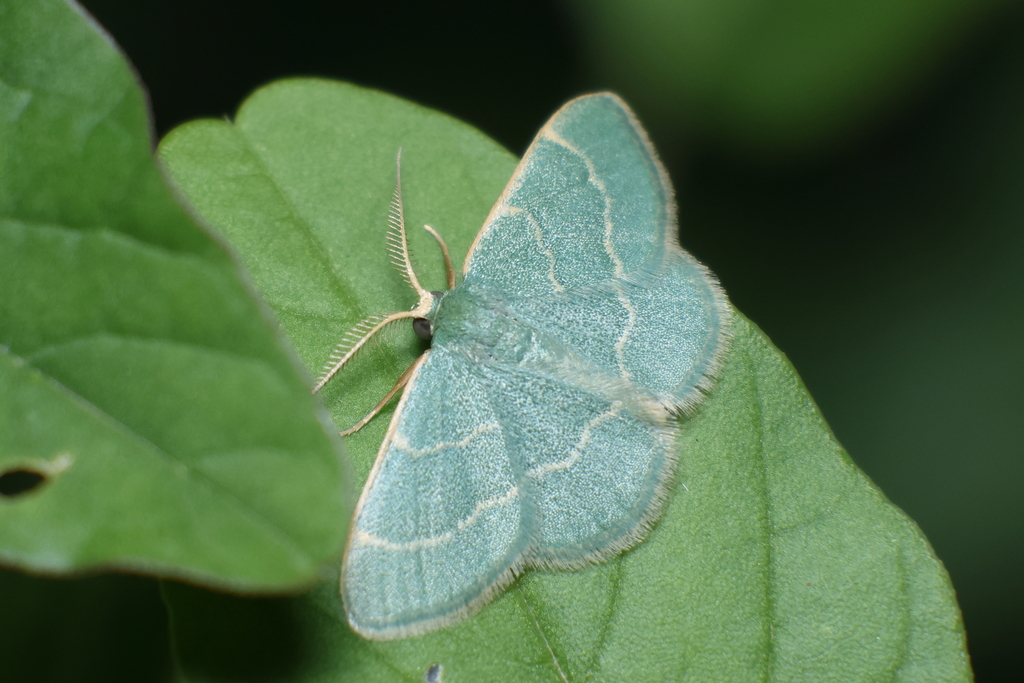
(c) Isaac Ethington, some rights reserved (CC BY) · licence
Family: Geometridae · Class: Insecta · Order: Lepidoptera
Chlorochlamys appellaria is a California animal in the Geometridae family.
Chlorochlamys appellaria is a small moth in the family Geometridae, commonly known as geometrid moths or inchworms. Adults typically measure 18 to 25 mm (0.7 to 1.0 inches) in wingspan. The forewings are pale green to yellowish-green with subtle white and darker green markings that create a delicate pattern across the wing surface. The hindwings are similarly colored but generally paler than the forewings. Like other members of the genus Chlorochlamys, the wings have a translucent quality and the body is slender with thread-like antennae. This species has a broad distribution across the western and south-central United States. The range extends from southern California eastward through Nevada and Utah, continuing to Oklahoma and reaching the coast of Texas. Within California, C. appellaria occurs primarily in the southern regions where suitable host plants are abundant. The species' distribution closely follows the range of its host plants in the genus Eriogonum. Chlorochlamys appellaria inhabits arid and semi-arid environments where buckwheat species (Eriogonum) grow naturally. These areas typically include desert scrublands, chaparral, oak woodlands, and grassland margins. The species is found from sea level to moderate elevations, generally below 2,000 meters (6,500 feet). Adults are attracted to areas with abundant flowering plants that provide nectar sources, while larvae require the specific chemistry of Eriogonum foliage for development. Larvae of C. appellaria are obligate feeders on plants in the genus Eriogonum, commonly known as buckwheat or wild buckwheat. These caterpillars are typical geometrid larvae, characterized by their looping locomotion as they move along stems and leaves. The larvae are well-camouflaged, typically green or brown to match their host plant's coloration. Development from egg to adult typically requires one to two generations per year, depending on local climate conditions and host plant phenology. Adults are primarily nocturnal and are attracted to artificial lights during their flight period. The species exhibits seasonal flight patterns that vary with geographic location and local weather conditions. In warmer southern portions of the range, adults may be active for extended periods from spring through fall. Males locate females through chemical communication using species-specific pheromones. Females deposit eggs singly or in small clusters on or near Eriogonum host plants. Chlorochlamys appellaria does not appear on federal or state endangered species lists and is not currently considered a conservation concern. The species benefits from the widespread distribution of Eriogonum plants across its range, many of which are common in disturbed and natural habitats. However, like many specialized herbivorous insects, populations may be locally affected by habitat loss, urban development, and changes in land use that reduce availability of native buckwheat species. Climate change may also influence the species' distribution as it affects both the moth and its host plants.
Classification
Class: Insecta · Order: Lepidoptera · Family: Geometridae
Frequently asked questions
How is Chlorochlamys appellaria classified?
Chlorochlamys appellaria belongs to class Insecta, order Lepidoptera, family Geometridae.
What family does Chlorochlamys appellaria belong to?
Chlorochlamys appellaria is in the Geometridae family.
What is Chlorochlamys appellaria?
Chlorochlamys appellaria is a small moth in the family Geometridae, commonly known as geometrid moths or inchworms.
Is Chlorochlamys appellaria found in California?
Yes. Chlorochlamys appellaria is recorded in California in The California Species Project's catalogue.
Related species
Other California species in the same genus, family, or bioregion.
Data from The California Species Project — 14,000+ California species with verified data from CNPS, CDFW, USFWS, and more.